

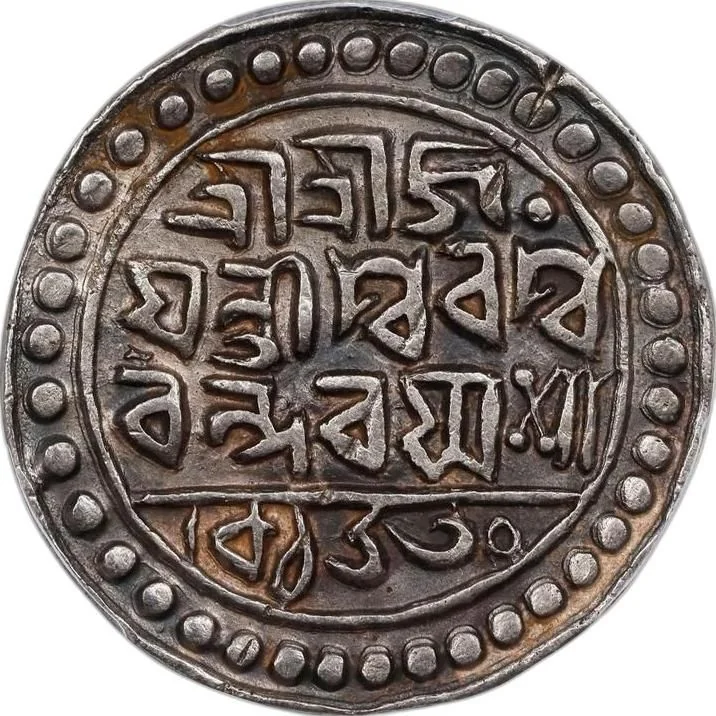
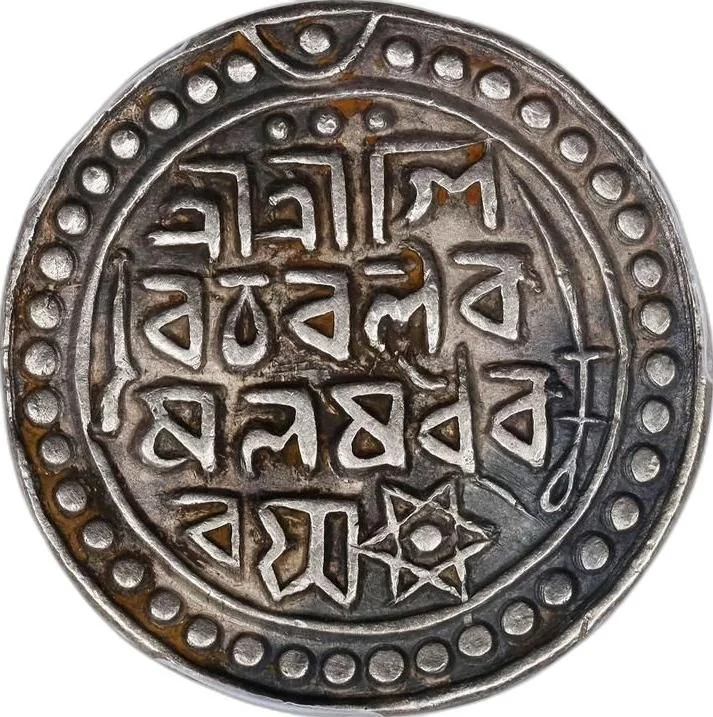
1 Rupee – Jaintia Kingdom
India
Context
Year: 1708
Nepal - Saka era Year: 1630
Country: India 
Issuer: Jaintia Kingdom
Ruler: Jay Narayan Syiem Sutnga
Currency:
Demonetized: Yes
Material
References
KM: #Click to copy to clipboard160
Numista: #420739
Value
Bullion value: $28.62
Obverse
Description:
"King" in stylized lettering.
Script: Devanagari
Reverse
Description:
Date and state lettering.
Script: Devanagari
Edge
Plain
Mintings
| Year | Mint Mark | Mintage | Quality | Collection |
|---|---|---|---|---|
| 1708 | — | — |
Historical background
In 1708, the Jaintia Kingdom, nestled in the Khasi-Jaintia hills of present-day Meghalaya, India, operated within a complex economic system that was largely non-monetized. The kingdom's economy was fundamentally based on barter, with rice, livestock (particularly cattle and goats), and other agricultural produce serving as the primary mediums of exchange and measures of value for local trade and tribute. This reflected a subsistence-oriented society where currency, in the formal sense of minted coins, was not produced or required for daily internal transactions.
However, the Jaintia Kingdom was not isolated. Its strategic location placed it at the crossroads of lucrative trade routes connecting the Brahmaputra Valley plains of Assam with the Sylhet plains of Bengal. This exposure brought external currencies into its borders. By 1708, it is likely that Mughal rupees (silver coins) and other regional coinage from neighboring Ahom, Koch, and Bengal territories circulated among merchants and the royal court for long-distance trade, particularly in high-value goods like lime, elephant ivory, and betel nuts. The kingdom's wealth was thus partly gauged by its control over these trade corridors and its ability to tax the movement of goods, rather than by a sovereign currency.
The political landscape of 1708 was one of cautious sovereignty. While the Jaintia kings (Syiem) maintained their independence, they were increasingly aware of the expanding influence of the Mughal Empire to the south and west, and the powerful Ahom Kingdom to the north. The flow of external coinage was a tangible symbol of these economic and political pressures. Therefore, the "currency situation" was a duality: a persistent, traditional barter economy for internal cohesion, existing alongside a growing infiltration of foreign coins that facilitated external trade and reflected the kingdom's precarious position between major regional powers.
However, the Jaintia Kingdom was not isolated. Its strategic location placed it at the crossroads of lucrative trade routes connecting the Brahmaputra Valley plains of Assam with the Sylhet plains of Bengal. This exposure brought external currencies into its borders. By 1708, it is likely that Mughal rupees (silver coins) and other regional coinage from neighboring Ahom, Koch, and Bengal territories circulated among merchants and the royal court for long-distance trade, particularly in high-value goods like lime, elephant ivory, and betel nuts. The kingdom's wealth was thus partly gauged by its control over these trade corridors and its ability to tax the movement of goods, rather than by a sovereign currency.
The political landscape of 1708 was one of cautious sovereignty. While the Jaintia kings (Syiem) maintained their independence, they were increasingly aware of the expanding influence of the Mughal Empire to the south and west, and the powerful Ahom Kingdom to the north. The flow of external coinage was a tangible symbol of these economic and political pressures. Therefore, the "currency situation" was a duality: a persistent, traditional barter economy for internal cohesion, existing alongside a growing infiltration of foreign coins that facilitated external trade and reflected the kingdom's precarious position between major regional powers.

✨ Legendary