

½ Atiá – Portuguese India
India
Context
Years: 1789–1799
Country: India 
Issuer: Portuguese India
Ruler: Maria I
Currency:
(1706—1880)
Subdivision: ½ Atiá = ⅛ Tanga
Demonetized: Yes
Material
Diameter: 18 mm
Weight: 4.9 g
Shape: Irregular round
Composition: Copper
Magnetic: No
Technique: Hammered
References
KM: #Click to copy to clipboard41
Numista: #50958
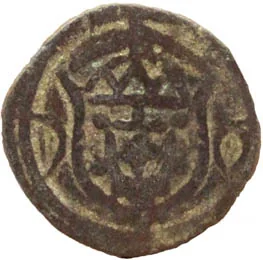
Obverse
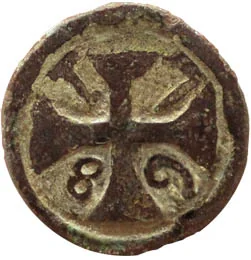
Reverse
Description:
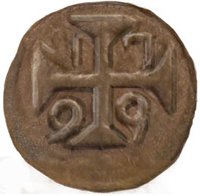
Cross of the Military Order of Christ separates the date.
Inscription:
1-7
8-9
8-9
Script: Latin
Edge
Mints
| Name | Mark |
|---|---|
| Dio | D-O |
Historical background
In 1789, the currency situation in Portuguese India, centered on Goa, was a complex and fragmented system reflecting both its regional trade dynamics and its subordinate position within the Portuguese empire. The official currency was the Portuguese réis, with the xerafim (equivalent to 300 réis) serving as the chief accounting unit for larger transactions. However, the reality in bazaars and ports was dominated by a plethora of foreign coins, a testament to Goa's role in Indian Ocean commerce. Gold mohurs and silver rupias from neighboring Maratha territories, Mughal rupees, and even Venetian sequins and Spanish-American pesos circulated freely, their values fluctuating based on metallic weight and market demand rather than official decree.
This monetary pluralism created significant administrative and economic challenges for the colonial government. The Viceroyalty struggled to enforce exchange rates and suffered from a chronic shortage of specie, as much of the Portuguese-minted coinage was exported to settle trade imbalances with other parts of Asia. Attempts to standardize the system, such as the introduction of the distinctive "São Tomás" copper coins for small change, were insufficient to unify the monetary landscape. Consequently, transactions often required the expertise of money-changers (sarafs), and the government's own revenues, collected in a mix of coins, were difficult to assess and consolidate.
Underlying this chaotic circulation was a profound economic decline. By the late 18th century, Goa's once-dominant commercial position had eroded due to competition from other European companies and the rise of new Indian powers. The currency disorder was both a symptom and a cause of this weakness, hindering reliable taxation and trade. While the Portuguese state in Goa continued to proclaim its monetary standards, its practical authority over the coinage in use was limited, existing alongside and often subordinate to the economic gravity of the wider Indian subcontinent.
This monetary pluralism created significant administrative and economic challenges for the colonial government. The Viceroyalty struggled to enforce exchange rates and suffered from a chronic shortage of specie, as much of the Portuguese-minted coinage was exported to settle trade imbalances with other parts of Asia. Attempts to standardize the system, such as the introduction of the distinctive "São Tomás" copper coins for small change, were insufficient to unify the monetary landscape. Consequently, transactions often required the expertise of money-changers (sarafs), and the government's own revenues, collected in a mix of coins, were difficult to assess and consolidate.
Underlying this chaotic circulation was a profound economic decline. By the late 18th century, Goa's once-dominant commercial position had eroded due to competition from other European companies and the rise of new Indian powers. The currency disorder was both a symptom and a cause of this weakness, hindering reliable taxation and trade. While the Portuguese state in Goa continued to proclaim its monetary standards, its practical authority over the coinage in use was limited, existing alongside and often subordinate to the economic gravity of the wider Indian subcontinent.
✨ Legendary