

8 xerafins – Portuguese India
Add to wishlist
India
Context
Years: 1782–1787
Country: India
Issuer: Portuguese India
Currency:
(1706—1880)
Subdivision: 8 xerafins = 4 Rupias
Demonetized: Yes
Material
Diameter: 17 mm
Weight: 3.2 g
Gold Weight:: 3.20 g
Shape: Irregular round
Composition: Gold
Magnetic: No
Technique: Hammered
References
KM: #
Numista: #50932
Value
Bullion value: $492.60
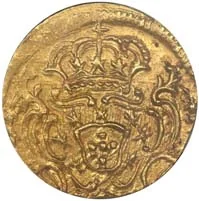
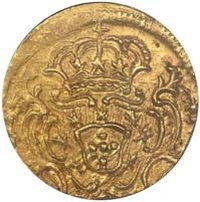
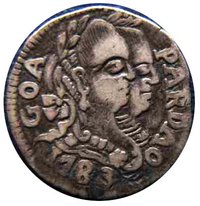
Obverse
Description:
Royal Crest
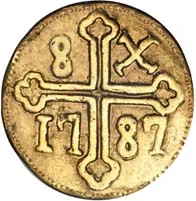
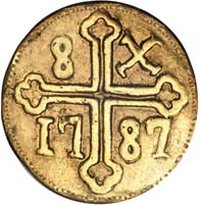
Reverse
Description:
Cross of St. Thomas divides denomination and date.
Inscription:
8 - X
17-87
17-87
Script: Latin
Edge
Mints
| Name | Mark |
|---|---|
| Goa | — |
Mintings
| Year | Mint Mark | Mintage | Quality | Collection |
|---|---|---|---|---|
| 1782 | — | — | ||
| 1784 | — | — | ||
| 1787 | — | — |
Historical background
In 1782, the currency situation in Portuguese India, centered on Goa, was characterized by profound complexity and instability. The official currency was the Portuguese Indian rupia (XRP), but its circulation was overwhelmed by a multitude of foreign coins, reflecting Goa's role as a trading hub. Spanish-American silver pesos (particularly the "Pataca" or 8-real piece), French écus, Venetian sequins, and various Indian and Mughal rupees all circulated freely, their values fluctuating based on weight, fineness, and local demand. This created a chaotic monetary environment where daily commerce required constant calculation and assay.
The root of this disorder lay in a chronic shortage of official currency minted by the Estado da Índia. The Lisbon government, often prioritizing metropolitan needs, failed to supply sufficient specie to its Asian colony. Consequently, the local economy became dependent on the inflow of foreign coins from regional trade, especially the robust silver pesos from the Americas and the Middle East. This reliance made the economy vulnerable to external shifts in trade routes and bullion flows, undermining Portuguese monetary sovereignty.
Administrative attempts to impose order were largely ineffective. The authorities periodically issued proclamations fixing exchange rates between the various coins, but these official rates rarely matched market realities, leading to widespread evasion, hoarding, and black-market trading. Furthermore, the physical state of coins in circulation was often poor due to clipping and wear, adding another layer of difficulty to transactions. Thus, in 1782, the currency system was less a unified structure and more an ad-hoc, market-driven patchwork that hampered both governance and economic predictability.
The root of this disorder lay in a chronic shortage of official currency minted by the Estado da Índia. The Lisbon government, often prioritizing metropolitan needs, failed to supply sufficient specie to its Asian colony. Consequently, the local economy became dependent on the inflow of foreign coins from regional trade, especially the robust silver pesos from the Americas and the Middle East. This reliance made the economy vulnerable to external shifts in trade routes and bullion flows, undermining Portuguese monetary sovereignty.
Administrative attempts to impose order were largely ineffective. The authorities periodically issued proclamations fixing exchange rates between the various coins, but these official rates rarely matched market realities, leading to widespread evasion, hoarding, and black-market trading. Furthermore, the physical state of coins in circulation was often poor due to clipping and wear, adding another layer of difficulty to transactions. Thus, in 1782, the currency system was less a unified structure and more an ad-hoc, market-driven patchwork that hampered both governance and economic predictability.

✨ Legendary