

⅒ silver ecu – France
Add to wishlist
France
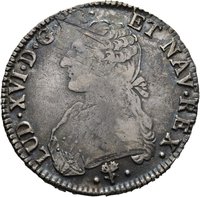
Obverse
Description:
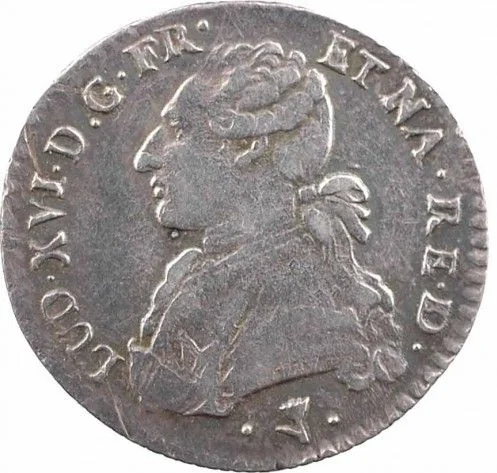
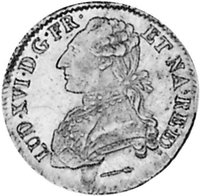
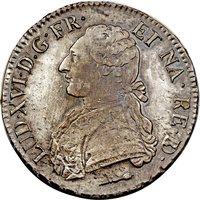
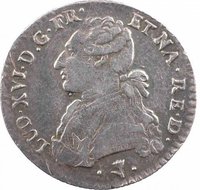
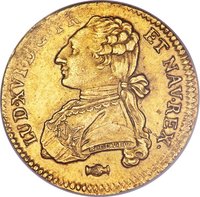
Left bust of the king in an embroidered jacket, wearing the Order of the Holy Spirit, his hair tied back with a ribbon. Legend begins at 7 o'clock. "B.DUVIV.F." on the bust edge.
Inscription:
LUD·XVI·D·G·FR ·ET NA·RE·B D·
Script: Latin
Engraver: Pierre-Benjamin Duvivier
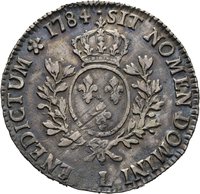
Reverse
Description:
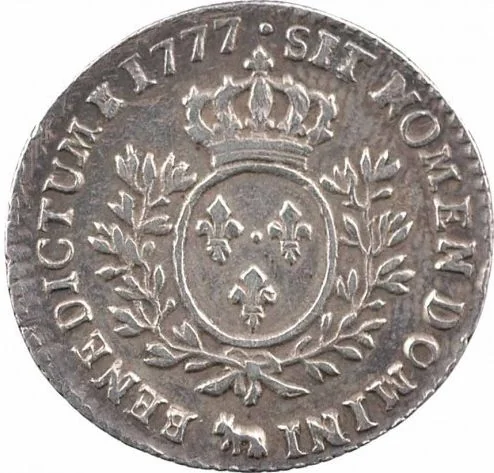
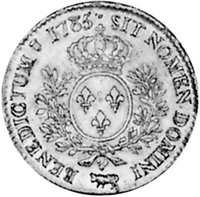
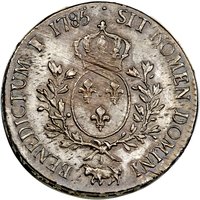
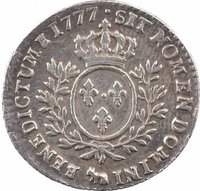
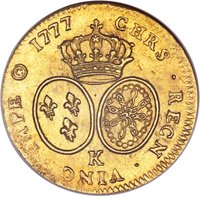
French coat of arms with olive branches.
Inscription:
SIT NOMEN DOMINI BENEDICTVM 1777 ·
Script: Latin
Engraver: Pierre-Benjamin Duvivier
Edge
Corded
Mints
| Name | Mark |
|---|---|
| Pau | 🐄 |
Mintings
| Year | Mint Mark | Mintage | Quality | Collection |
|---|---|---|---|---|
| 1777 | 🐄 | 12,000 |
Historical background
In 1777, France was navigating a precarious financial situation under the reign of Louis XVI. The national treasury was severely depleted, a legacy of decades of extravagant spending by the court, costly wars (most notably the Seven Years' War which ended in 1763), and an inefficient, archaic tax system that heavily burdened the peasantry while exempting the nobility and clergy. To manage its debts, the monarchy relied heavily on borrowing, particularly through the sale of government bonds (rentes), and was increasingly dependent on a small group of powerful financiers. This structural deficit was the true core of the "currency situation," as the state's solvency, not the coinage itself, was the fundamental problem.
The physical currency in circulation was a complex mix of metallic coins. The official unit of account was the livre tournois, but actual coins included gold louis d'or, silver écus, and a plethora of smaller copper and billon coins. The system was notoriously confusing, with values fluctuating between regions. More critically, to fund its participation in the American Revolutionary War (which France had formally entered in 1778), the government was forced to engage in further borrowing and would soon resort to the dangerous expedient of simply printing more paper money. While the billets de monnaie and later the assignats were still a few years away, the path was being set for monetary inflation.
Thus, the currency situation in 1777 was one of underlying crisis masked by fragile stability. The absolute monarchy was trapped in a vicious cycle: it needed major fiscal reform to restore confidence and balance its books, but any attempt to tax the privileged estates met with fierce political resistance from the Parlements and the nobility. Finance Minister Jacques Necker, appointed that same year, famously avoided new taxes and continued borrowing to fund the war, publishing his optimistic Compte rendu au roi in 1781 to bolster public credit. This approach, however, only deferred the inevitable collapse, making the eventual monetary and financial explosion of the French Revolution more severe.
The physical currency in circulation was a complex mix of metallic coins. The official unit of account was the livre tournois, but actual coins included gold louis d'or, silver écus, and a plethora of smaller copper and billon coins. The system was notoriously confusing, with values fluctuating between regions. More critically, to fund its participation in the American Revolutionary War (which France had formally entered in 1778), the government was forced to engage in further borrowing and would soon resort to the dangerous expedient of simply printing more paper money. While the billets de monnaie and later the assignats were still a few years away, the path was being set for monetary inflation.
Thus, the currency situation in 1777 was one of underlying crisis masked by fragile stability. The absolute monarchy was trapped in a vicious cycle: it needed major fiscal reform to restore confidence and balance its books, but any attempt to tax the privileged estates met with fierce political resistance from the Parlements and the nobility. Finance Minister Jacques Necker, appointed that same year, famously avoided new taxes and continued borrowing to fund the war, publishing his optimistic Compte rendu au roi in 1781 to bolster public credit. This approach, however, only deferred the inevitable collapse, making the eventual monetary and financial explosion of the French Revolution more severe.
Series: Écus aux rameaux d'olivier
✨ Legendary