

1 Xerafim – Portuguese India
India
Context
Year: 1740
Country: India 
Issuer: Portuguese India
Issuing organization: Casa da Moeda de Damão
Ruler: João V
Currency:
(1706—1880)
Demonetized: Yes
Material
Diameter: 22 mm
Weight: 11.3 g
Silver weight: 11.30 g
Shape: Irregular round
Composition: Silver
Magnetic: No
Technique: Hammered
References
KM: #Click to copy to clipboard117
Numista: #50592
Value
Bullion value: $31.48
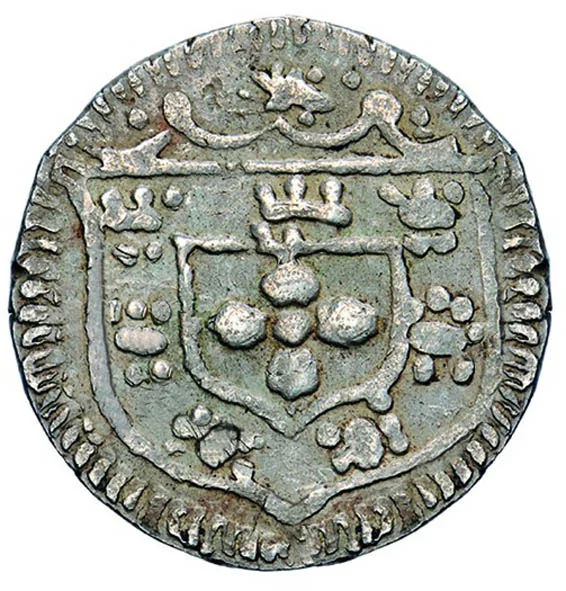
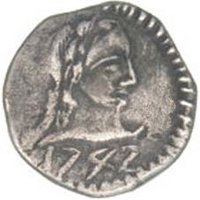
Obverse
Description:
Gomes (2013: 86.01)
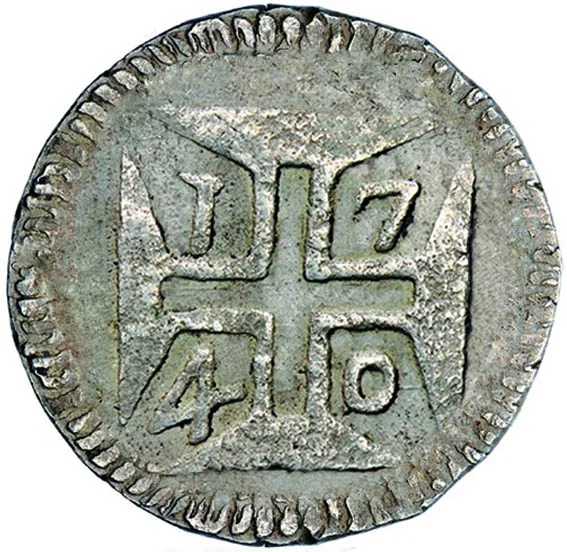
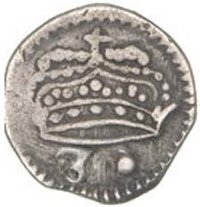
Reverse
Inscription:
1-7
4-0
4-0
Edge
Mintings
| Year | Mint Mark | Mintage | Quality | Collection |
|---|---|---|---|---|
| 1740 | — | — |
Historical background
In 1740, the currency situation in Portuguese India was a complex tapestry of official and unofficial systems, reflecting the colony's diminished economic power and its integration into wider Indian Ocean trade networks. The official currency, minted by the Estado da Índia in Goa, was the xerafim (divided into tangas and réis), but its value and availability were problematic. Chronic shortages of precious metals, especially after the decline of the Portuguese monopoly on Asian trade, led to irregular minting and a proliferation of debased coinage, eroding public trust in the official currency.
Consequently, the daily economic life of the territory was dominated by a multitude of foreign coins, which circulated freely and were often preferred for their reliable intrinsic value. The most important of these was the Mughal silver rupia (rupee), the dominant trade currency of Western India. Gold huns from the Deccan, Venetian sequins, and various other European and Asian coins also circulated widely. This created a de facto multi-currency system where merchants and officials constantly had to navigate exchange rates and assays, with transactions often specifying payment in a particular type of coin.
This monetary fragmentation was symptomatic of Portugal's weakened political position. While the Portuguese administration attempted to fix exchange rates and derive seigniorage, their control was limited. The vibrant, coin-based economies of neighboring Maratha and Mughal territories exerted a stronger gravitational pull. Thus, in 1740, the currency scenario was one of official weakness and practical reliance on the stability of foreign, particularly Mughal, specie, highlighting how Portuguese India survived more through participation in regional commerce than through the strength of its own imperial structures.
Consequently, the daily economic life of the territory was dominated by a multitude of foreign coins, which circulated freely and were often preferred for their reliable intrinsic value. The most important of these was the Mughal silver rupia (rupee), the dominant trade currency of Western India. Gold huns from the Deccan, Venetian sequins, and various other European and Asian coins also circulated widely. This created a de facto multi-currency system where merchants and officials constantly had to navigate exchange rates and assays, with transactions often specifying payment in a particular type of coin.
This monetary fragmentation was symptomatic of Portugal's weakened political position. While the Portuguese administration attempted to fix exchange rates and derive seigniorage, their control was limited. The vibrant, coin-based economies of neighboring Maratha and Mughal territories exerted a stronger gravitational pull. Thus, in 1740, the currency scenario was one of official weakness and practical reliance on the stability of foreign, particularly Mughal, specie, highlighting how Portuguese India survived more through participation in regional commerce than through the strength of its own imperial structures.
✨ Legendary