

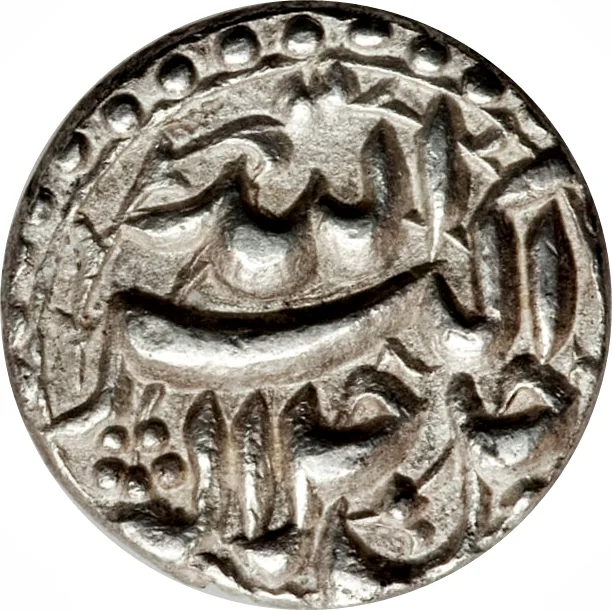
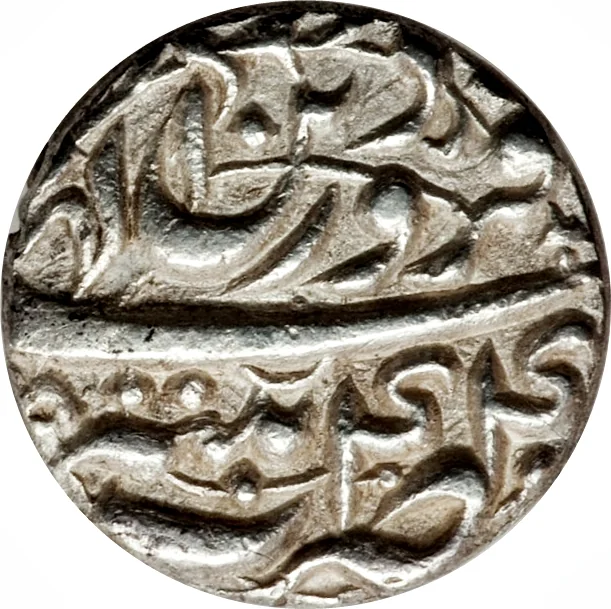
½ Rupee – Mughal Empire
India
Context
Years: 1598–1604
Country: India 
Issuer: Mughal Empire
Ruler: Akbar
Currency:
(1540—1842)
Demonetized: Yes
Material
Diameter: 17 mm
Weight: 5.46 g
Silver weight: 5.46 g
Shape: Irregular round
Composition: Silver
Magnetic: No
References
KM: #Click to copy to clipboard66.4
Numista: #50469
Value
Bullion value: $15.84
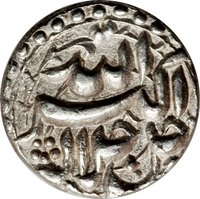
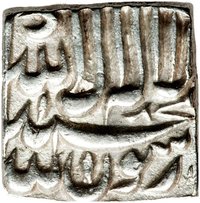
Obverse
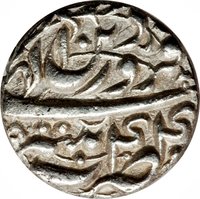
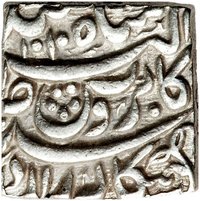
Reverse
Edge
Mints
| Name | Mark |
|---|---|
| Azimabad | — |
Mintings
| Year | Mint Mark | Mintage | Quality | Collection |
|---|---|---|---|---|
| — | 43 | — | ||
| — | 47 | — | ||
| — | 48 | — |
Historical background
In 1598, the Mughal Empire under Emperor Akbar was in the midst of a profound monetary and fiscal consolidation, following decades of territorial expansion. The empire’s currency system was highly centralized and sophisticated, built on a trimetallic standard of gold (mohur), silver (rupiya), and copper (dam). The silver rupiya, of high and consistent purity (approximately 97%), was the primary unit for revenue assessment, large trade, and state transactions, establishing a foundation for economic stability. Akbar’s reign saw the establishment of imperial mints (dar al-zarb) across the subcontinent, which strictly controlled coinage to standardize weight and fineness, thereby enhancing the currency's credibility and facilitating both internal commerce and burgeoning foreign trade.
The year 1598 falls within a period of particular administrative refinement following the completion of Akbar’s Ain-i-Akbari in the mid-1590s, which meticulously documented the empire’s revenue and monetary systems. Copper dams served as the ubiquitous small-change currency for daily bazaar transactions and peasant tax payments, with a fixed exchange rate (officially 40 dams to 1 rupiya) that linked the rural subsistence economy to the imperial silver system. This period was also marked by a significant influx of New World silver, primarily from Spanish America via trade with Europe and the Ottoman Empire, which flowed into Mughal ports in exchange for textiles and spices. This bullion influx helped monetize the economy further and prevented any major scarcity of silver, ensuring a steady minting of coins.
Despite this robust system, challenges persisted. The vastness of the empire meant that older regional coinages sometimes remained in local circulation. Furthermore, the fixed exchange rate between copper and silver was occasionally strained by regional scarcities or gluts of copper, leading to local inflationary pressures. Nevertheless, in 1598, the Mughal currency regime was a pillar of imperial strength, providing a reliable medium that supported Akbar’s administrative integration, funded his architectural and cultural projects, and underpinned the economic prosperity that characterized the zenith of his rule.
The year 1598 falls within a period of particular administrative refinement following the completion of Akbar’s Ain-i-Akbari in the mid-1590s, which meticulously documented the empire’s revenue and monetary systems. Copper dams served as the ubiquitous small-change currency for daily bazaar transactions and peasant tax payments, with a fixed exchange rate (officially 40 dams to 1 rupiya) that linked the rural subsistence economy to the imperial silver system. This period was also marked by a significant influx of New World silver, primarily from Spanish America via trade with Europe and the Ottoman Empire, which flowed into Mughal ports in exchange for textiles and spices. This bullion influx helped monetize the economy further and prevented any major scarcity of silver, ensuring a steady minting of coins.
Despite this robust system, challenges persisted. The vastness of the empire meant that older regional coinages sometimes remained in local circulation. Furthermore, the fixed exchange rate between copper and silver was occasionally strained by regional scarcities or gluts of copper, leading to local inflationary pressures. Nevertheless, in 1598, the Mughal currency regime was a pillar of imperial strength, providing a reliable medium that supported Akbar’s administrative integration, funded his architectural and cultural projects, and underpinned the economic prosperity that characterized the zenith of his rule.
✨ Legendary