

2 Fanams – Madras Presidency
India

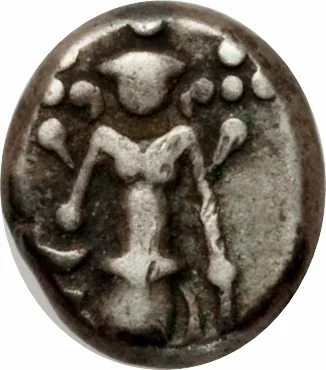
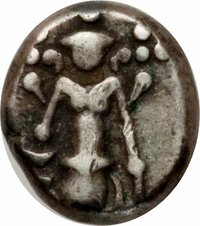
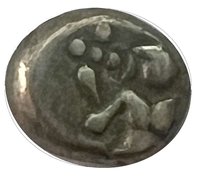
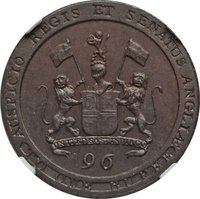
Obverse
Description:
A partial standing Vishnu figure in a beaded border.
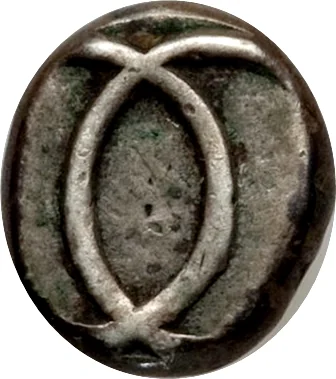
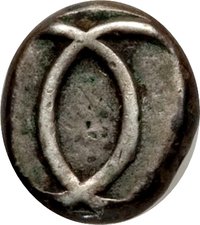
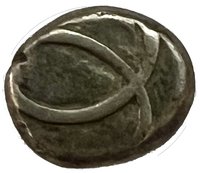
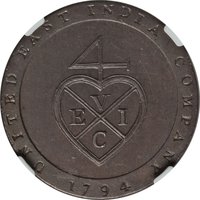
Reverse
Description:
Two interlinked Cs with a dot, inside a subtle beaded border.
Edge
Plain
Mintings
| Year | Mint Mark | Mintage | Quality | Collection |
|---|---|---|---|---|
| — | — | — |
Historical background
In 1764, the currency situation in the Madras Presidency was complex and transitional, reflecting the broader political and economic upheaval following the British East India Company's victory in the First Anglo-Mysore War (1767-69 had not yet begun). The Company, while consolidating its territorial control from its base at Fort St. George, operated within a pre-existing multi-currency system. The dominant circulating coins were the gold pagoda (primarily the "Star Pagoda" minted by the Company), the silver rupee (of various Mughal and regional standards), and a plethora of lower-value copper coins. This created constant challenges for trade and revenue collection due to fluctuating exchange rates between the metallic standards.
The Company's own mint in Madras was active, but it struggled to impose uniformity. A key problem was the shortage of silver rupees, which were essential for larger commercial and military transactions, especially with Northern India. This often forced the Company to rely on importing Spanish American silver dollars (pieces of eight) and Arcot rupees minted by the Nawab of Arcot, over whom the British were extending financial and political control. The value of these coins was not intrinsic alone but was also dictated by official "Company rates" issued periodically, which attempted to fix exchange values between pagodas, rupees, and fanams for revenue purposes.
Consequently, the monetary landscape was fragmented and unstable. Merchants, soldiers, and peasants had to navigate a daily reality of multiple, concurrently circulating coins whose values could shift with political decrees, metallic inflows, and local market pressures. This period laid the groundwork for the more standardized monetary reforms that would follow later in the century, as the East India Company moved from being a trading entity with territorial holdings toward a sovereign colonial power seeking fiscal control. The year 1764 thus represents a point where the traditional systems of South India were being actively, but not yet decisively, reshaped by colonial exigencies.
The Company's own mint in Madras was active, but it struggled to impose uniformity. A key problem was the shortage of silver rupees, which were essential for larger commercial and military transactions, especially with Northern India. This often forced the Company to rely on importing Spanish American silver dollars (pieces of eight) and Arcot rupees minted by the Nawab of Arcot, over whom the British were extending financial and political control. The value of these coins was not intrinsic alone but was also dictated by official "Company rates" issued periodically, which attempted to fix exchange values between pagodas, rupees, and fanams for revenue purposes.
Consequently, the monetary landscape was fragmented and unstable. Merchants, soldiers, and peasants had to navigate a daily reality of multiple, concurrently circulating coins whose values could shift with political decrees, metallic inflows, and local market pressures. This period laid the groundwork for the more standardized monetary reforms that would follow later in the century, as the East India Company moved from being a trading entity with territorial holdings toward a sovereign colonial power seeking fiscal control. The year 1764 thus represents a point where the traditional systems of South India were being actively, but not yet decisively, reshaped by colonial exigencies.
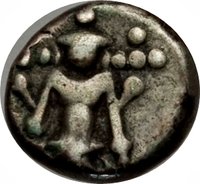
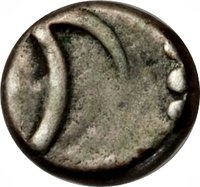
💎 Very Rare