

¼ atiá – Portuguese India
Add to wishlist
India
Context
Years: 1721–1750
Country: India
Issuer: Portuguese India
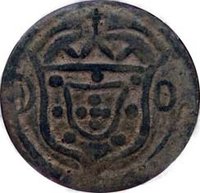
Issuing organization: Casa da Moeda de Diu
Ruler: João V
Currency:
(1706—1880)
Subdivision: ¼ atiá = 1⁄16 Tanga
Demonetized: Yes
Material
Diameter: 18 mm
Weight: 4.2 g
Shape: Irregular round
Composition: Copper
Magnetic: No
Technique: Hammered
References
KM: #
Numista: #50306
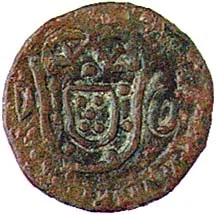
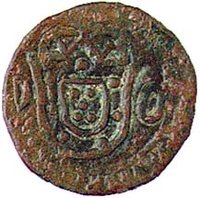
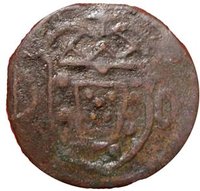
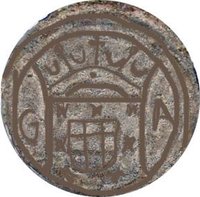
Obverse
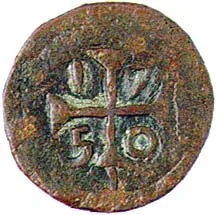
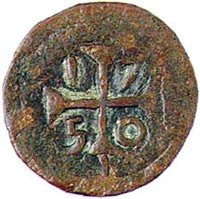
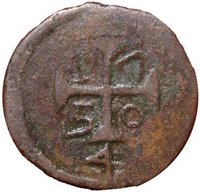
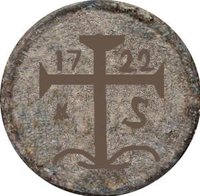
Reverse
Description:
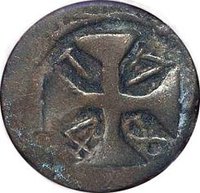
Cross of the Military Order of Christ above the date. Below, the numeral "1" for one Dugani.
Inscription:
1-7
5-0
1
5-0
1
Script: Latin
Edge
Mintings
| Year | Mint Mark | Mintage | Quality | Collection |
|---|---|---|---|---|
| 1721 | D-O | — | ||
| 1750 | D-O | — |
Historical background
In 1721, the currency situation in Portuguese India was a complex and challenging reflection of the Estado da Índia's diminished economic power. The official Portuguese currency, the cruzado, remained the nominal unit of account, but its circulation and authority were severely undermined. Decades of economic decline, military losses to the Dutch and Marathas, and a chronic shortage of specie (minted coin) from the metropolis meant that the Portuguese administration in Goa struggled to maintain a stable and sovereign monetary system.
The vacuum was filled by a multitude of foreign coins that circulated freely and were essential for trade. The most important of these was the gold Mughal mohur and the ubiquitous silver rupee, which dominated high-value and regional commerce. Portuguese authorities were often forced to use these coins to pay troops and settle large transactions. Furthermore, a variety of other European coins, particularly Spanish reales (pieces of eight) and their colonial derivatives, flowed through Goa's port due to its role in intra-Asian trade, creating a de facto multi-currency environment.
Faced with this reality, the Portuguese response was primarily one of pragmatic recognition rather than effective control. The Casa da Moeda (Goa Mint) operated intermittently, often striking crude tangas and reis in copper and low-grade silver, but these were largely for local, small-scale use. The state's fiscal weakness was evident in its frequent debasements of this local coinage and its reliance on cambios (money-changers) to assess and convert the profusion of foreign coins. Thus, in 1721, the currency landscape was one of monetary fragmentation, where the Crown's nominal authority clashed with the practical dominance of stronger, foreign currencies in a struggling colonial enclave.
The vacuum was filled by a multitude of foreign coins that circulated freely and were essential for trade. The most important of these was the gold Mughal mohur and the ubiquitous silver rupee, which dominated high-value and regional commerce. Portuguese authorities were often forced to use these coins to pay troops and settle large transactions. Furthermore, a variety of other European coins, particularly Spanish reales (pieces of eight) and their colonial derivatives, flowed through Goa's port due to its role in intra-Asian trade, creating a de facto multi-currency environment.
Faced with this reality, the Portuguese response was primarily one of pragmatic recognition rather than effective control. The Casa da Moeda (Goa Mint) operated intermittently, often striking crude tangas and reis in copper and low-grade silver, but these were largely for local, small-scale use. The state's fiscal weakness was evident in its frequent debasements of this local coinage and its reliance on cambios (money-changers) to assess and convert the profusion of foreign coins. Thus, in 1721, the currency landscape was one of monetary fragmentation, where the Crown's nominal authority clashed with the practical dominance of stronger, foreign currencies in a struggling colonial enclave.
✨ Legendary