

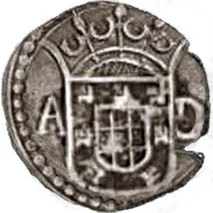
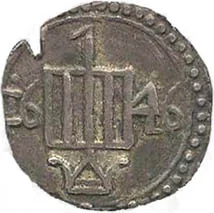
1 tanga – Portuguese India
Add to wishlist
India
Mintings
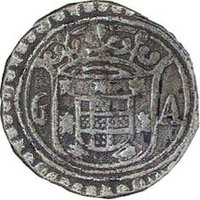
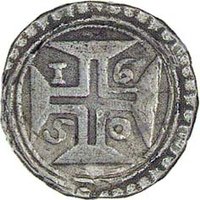
| Year | Mint Mark | Mintage | Quality | Collection |
|---|---|---|---|---|
| 1646 | A-G | — |
Historical background
In 1646, the currency situation in Portuguese India was complex and strained, reflecting the broader political and economic pressures on the Estado da Índia. The official currency was the Portuguese real, but its circulation and authority were increasingly challenged. Decades of conflict with the Dutch East India Company (VOC) had resulted in the loss of key trading hubs like Malacca (1641) and access to lucrative spice sources, severely depleting Lisbon's ability to supply sufficient specie to its Asian possessions. Consequently, the economy of Goa and other enclaves suffered from a chronic shortage of reliable coinage.
The vacuum was filled by a multitude of foreign coins that circulated freely and were essential for commerce. The most important of these was the Spanish silver real of eight or "piece of eight," a near-universal trading currency minted in the Americas. Alongside it, various gold pagodas from neighboring South Indian kingdoms, Mughal silver rupias, and even coins from the Ottoman Empire and Venetian ducats were used in daily transactions. This proliferation created a chaotic monetary environment where exchange rates fluctuated based on metal purity, weight, and the ever-shifting fortunes of Portuguese military and naval power.
Local Portuguese authorities responded with ad-hoc measures that further complicated the situation. They often counterstamped foreign coins, like the Mughal rupee, with a Portuguese crest to validate their use within the Estado, a practice acknowledging their dependence on external monetary systems. Attempts to mint local currency at the Goa mint were inconsistent and hampered by a lack of silver bullion. Thus, in 1646, the currency system was a fragile hybrid, symbolizing the decline of Portuguese imperial control and its forced integration into the polycentric and competitive financial networks of the Indian Ocean world.
The vacuum was filled by a multitude of foreign coins that circulated freely and were essential for commerce. The most important of these was the Spanish silver real of eight or "piece of eight," a near-universal trading currency minted in the Americas. Alongside it, various gold pagodas from neighboring South Indian kingdoms, Mughal silver rupias, and even coins from the Ottoman Empire and Venetian ducats were used in daily transactions. This proliferation created a chaotic monetary environment where exchange rates fluctuated based on metal purity, weight, and the ever-shifting fortunes of Portuguese military and naval power.
Local Portuguese authorities responded with ad-hoc measures that further complicated the situation. They often counterstamped foreign coins, like the Mughal rupee, with a Portuguese crest to validate their use within the Estado, a practice acknowledging their dependence on external monetary systems. Attempts to mint local currency at the Goa mint were inconsistent and hampered by a lack of silver bullion. Thus, in 1646, the currency system was a fragile hybrid, symbolizing the decline of Portuguese imperial control and its forced integration into the polycentric and competitive financial networks of the Indian Ocean world.
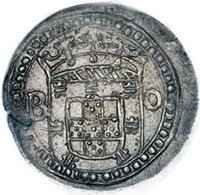
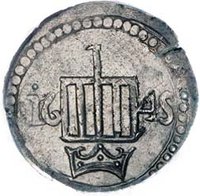
✨ Legendary