

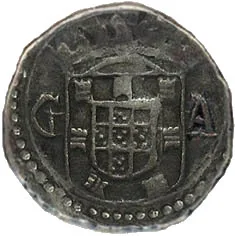
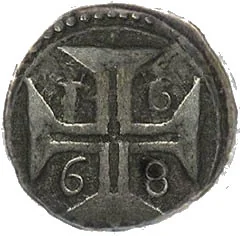
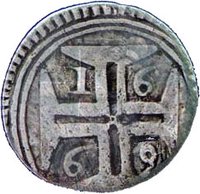
½ Xerafim – Portuguese India
India
Context
Years: 1665–1668
Country: India 
Issuer: Portuguese India
Ruler: Afonso VI
Currency:
(1580—1706)
Demonetized: Yes
Material
Diameter: 20 mm
Weight: 5.1 g
Silver weight: 5.10 g
Shape: Irregular round
Composition: Silver
Magnetic: No
Technique: Hammered
References
KM: #Click to copy to clipboard72
Numista: #49819
Value
Bullion value: $14.70
Mints
| Name | Mark |
|---|---|
| Goa | — |
Mintings
| Year | Mint Mark | Mintage | Quality | Collection |
|---|---|---|---|---|
| 1665 | G-A | — | ||
| 1666 | G-A | — | ||
| 1668 | G-A | — |
Historical background
In 1665, the currency situation in Portuguese India was a complex reflection of the Estado da Índia's declining economic power and its position within a vibrant, multi-polar Indian Ocean economy. The official currency, the Portuguese xerafim, circulated alongside a plethora of other coins, creating a de facto monetary pluralism. Most significant were the ubiquitous Mughal silver rupia (rupee) and the gold mohur, which were the dominant trade currencies in the region. Furthermore, a variety of other European coins (like Spanish Reales) and local issues from neighboring Indian states were in use, their values constantly fluctuating against one another based on metallic content and market demand.
This monetary environment was fraught with challenges for the Portuguese administration in Goa. The colony suffered from a chronic trade deficit, leading to a continuous outflow of precious silver to pay for textiles and spices, which drained the treasury. To control this, authorities frequently attempted to fix exchange rates and mandate the use of Portuguese coinage, but these efforts were largely ineffective against market forces. Counterfeiting and the clipping of coins were rampant, further eroding trust and stability. The financial strain was exacerbated by the loss of key trading hubs like Hormuz and Malacca to rival powers, which had previously generated crucial revenue.
Consequently, the currency system in 1665 was symptomatic of a wider imperial crisis. The Portuguese state struggled to assert monetary sovereignty, while merchants and the local population pragmatically operated within a multi-currency system centered on the more reliable and widely accepted Mughal rupee. This scenario underscored a pivotal shift: Goa, while still an important node, was no longer the dominant commercial force and was increasingly integrated into and dependent on the economic systems of the Indian subcontinent, rather than dictating terms from a position of strength.
This monetary environment was fraught with challenges for the Portuguese administration in Goa. The colony suffered from a chronic trade deficit, leading to a continuous outflow of precious silver to pay for textiles and spices, which drained the treasury. To control this, authorities frequently attempted to fix exchange rates and mandate the use of Portuguese coinage, but these efforts were largely ineffective against market forces. Counterfeiting and the clipping of coins were rampant, further eroding trust and stability. The financial strain was exacerbated by the loss of key trading hubs like Hormuz and Malacca to rival powers, which had previously generated crucial revenue.
Consequently, the currency system in 1665 was symptomatic of a wider imperial crisis. The Portuguese state struggled to assert monetary sovereignty, while merchants and the local population pragmatically operated within a multi-currency system centered on the more reliable and widely accepted Mughal rupee. This scenario underscored a pivotal shift: Goa, while still an important node, was no longer the dominant commercial force and was increasingly integrated into and dependent on the economic systems of the Indian subcontinent, rather than dictating terms from a position of strength.

✨ Legendary