

1 Dinheiro – Portuguese Malacca
Malaysia
Context
Years: 1522–1550
Country: Malaysia 
Issuer: Portuguese Malacca
Currency:
(1509—1580)
Demonetized: Yes
Material
References
KM: #Click to copy to clipboard13
Numista: #49571
Obverse
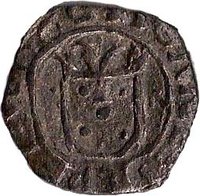
Description:
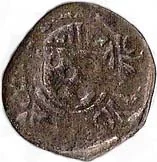
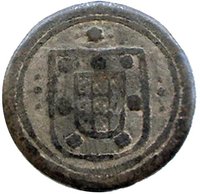
Shield with Portuguese arms encircled.
Inscription:
+IOANES 3 R P ET AL D G
Script: Latin
Reverse
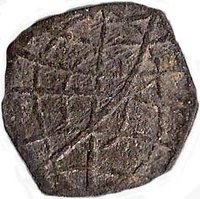
Description:
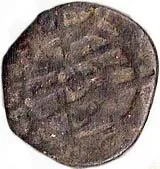
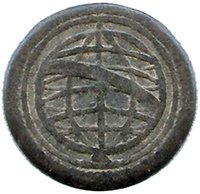
Astronomical model of celestial orbits.
Edge
Mintings
| Year | Mint Mark | Mintage | Quality | Collection |
|---|---|---|---|---|
| — | — | — |
Historical background
In 1522, Portuguese Malacca operated under a complex and evolving currency system, reflecting its role as a pivotal hub in the global spice trade. The Portuguese, having conquered the city in 1511, did not immediately impose a unified monetary standard. Instead, they pragmatically managed a multi-currency environment where various coins circulated simultaneously. The most important of these was the gold catholica (or português) and the silver real, minted in Goa and intended to anchor the regional economy. However, their supply was often insufficient, forcing the continuation of older, trusted mediums of exchange.
The lifeblood of daily commerce remained the pre-existing currencies, particularly tin calains (or tinhas) minted locally and copper cash imported from China. These coins facilitated smaller transactions in the bustling markets. Furthermore, significant trade, especially with merchants from Gujarat, Bengal, and the Malay Archipelago, was still conducted using silver keping from Pasai and other Sumatran states, and even gold mas and tahil weights of gold dust. The Spanish-American silver real (later the famous "piece of eight") was also beginning to enter the port through indirect trade, foreshadowing its future dominance.
This monetary mosaic created significant challenges for the Portuguese administration. Officials constantly struggled with exchange rates, counterfeiting, and the outflow of good coinage to pay for spices, leading to frequent shortages. While the Portuguese crown sought to establish its coinage as authoritative, the reality in 1522 was one of adaptation and coexistence. The currency situation was less a unified system and more a competitive, fluid bazaar of metals, where the value of a coin was ultimately determined by its metallic content and the trust of the international merchant community gathered in the port.
The lifeblood of daily commerce remained the pre-existing currencies, particularly tin calains (or tinhas) minted locally and copper cash imported from China. These coins facilitated smaller transactions in the bustling markets. Furthermore, significant trade, especially with merchants from Gujarat, Bengal, and the Malay Archipelago, was still conducted using silver keping from Pasai and other Sumatran states, and even gold mas and tahil weights of gold dust. The Spanish-American silver real (later the famous "piece of eight") was also beginning to enter the port through indirect trade, foreshadowing its future dominance.
This monetary mosaic created significant challenges for the Portuguese administration. Officials constantly struggled with exchange rates, counterfeiting, and the outflow of good coinage to pay for spices, leading to frequent shortages. While the Portuguese crown sought to establish its coinage as authoritative, the reality in 1522 was one of adaptation and coexistence. The currency situation was less a unified system and more a competitive, fluid bazaar of metals, where the value of a coin was ultimately determined by its metallic content and the trust of the international merchant community gathered in the port.
✨ Legendary