

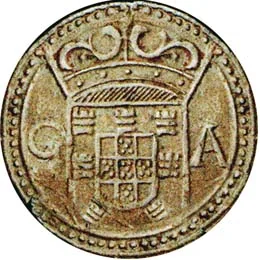
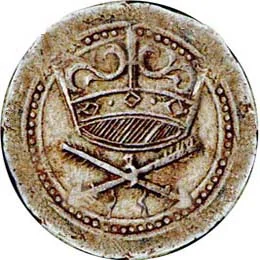
½ Bastião – Portuguese India
India
Context
Years: 1568–1581
Country: India 
Issuer: Portuguese India
Ruler: Sebastião I
Currency:
(1509—1580)
Subdivision: ½ Bastião = 150 Reais
Demonetized: Yes
Material
Diameter: 22 mm
Weight: 10 g
Silver weight: 10.00 g
Shape: Irregular round
Composition: Silver
Magnetic: No
References
KM: #Click to copy to clipboard34
Numista: #49488
Value
Bullion value: $28.83
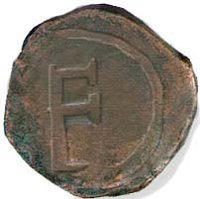
Obverse
Inscription:
G - A
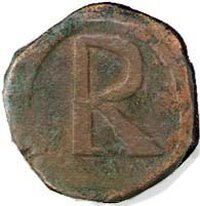
Reverse
Edge
Mints
| Name | Mark |
|---|---|
| Goa | — |
Mintings
| Year | Mint Mark | Mintage | Quality | Collection |
|---|---|---|---|---|
| — | G-A | — |
Historical background
In 1568, the currency situation in Portuguese India was a complex tapestry of local and imported coinage, reflecting the Estado da Índia's role as a commercial intermediary rather than a sovereign with a unified monetary system. The Portuguese administration in Goa did not impose a single currency but operated within the vibrant and established monetary networks of the Indian Ocean. The most important coin in official and high-value transactions was the Portuguese cruzado, a gold coin roughly equivalent to the Venetian ducat, used for long-distance trade, crown payments, and major purchases. Alongside it, the silver tanga, introduced earlier in the century, served as a key unit of account and a widely circulating silver coin for regional trade.
However, the daily economic life of the bazaars and ports was dominated by a plethora of indigenous and foreign currencies. These included silver larins (bent wire coins of Persian origin), gold huns or pagodas from Vijayanagara and other South Indian kingdoms, and various copper and billon coins for small change. The Mughal silver rupee was also gaining prominence in northern circuits. The Portuguese authorities generally accepted these currencies for taxes and trade, often stamping them with a royal mark ("cunho") to validate their weight and value within their territories, a practice that lent some official recognition but did not create a standardized coinage.
This monetary pluralism presented constant challenges, including exchange rate fluctuations, counterfeiting, and the drain of precious metals to Europe. In 1568, the system was under strain from the broader pressures facing the Estado da Índia, including increased competition and rising military costs. While attempts at monetary reform would occur later, the situation in this period was characterized by a pragmatic, if sometimes chaotic, accommodation to the diverse and deeply entrenched currency systems of Asia, upon which Portuguese commercial survival depended.
However, the daily economic life of the bazaars and ports was dominated by a plethora of indigenous and foreign currencies. These included silver larins (bent wire coins of Persian origin), gold huns or pagodas from Vijayanagara and other South Indian kingdoms, and various copper and billon coins for small change. The Mughal silver rupee was also gaining prominence in northern circuits. The Portuguese authorities generally accepted these currencies for taxes and trade, often stamping them with a royal mark ("cunho") to validate their weight and value within their territories, a practice that lent some official recognition but did not create a standardized coinage.
This monetary pluralism presented constant challenges, including exchange rate fluctuations, counterfeiting, and the drain of precious metals to Europe. In 1568, the system was under strain from the broader pressures facing the Estado da Índia, including increased competition and rising military costs. While attempts at monetary reform would occur later, the situation in this period was characterized by a pragmatic, if sometimes chaotic, accommodation to the diverse and deeply entrenched currency systems of Asia, upon which Portuguese commercial survival depended.
✨ Legendary