

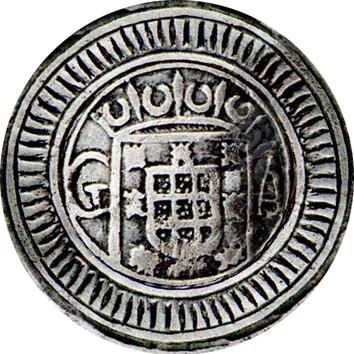
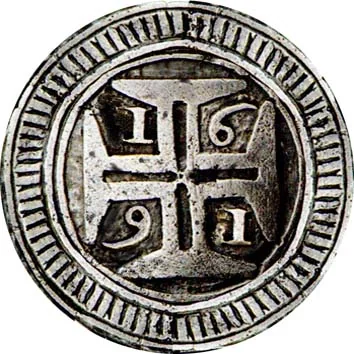
2 xerafins – Portuguese India
Add to wishlist
India
Mintings
| Year | Mint Mark | Mintage | Quality | Collection |
|---|---|---|---|---|
| 1685 | G-A | — | ||
| 1686 | G-A | — | ||
| 1688 | G-A | — | ||
| 1690 | G-A | — | ||
| 1691 | G-A | — | ||
| 1692 | G-A | — | ||
| 1693 | G-A | — | ||
| 1694 | G-A | — | ||
| 1697 | G-A | — | ||
| 1699 | G-A | — | ||
| 1700 | G-A | — |
Historical background
In 1685, the currency situation in Portuguese India was a complex tapestry of official and unofficial systems, reflecting the Estado da Índia's diminished economic power. The official currency was the Portuguese real, but decades of fiscal mismanagement and the loss of key trading hubs had severely debased its value and limited its circulation. The crown's chronic shortage of specie led to the frequent minting of low-quality copper bazarucos for local small-scale trade, which were deeply unpopular and prone to inflation, further eroding public trust in the colonial administration's monetary authority.
The real economic lifeblood of Goa, Damão, and Diu was a diverse array of foreign coins that circulated freely and authoritatively. The most important of these was the Spanish piece of eight (or pataca), a silver coin that served as the dominant regional currency for international trade. Alongside it, a multitude of other coins flowed through the markets: Mughal rupias and mohurs, Venetian sequins, and various Arab and Persian issues. This de facto multi-currency system meant that the Portuguese administration had to accept and often set official exchange rates for these foreign currencies to facilitate commerce and tax collection, a clear concession to economic reality.
This monetary landscape created significant challenges for the colonial government. Revenue collection and official accounting became fraught with complexities of exchange and valuation, while the reliance on foreign silver exposed the economy to external flows beyond Portuguese control. The situation underscored a broader historical truth: by the late 17th century, Portuguese India was no longer a hegemonic commercial power but a participant in a wider Indian Ocean economy, its fiscal sovereignty compromised and its currency system sustained more by the coins of its rivals and neighbors than by its own mint.
The real economic lifeblood of Goa, Damão, and Diu was a diverse array of foreign coins that circulated freely and authoritatively. The most important of these was the Spanish piece of eight (or pataca), a silver coin that served as the dominant regional currency for international trade. Alongside it, a multitude of other coins flowed through the markets: Mughal rupias and mohurs, Venetian sequins, and various Arab and Persian issues. This de facto multi-currency system meant that the Portuguese administration had to accept and often set official exchange rates for these foreign currencies to facilitate commerce and tax collection, a clear concession to economic reality.
This monetary landscape created significant challenges for the colonial government. Revenue collection and official accounting became fraught with complexities of exchange and valuation, while the reliance on foreign silver exposed the economy to external flows beyond Portuguese control. The situation underscored a broader historical truth: by the late 17th century, Portuguese India was no longer a hegemonic commercial power but a participant in a wider Indian Ocean economy, its fiscal sovereignty compromised and its currency system sustained more by the coins of its rivals and neighbors than by its own mint.
✨ Legendary