

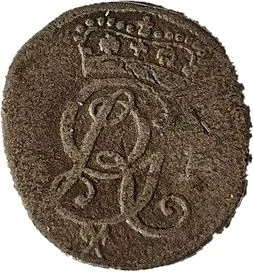
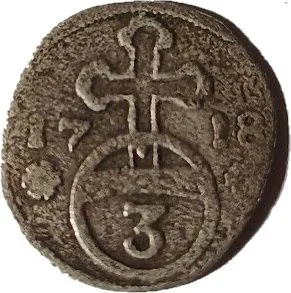
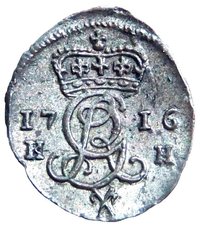
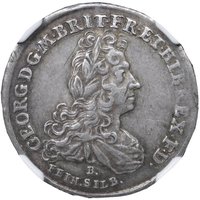
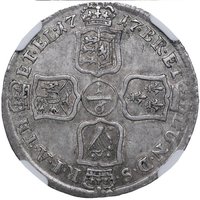
3 Pfennigs – Brunswick-Lüneburg-Calenberg-Hannover
Germany

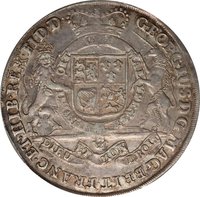
Obverse
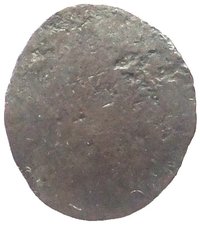
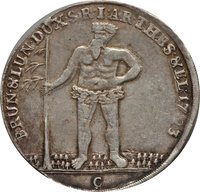
Reverse
Description:
Imperial orb with date-denominated value.
Inscription:
17 18
✽ ✽
3
✽ ✽
3
Edge
Mints
| Name | Mark |
|---|---|
| Zellerfeld | — |
Mintings
| Year | Mint Mark | Mintage | Quality | Collection |
|---|---|---|---|---|
| 1716 | — | — | ||
| 1717 | — | — | ||
| 1718 | — | — | ||
| 1719 | — | — | ||
| 1721 | — | — | ||
| 1723 | — | — | ||
| 1724 | — | — |
Historical background
In 1716, the currency situation in the Duchy of Brunswick-Lüneburg, specifically the Principality of Calenberg (with its capital in Hanover), was complex and challenging, reflecting the fragmented political landscape of the Holy Roman Empire. The territory was part of a web of competing monetary systems, where its own coins circulated alongside those of neighboring German states and more influential currencies like the Reichsthaler. The recent acquisition of the British throne by the Elector George Louis in 1714 had created a political union with Great Britain, but not a monetary one, adding a layer of financial interplay without simplifying the domestic coinage.
The core problem was chronic instability and debasement. The need to finance state expenditures, particularly for the army, often led rulers to reduce the precious metal content in coins, a practice known as Kipper- und Wipperzeit had plagued the region a century earlier. While not in full crisis in 1716, the temptation remained. Furthermore, numerous mints operated under concession, sometimes producing inferior coins for profit, which eroded public trust and hampered commerce. This resulted in a confusing multiplicity of coins in circulation, each with fluctuating real value against the accounting unit, the Thaler.
Consequently, economic activity was hindered by uncertainty in everyday transactions, requiring constant recalculation and exchange. The year 1716 falls within a period where the Hanoverian authorities, influenced by more stable British and Dutch financial practices, were increasingly aware of the need for reform. While a comprehensive solution was still years away, the situation underscored the growing necessity for a standardized, reliable currency to support the state's rising importance on the European stage, paving the way for future monetary consolidations in the 18th century.
The core problem was chronic instability and debasement. The need to finance state expenditures, particularly for the army, often led rulers to reduce the precious metal content in coins, a practice known as Kipper- und Wipperzeit had plagued the region a century earlier. While not in full crisis in 1716, the temptation remained. Furthermore, numerous mints operated under concession, sometimes producing inferior coins for profit, which eroded public trust and hampered commerce. This resulted in a confusing multiplicity of coins in circulation, each with fluctuating real value against the accounting unit, the Thaler.
Consequently, economic activity was hindered by uncertainty in everyday transactions, requiring constant recalculation and exchange. The year 1716 falls within a period where the Hanoverian authorities, influenced by more stable British and Dutch financial practices, were increasingly aware of the need for reform. While a comprehensive solution was still years away, the situation underscored the growing necessity for a standardized, reliable currency to support the state's rising importance on the European stage, paving the way for future monetary consolidations in the 18th century.
✨ Legendary