

1 ducat – Hungary
Add to wishlist
Hungary
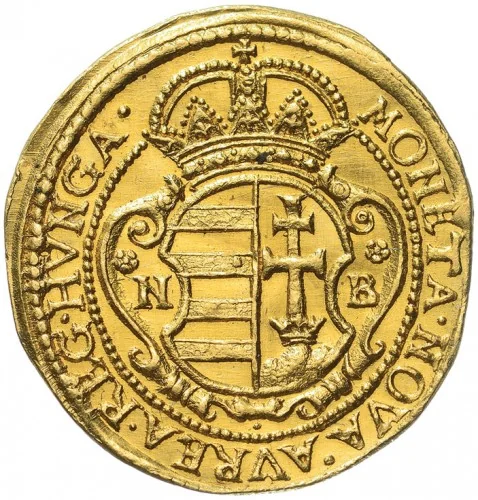
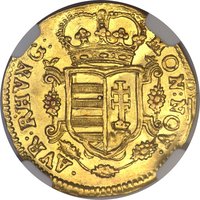
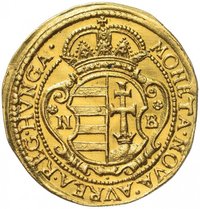
Obverse
Description:
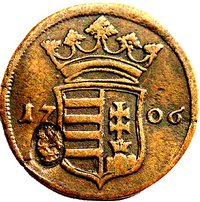
Floral cartouche with crowned arms, encircled by pearls.
Inscription:
MONETA · NOVA · AVREA · REG · HVNGA ·
Script: Latin
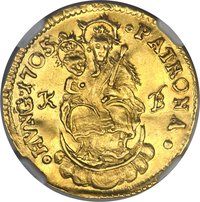
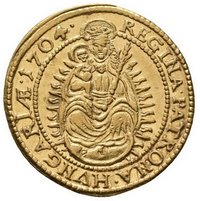
Reverse
Description:
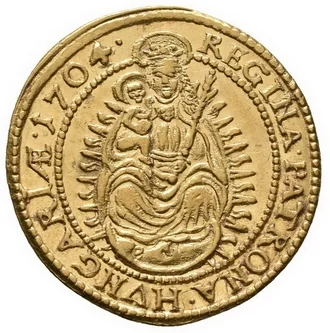
Madonna and Child in a pearl halo.
Inscription:
REGINA · PATRONA · HVNHGARIÆ · 1704 ·
Script: Latin
Edge
Mints
| Name | Mark |
|---|---|
| Baia Mare | NB |
Mintings
| Year | Mint Mark | Mintage | Quality | Collection |
|---|---|---|---|---|
| 1704 | N | — | ||
| 1705 | N | — |
Historical background
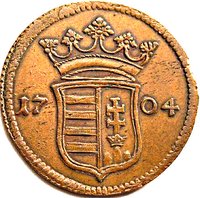
In 1704, Hungary's currency situation was deeply unstable and fragmented, a direct consequence of its political turmoil within the Habsburg Empire. The ongoing Rákóczi War of Independence (1703-1711), led by Prince Francis II Rákóczi against Habsburg rule, had fractured the kingdom's monetary system. The Habsburg authorities in Vienna controlled the minting of official coinage, primarily silver thalers and copper denars, but their reach was limited to territories they held. Meanwhile, Rákóczi's Kuruc forces issued their own emergency coinage to fund the rebellion, often of lower metallic content and weight, leading to a parallel and depreciating currency in the areas they controlled.
This period was characterized by severe inflation, particularly in the copper-based small change that facilitated everyday trade. The Habsburg government, desperate to finance its own military campaigns in the War of the Spanish Succession and the Hungarian rebellion, repeatedly debased the copper currency. The overproduction of these coins, known as krajcár, led to a dramatic loss of public trust and a sharp decline in their purchasing power. Prices for basic goods soared, causing significant hardship for the common population and disrupting the local economy.
Furthermore, the circulation of older, higher-value silver coins from earlier reigns, alongside a multitude of foreign coins from neighboring states like the Ottoman Empire and Poland, created a chaotic monetary landscape. The simultaneous existence of official Habsburg coinage, rebel Kuruc issues, and various foreign currencies meant that exchange rates were volatile and localized. This monetary chaos reflected the broader struggle for control of Hungary itself, making stable commerce difficult and underscoring the economic dimension of the war for independence.
This period was characterized by severe inflation, particularly in the copper-based small change that facilitated everyday trade. The Habsburg government, desperate to finance its own military campaigns in the War of the Spanish Succession and the Hungarian rebellion, repeatedly debased the copper currency. The overproduction of these coins, known as krajcár, led to a dramatic loss of public trust and a sharp decline in their purchasing power. Prices for basic goods soared, causing significant hardship for the common population and disrupting the local economy.
Furthermore, the circulation of older, higher-value silver coins from earlier reigns, alongside a multitude of foreign coins from neighboring states like the Ottoman Empire and Poland, created a chaotic monetary landscape. The simultaneous existence of official Habsburg coinage, rebel Kuruc issues, and various foreign currencies meant that exchange rates were volatile and localized. This monetary chaos reflected the broader struggle for control of Hungary itself, making stable commerce difficult and underscoring the economic dimension of the war for independence.
Series: 1704 Hungary circulation coins
✨ Legendary