

5 Bazarucos – Portuguese India
India
Context
Years: 1765–1768
Country: India 
Issuer: Portuguese India
Issuing organization: Casa da Moeda de Diu
Ruler: Joseph I
Currency:
(1706—1880)
Demonetized: Yes
Material
References
KM: #Click to copy to clipboard35
Numista: #49217
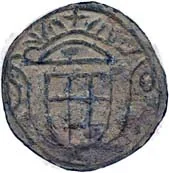
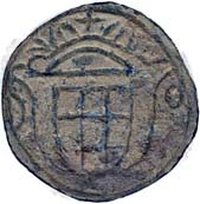
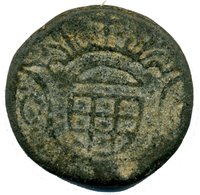
Obverse
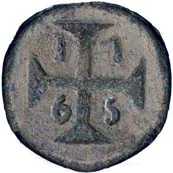
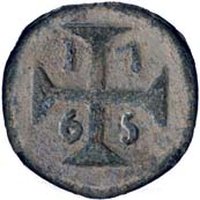
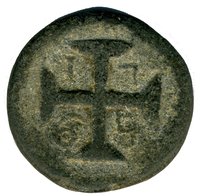
Reverse
Description:
Military Order of Christ Cross, dated at each corner.
Inscription:
1 7
6 5
6 5
Script: Latin
Edge
Categories
| Symbols> Coat of Arms |
| Symbol> Cross |
Mintings
| Year | Mint Mark | Mintage | Quality | Collection |
|---|---|---|---|---|
| 1765 | D-O | — | ||
| 1768 | D-O | — |
Historical background
In 1765, the currency situation in Portuguese India was a complex tapestry of competing monetary systems, reflecting the colony's diminished political power and its position within regional trade networks. The official Portuguese currency, the real, was theoretically in circulation, but in practice it was often scarce and faced severe debasement. The real power lay with a multitude of foreign coins that circulated freely and were essential for commerce. The most important of these was the Portuguese gold moeda, but crucially, vast quantities of silver Spanish American pesos (often called "Patacas" or "Pieces of Eight") and various Indian and Mughal rupees formed the lifeblood of everyday transactions in Goa, Damão, and Diu.
This monetary pluralism arose from necessity. Portugal's metropolitan economy was weak, and it could not supply sufficient specie to its Asian possessions. Furthermore, the lucrative trade with neighboring Indian states and other European East India companies required widely accepted, high-value currency. The Spanish peso, with its reliable silver content, served as a de facto trade currency across Asia. Locally, the Mughal rupee remained dominant in market exchanges, forcing the Portuguese administration to acknowledge and engage with these external systems. The result was an official exchange rate list (câmbio) published periodically, fixing the value of dozens of different gold, silver, and even copper coins from Brazil, Portugal, Spain, France, and various Indian polities against the Portuguese real.
Ultimately, the currency scene of 1765 symbolized Portuguese India's pragmatic adaptation to its reduced circumstances. Rather than enforcing a unified monetary system, the authorities managed a chaotic bazaar of coins, a policy that facilitated survival through trade but also highlighted Lisbon's limited control. This system was inefficient, prone to speculation and exchange rate fluctuations, and it channeled much of the colony's wealth into foreign specie. It was a clear financial manifestation of an empire living on past glory, dependent on the economic currents of rivals and neighbors to sustain its dwindling enclaves.
This monetary pluralism arose from necessity. Portugal's metropolitan economy was weak, and it could not supply sufficient specie to its Asian possessions. Furthermore, the lucrative trade with neighboring Indian states and other European East India companies required widely accepted, high-value currency. The Spanish peso, with its reliable silver content, served as a de facto trade currency across Asia. Locally, the Mughal rupee remained dominant in market exchanges, forcing the Portuguese administration to acknowledge and engage with these external systems. The result was an official exchange rate list (câmbio) published periodically, fixing the value of dozens of different gold, silver, and even copper coins from Brazil, Portugal, Spain, France, and various Indian polities against the Portuguese real.
Ultimately, the currency scene of 1765 symbolized Portuguese India's pragmatic adaptation to its reduced circumstances. Rather than enforcing a unified monetary system, the authorities managed a chaotic bazaar of coins, a policy that facilitated survival through trade but also highlighted Lisbon's limited control. This system was inefficient, prone to speculation and exchange rate fluctuations, and it channeled much of the colony's wealth into foreign specie. It was a clear financial manifestation of an empire living on past glory, dependent on the economic currents of rivals and neighbors to sustain its dwindling enclaves.
✨ Legendary