

1 thaler – Hungary
Add to wishlist
Hungary
Context
Material
References
KM: #
Numista: #49117
Value
Bullion value: $58.57
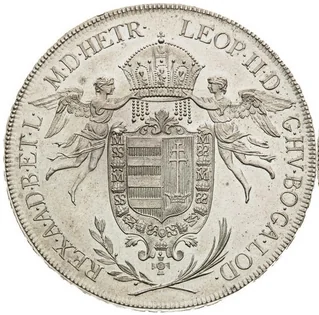
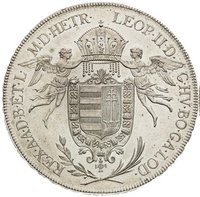
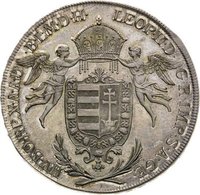
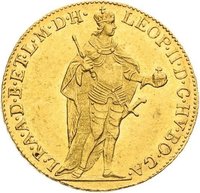
Obverse
Description:
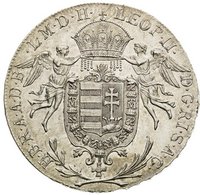
Angels suspended midair, wings folded, holding a crowned double Hungarian shield in a cartouche.
Inscription:
LEOP . II . D . G . HV . BO . GA . LOD . REX . A . A . D . B ET . L . M . D . HETR .
Script: Latin
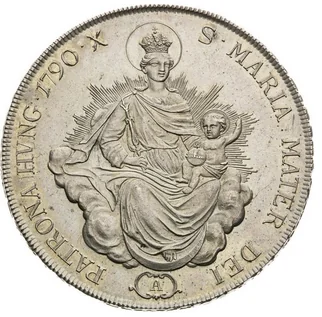
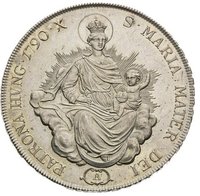
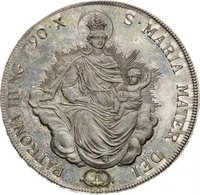
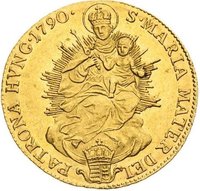
Reverse
Description:
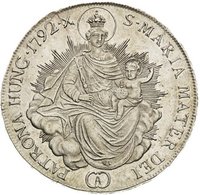
Radiant Madonna and Child enthroned on a crescent moon.
Inscription:
S·MARIA MATER DEI·PATRONA·HUNG·1790·
Script: Latin
Edge
Inscripted
Legend:
PIETATE ET CONCORDIA
Categories
| Person> Religious figure |
Mints
| Name | Mark |
|---|---|
| Münze Österreich | A |
Mintings
| Year | Mint Mark | Mintage | Quality | Collection |
|---|---|---|---|---|
| 1790 | A | — |
Historical background
In 1790, Hungary found itself in a complex monetary situation, deeply intertwined with its political relationship with the Habsburg Monarchy. The country operated within the broader currency system of the Austrian Empire, where the official unit of account was the Conventionsthaler (or Konvenciós forint), established by the monetary convention of 1753. However, the actual circulating medium was a chaotic mix of physical coins, including domestic and foreign silver thalers, gold ducats, and a proliferation of small-denomination copper and silver coins, often of varying quality and value from different regions of the empire.
This period was marked by significant inflationary pressure and currency instability. The costly wars of the 18th century, particularly the support for the War of the Austrian Succession and the Seven Years' War, had been financed heavily through debt and the debasement of coinage. The state responded by issuing lower-quality Scheidemünze (small change coins) with a higher face value than their intrinsic metal content, leading to a loss of public trust and Gresham's Law in action, where "bad money drove out good." People hoarded full-weight silver and gold coins, exacerbating the shortage of reliable currency for everyday trade.
The currency issue was a focal point of rising Hungarian national sentiment and demands for greater autonomy from Vienna. The Diet of 1790, convened during a moment of Habsburg weakness following the death of Joseph II, saw the Hungarian estates aggressively pressing for economic and political reforms. Among their key demands was the establishment of a separate Hungarian coinage minted within the kingdom, bearing national symbols, as a tangible assertion of sovereignty and a means to stabilize their own economy. While Emperor Leopold II made political concessions, the fundamental restructuring of the monetary system would remain a persistent and unresolved challenge well into the 19th century.
This period was marked by significant inflationary pressure and currency instability. The costly wars of the 18th century, particularly the support for the War of the Austrian Succession and the Seven Years' War, had been financed heavily through debt and the debasement of coinage. The state responded by issuing lower-quality Scheidemünze (small change coins) with a higher face value than their intrinsic metal content, leading to a loss of public trust and Gresham's Law in action, where "bad money drove out good." People hoarded full-weight silver and gold coins, exacerbating the shortage of reliable currency for everyday trade.
The currency issue was a focal point of rising Hungarian national sentiment and demands for greater autonomy from Vienna. The Diet of 1790, convened during a moment of Habsburg weakness following the death of Joseph II, saw the Hungarian estates aggressively pressing for economic and political reforms. Among their key demands was the establishment of a separate Hungarian coinage minted within the kingdom, bearing national symbols, as a tangible assertion of sovereignty and a means to stabilize their own economy. While Emperor Leopold II made political concessions, the fundamental restructuring of the monetary system would remain a persistent and unresolved challenge well into the 19th century.
Series: 1790 Hungary circulation coins
✨ Legendary