

½ Manuel – Portuguese India
India
Context
Years: 1509–1521
Country: India 
Issuer: Portuguese India
Ruler: Manuel I
Currency:
(1509—1580)
Subdivision: ½ Manuel = 240 Reais
Demonetized: Yes
Material
Diameter: 16 mm
Weight: 1.6 g
Gold weight: 1.60 g
Shape: Irregular round
Composition: Gold
Magnetic: No
References
KM: #Click to copy to clipboard7
Numista: #49105
Value
Bullion value: $266.88
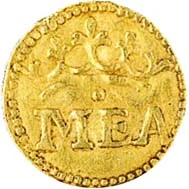
Obverse
Inscription:
MEA (Half)
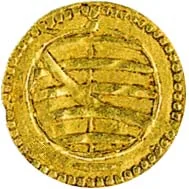
Reverse
Edge
Mintings
| Year | Mint Mark | Mintage | Quality | Collection |
|---|---|---|---|---|
| — | — | — |
Historical background
In 1509, the currency situation in Portuguese India was a complex and evolving hybrid system, reflecting the early stage of colonial economic imposition. The Portuguese, under the command of Dom Francisco de Almeida who secured their naval dominance at the Battle of Diu that year, did not yet possess a formal mint in their capital at Cochin. Consequently, the local economy continued to rely heavily on a multitude of existing, widely trusted currencies. The most prominent of these was the gold hūn (or pardau) and the silver tanga, primarily minted by the neighbouring Sultanate of Bijapur. These coins, alongside a variety of other regional issues, formed the bedrock of high-value trade and taxation.
Portuguese commercial and military power was exercised through control of the seas and key ports, not through a unified currency. Their primary contribution to the monetary landscape was the introduction of European gold and silver coins, like the Portuguese cruzado, used for official transactions, paying troops, and long-distance trade. However, these often circulated alongside and were valued against the established indigenous coins. Furthermore, for smaller, everyday transactions, the vast array of low-value copper and lead coins (bazarucos or ceitis) from local regimes and the prolific shell money (cauri*) from the Maldives remained indispensable for the common population.
Thus, the monetary environment was one of pragmatic coexistence and calculated assimilation. The Portuguese state and private traders accepted and utilised local currencies to facilitate their spice purchases and port operations, while simultaneously trying to assert the value of their own coinage. The system was inherently messy, with exchange rates fluctuating based on metal content, political influence, and mercantile demand. The situation in 1509 was therefore transitional, laying the groundwork for the more formalised and aggressive currency reforms that would follow under subsequent governors, particularly Afonso de Albuquerque, who would seek to standardise and control the monetary system as a tool of sovereignty.
Portuguese commercial and military power was exercised through control of the seas and key ports, not through a unified currency. Their primary contribution to the monetary landscape was the introduction of European gold and silver coins, like the Portuguese cruzado, used for official transactions, paying troops, and long-distance trade. However, these often circulated alongside and were valued against the established indigenous coins. Furthermore, for smaller, everyday transactions, the vast array of low-value copper and lead coins (bazarucos or ceitis) from local regimes and the prolific shell money (cauri*) from the Maldives remained indispensable for the common population.
Thus, the monetary environment was one of pragmatic coexistence and calculated assimilation. The Portuguese state and private traders accepted and utilised local currencies to facilitate their spice purchases and port operations, while simultaneously trying to assert the value of their own coinage. The system was inherently messy, with exchange rates fluctuating based on metal content, political influence, and mercantile demand. The situation in 1509 was therefore transitional, laying the groundwork for the more formalised and aggressive currency reforms that would follow under subsequent governors, particularly Afonso de Albuquerque, who would seek to standardise and control the monetary system as a tool of sovereignty.


✨ Legendary