


Obverse
Description:
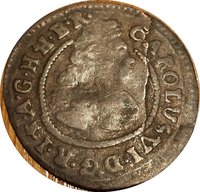
Bust with curly wig breaks the top and bottom inscription. Inscription is interrupted by a crowned Hungarian shield and a Madonna and child. No inner pearl circle.
Inscription:
IOSEPH D : G · R · I · S · A · G · H · B · REX ·
Reverse
Description:
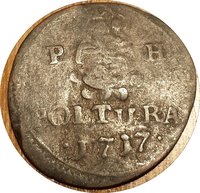
Imperial eagle without inner circle, K B mintmark split by tail, no orb between heads. Eagle interrupts inscription above and below. Crowned U-shaped cartouche with quadripartite shield (alternating Árpádian stripes and Bohemian lion). Central shield features uncrowned Austrian and Burgundian arms. Date ends inscription.
Inscription:
ARCHID · AVS · D · BV M · MOR · CO · TY · 1711
K B
K B
Edge
Plain
Mints
| Name | Mark |
|---|---|
| Kremnica | KB |
Mintings
| Year | Mint Mark | Mintage | Quality | Collection |
|---|---|---|---|---|
| 1711 | K | — |
Historical background
Following the signing of the Treaty of Szatmár in 1711, which ended the Rákóczi War of Independence against Habsburg rule, Hungary found itself in a state of severe economic and monetary exhaustion. The long conflict had devastated the country's economy, disrupting agriculture, trade, and mining—the traditional source of Hungarian silver and gold. The Habsburg government in Vienna, now firmly reasserting control, inherited a kingdom with a crippled financial system and a chaotic circulation of vastly depreciated currency.
The core of the monetary crisis stemmed from the wartime practices of both sides. To finance the war, Prince Ferenc Rákóczi’s kuruc forces had issued large quantities of underweight silver coins (like the poltura) and debased copper currency, often minted from melted-down church bells and utensils. Simultaneously, the Habsburg Hofkammer in Vienna had flooded the region with low-quality copper coins (kreuzers) to pay for its military expenses. This resulted in a dual crisis: a severe shortage of high-value, full-weight silver coins for large transactions and international trade, and an overwhelming glut of nearly worthless small change that fueled rampant inflation and public mistrust.
Consequently, in 1711, Hungary’s monetary landscape was fragmented and unstable. Multiple coin types of uncertain value circulated simultaneously, undermining commerce and tax collection. The urgent task for the Habsburg authorities was to restore monetary order, a process that would begin with the standardization and recall of debased coinage, and the re-establishment of centralized minting under Viennese authority. This stabilization was a fundamental prerequisite for integrating Hungary into the broader Habsburg fiscal system and facilitating the economic reconstruction of the war-ravaged kingdom.
The core of the monetary crisis stemmed from the wartime practices of both sides. To finance the war, Prince Ferenc Rákóczi’s kuruc forces had issued large quantities of underweight silver coins (like the poltura) and debased copper currency, often minted from melted-down church bells and utensils. Simultaneously, the Habsburg Hofkammer in Vienna had flooded the region with low-quality copper coins (kreuzers) to pay for its military expenses. This resulted in a dual crisis: a severe shortage of high-value, full-weight silver coins for large transactions and international trade, and an overwhelming glut of nearly worthless small change that fueled rampant inflation and public mistrust.
Consequently, in 1711, Hungary’s monetary landscape was fragmented and unstable. Multiple coin types of uncertain value circulated simultaneously, undermining commerce and tax collection. The urgent task for the Habsburg authorities was to restore monetary order, a process that would begin with the standardization and recall of debased coinage, and the re-establishment of centralized minting under Viennese authority. This stabilization was a fundamental prerequisite for integrating Hungary into the broader Habsburg fiscal system and facilitating the economic reconstruction of the war-ravaged kingdom.

✨ Legendary