


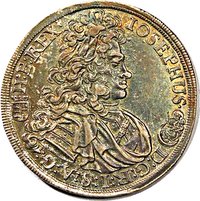
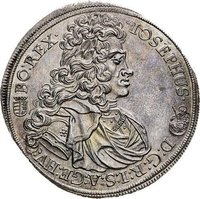
Obverse
Description:
Armored bust with curly wig right, breaking inner circle. Inscription interrupted by crowned Hungarian shield and Madonna and Child.
Inscription:
IOSEPHUS D : G · R · I · S · A · G H · B · REX
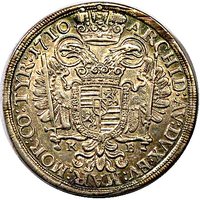
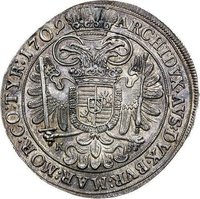
Reverse
Description:
Imperial eagle in circle, K B mintmark split by tail. Fourfold crowned shield (stripes/lion alternating) in U-cartouche; central shield with uncrowned Austrian-Burgundian arms. Pearl circle inscription, date at end.
Inscription:
ARCHIDVX · AVS · DVX · BVR · MAR · MOR · CO · TYR · 1709
K B
K B
Edge
Plain
Mints
| Name | Mark |
|---|---|
| Kremnica | KB |
Mintings
| Year | Mint Mark | Mintage | Quality | Collection |
|---|---|---|---|---|
| 1709 | KB | 49,000 |
Historical background
In 1709, Hungary’s currency situation was deeply unstable and a direct consequence of the ongoing War of the Spanish Succession (1701-1714). The Habsburg monarchy, ruling from Vienna, was engaged in a massive and costly continental war, financing its armies largely by debasing the coinage minted within the Kingdom of Hungary. The primary currency, the silver thaler (or forint), saw its precious metal content drastically reduced, while copper and billon (a low-grade silver alloy) coins were minted in excessive quantities to cover wartime expenditures. This led to severe inflation, a loss of public trust in the currency, and economic hardship for the population, particularly those on fixed incomes or paid in the devalued coins.
The monetary chaos was exacerbated by the circulation of older, full-value silver coins alongside the new, inferior ones, creating a classic case of Gresham’s Law where "bad money drives out good." People hoarded the older, purer coins, removing them from circulation and worsening the scarcity of reliable currency. Furthermore, the Habsburg authorities often compelled Hungarian counties to accept the debased coins at their nominal face value for tax payments, while simultaneously demanding that taxes owed to the Crown be paid in higher-quality specie. This policy drained wealth from the kingdom and fueled deep resentment among the Hungarian estates.
This financial turmoil occurred against the backdrop of the recent Rákóczi War of Independence (1703-1711), which had only just entered its final phase. The war had already devastated the countryside and disrupted normal economic activity. The currency debasement of 1709 was therefore not an isolated economic event but a critical part of the broader political struggle, reflecting Vienna’s extractive approach to its Hungarian lands and contributing to the lingering grievances that would be partially addressed in the subsequent Peace of Szatmár in 1711.
The monetary chaos was exacerbated by the circulation of older, full-value silver coins alongside the new, inferior ones, creating a classic case of Gresham’s Law where "bad money drives out good." People hoarded the older, purer coins, removing them from circulation and worsening the scarcity of reliable currency. Furthermore, the Habsburg authorities often compelled Hungarian counties to accept the debased coins at their nominal face value for tax payments, while simultaneously demanding that taxes owed to the Crown be paid in higher-quality specie. This policy drained wealth from the kingdom and fueled deep resentment among the Hungarian estates.
This financial turmoil occurred against the backdrop of the recent Rákóczi War of Independence (1703-1711), which had only just entered its final phase. The war had already devastated the countryside and disrupted normal economic activity. The currency debasement of 1709 was therefore not an isolated economic event but a critical part of the broader political struggle, reflecting Vienna’s extractive approach to its Hungarian lands and contributing to the lingering grievances that would be partially addressed in the subsequent Peace of Szatmár in 1711.
✨ Legendary