


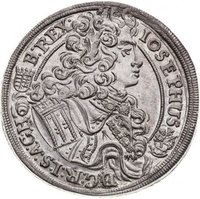
Obverse
Description:
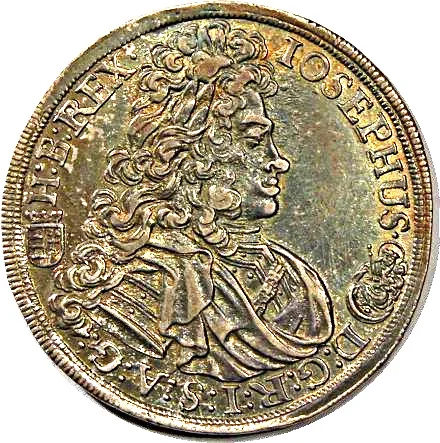
Bust right; Madonna and child between IOSEPHUS and D:G:. Hungarian shield between A:G: and H:B:REX. No pearl circles.
Inscription:
IOSEPHUS · D : G : R : I : S : A : G : H : B : REX
Script: Latin
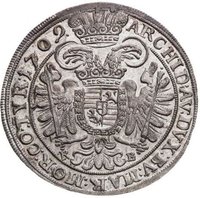
Reverse
Description:
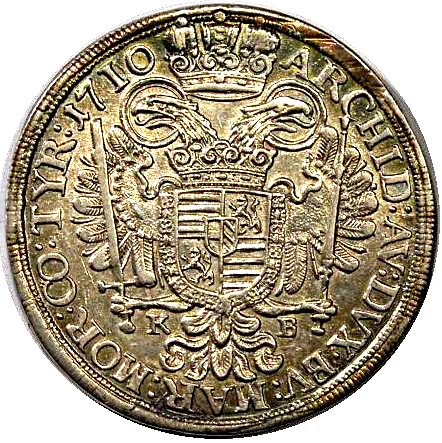
Imperial eagle with divided 'K B' mintmark. U-shaped cartouche with crowned Árpád-Bohemian quartered arms. Central shield of uncrowned Austrian-Burgundian arms. Inscription with date, no pearl circle.
Inscription:
ARCHID · AV · DVX · BV · MAR · MOR · CO · TYR · 1709
K - B
K - B
Script: Latin
Edge
Plain
Mints
| Name | Mark |
|---|---|
| Kremnica | KB |
Historical background
In 1708, Hungary’s currency situation was deeply unstable and inflationary, a direct consequence of its position within the Habsburg Monarchy during the prolonged War of the Spanish Succession (1701-1714). To finance his extensive military campaigns across Europe, Emperor Joseph I heavily exploited the mining resources of the Kingdom of Hungary, particularly the silver from mines in Körmöcbánya (now Kremnica, Slovakia). The Vienna Court, which controlled the minting rights, dramatically increased the production of silver coins, but with a crucial debasement: the thaler (or tallér) and the smaller denars were minted with progressively lower silver content and reduced weight.
This period saw the rapid circulation of these debased coins, known colloquially as kriegsgeld (war money), which eroded public trust and disrupted the economy. The inflation was severe; for example, the value of the Hungarian gold ducat, a traditionally stable coin, skyrocketed in terms of the debased silver currency, causing hardship for soldiers paid in weak money and for peasants paying feudal dues. The debasement also disrupted trade, as merchants and creditors suffered losses, and the Hungarian Diet repeatedly protested Vienna's monetary policy as a violation of the kingdom's rights.
Ultimately, the currency crisis of 1708 was not an isolated financial event but a symptom of Hungary’s subordinate political status, where its economic resources were harnessed for Habsburg imperial ambitions without regard for local stability. The inflationary spiral would continue until after the war, culminating in a major monetary reform in 1715 under Charles III, which introduced a new, standardized silver thaler (the Conventionsthaler) to restore confidence and value to the currency system.
This period saw the rapid circulation of these debased coins, known colloquially as kriegsgeld (war money), which eroded public trust and disrupted the economy. The inflation was severe; for example, the value of the Hungarian gold ducat, a traditionally stable coin, skyrocketed in terms of the debased silver currency, causing hardship for soldiers paid in weak money and for peasants paying feudal dues. The debasement also disrupted trade, as merchants and creditors suffered losses, and the Hungarian Diet repeatedly protested Vienna's monetary policy as a violation of the kingdom's rights.
Ultimately, the currency crisis of 1708 was not an isolated financial event but a symptom of Hungary’s subordinate political status, where its economic resources were harnessed for Habsburg imperial ambitions without regard for local stability. The inflationary spiral would continue until after the war, culminating in a major monetary reform in 1715 under Charles III, which introduced a new, standardized silver thaler (the Conventionsthaler) to restore confidence and value to the currency system.

✨ Legendary