

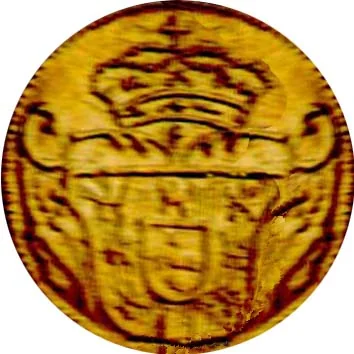
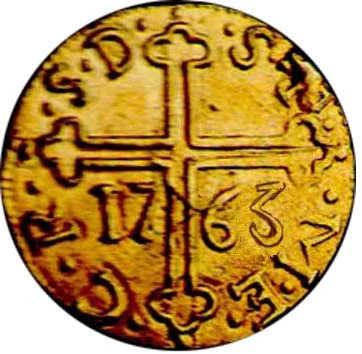
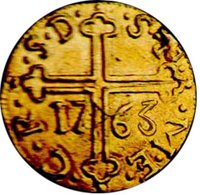
8 xerafins – Portuguese India
Add to wishlist
India
Context
Year: 1763
Country: India
Issuer: Portuguese India
Ruler: Joseph I
Currency:
(1706—1880)
Subdivision: 8 xerafins = 4 Rupias
Demonetized: Yes
Material
Diameter: 15 mm
Weight: 3.4 g
Gold Weight:: 3.40 g
Shape: Irregular round
Composition: Gold
Magnetic: No
Technique: Hammered
References
KM: #
Numista: #49042
Value
Bullion value: $529.33
Mints
| Name | Mark |
|---|---|
| Goa | — |
Mintings
| Year | Mint Mark | Mintage | Quality | Collection |
|---|---|---|---|---|
| 1763 | — | — |
Historical background
In 1763, the currency situation in Portuguese India was a complex tapestry of official and unofficial systems, reflecting the colony's diminished economic power and its integration into regional trade networks. The official currency was the Portuguese real, but its circulation was limited and its value often unstable. The heart of the monetary system in Goa, the capital, was the Casa da Moeda (Royal Mint), which primarily struck silver xerafins and copper bazarucos. However, chronic shortages of precious metals and the poor quality of locally minted coinage severely undermined their authority and acceptance.
In practice, the bustling markets of Goa, Damão, and Diu operated on a de facto standard of various foreign silver coins, a testament to Portugal's loss of commercial hegemony. The most important of these was the Spanish Piece of Eight (peso de ocho reales), a global trade currency, along with other European and Indian coins like the Venetian ducat and the Mughal rupee. These foreign coins were valued by their intrinsic silver weight and were essential for both intra-Asian trade and settling international transactions, leaving the local Portuguese coinage for smaller, everyday commerce.
This fragmented system created significant administrative and economic challenges. The Portuguese authorities struggled with constant currency debasement, counterfeiting, and the outflow of full-weight silver to pay for trade deficits. Attempts to fix exchange rates between the official xerafim and the circulating foreign coins were largely ineffective, leading to a dual economy. Thus, by 1763, the monetary landscape was one of pragmatic hybridity, where Portuguese legal tender coexisted uneasily with a more trusted and powerful ecosystem of international specie, highlighting the gap between imperial ambition and local economic reality.
In practice, the bustling markets of Goa, Damão, and Diu operated on a de facto standard of various foreign silver coins, a testament to Portugal's loss of commercial hegemony. The most important of these was the Spanish Piece of Eight (peso de ocho reales), a global trade currency, along with other European and Indian coins like the Venetian ducat and the Mughal rupee. These foreign coins were valued by their intrinsic silver weight and were essential for both intra-Asian trade and settling international transactions, leaving the local Portuguese coinage for smaller, everyday commerce.
This fragmented system created significant administrative and economic challenges. The Portuguese authorities struggled with constant currency debasement, counterfeiting, and the outflow of full-weight silver to pay for trade deficits. Attempts to fix exchange rates between the official xerafim and the circulating foreign coins were largely ineffective, leading to a dual economy. Thus, by 1763, the monetary landscape was one of pragmatic hybridity, where Portuguese legal tender coexisted uneasily with a more trusted and powerful ecosystem of international specie, highlighting the gap between imperial ambition and local economic reality.

✨ Legendary