

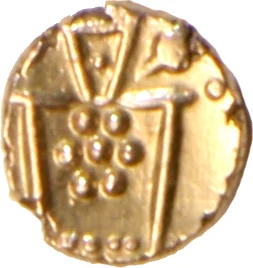

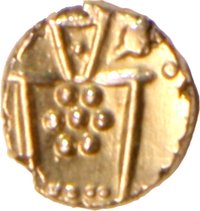
Obverse
Description:
Kali, facing forward, abstract form.
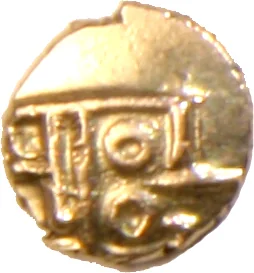
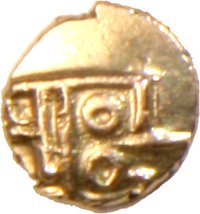
Reverse
Description:
Rama Raya: A Nagari Legend
Inscription:
राम राया
Edge
Mints
| Name | Mark |
|---|---|
| Negapatnam | — |
Mintings
| Year | Mint Mark | Mintage | Quality | Collection |
|---|---|---|---|---|
| — | — | — |
Historical background
In 1785, the currency situation in Dutch India, primarily centered on the Dutch East India Company (VOC) holdings in Ceylon (Sri Lanka) and the Coromandel Coast of India, was characterized by severe instability and complexity. The VOC operated a plural monetary system where multiple currencies circulated simultaneously. These included imported European silver coins (like the Dutch rijksdaalder), various Indian and Ceylonese gold and silver pagodas and fanams, and a vast quantity of debased copper coinage (known as doits in Ceylon). The Company itself was a major minting authority, but its primary goal was to extract profit, leading to frequent manipulations of coin values and metal content to finance its military and administrative costs, often at the expense of local economic stability.
This monetary chaos was exacerbated by the VOC's deepening financial crisis. By the 1780s, the Company was nearing bankruptcy, burdened by debt and costly wars, such as the Fourth Anglo-Dutch War (1780-1784). To meet its obligations, the VOC increasingly resorted to issuing paper credit (kreditiven) in Batavia and circulating low-value copper coins in vast quantities, which led to severe inflation, particularly in Ceylon. The intrinsic value of these coins was often far below their face value, causing a loss of public trust and widespread hoarding of full-weight silver coins, a classic example of Gresham's Law ("bad money drives out good").
Consequently, the year 1785 fell within a period of deteriorating economic control for the Dutch in India. Local merchants and populations often preferred other, more reliable currencies like the Spanish silver dollar or various Indian rupee issues for significant transactions, undermining the VOC's monetary authority. This fragmented and inflationary environment hampered trade, increased the cost of administration, and reflected the wider decline of Dutch commercial power in the region, setting the stage for increased British economic and political encroachment in the decades to follow.
This monetary chaos was exacerbated by the VOC's deepening financial crisis. By the 1780s, the Company was nearing bankruptcy, burdened by debt and costly wars, such as the Fourth Anglo-Dutch War (1780-1784). To meet its obligations, the VOC increasingly resorted to issuing paper credit (kreditiven) in Batavia and circulating low-value copper coins in vast quantities, which led to severe inflation, particularly in Ceylon. The intrinsic value of these coins was often far below their face value, causing a loss of public trust and widespread hoarding of full-weight silver coins, a classic example of Gresham's Law ("bad money drives out good").
Consequently, the year 1785 fell within a period of deteriorating economic control for the Dutch in India. Local merchants and populations often preferred other, more reliable currencies like the Spanish silver dollar or various Indian rupee issues for significant transactions, undermining the VOC's monetary authority. This fragmented and inflationary environment hampered trade, increased the cost of administration, and reflected the wider decline of Dutch commercial power in the region, setting the stage for increased British economic and political encroachment in the decades to follow.

⭐ Rare