

¼ Thaler – Hungary
Hungary

Obverse
Description:
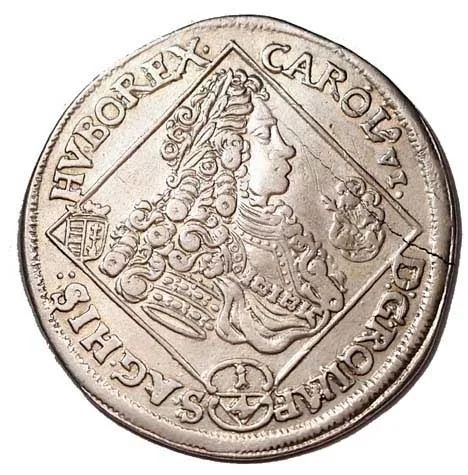
Armored bust with curly wig right. Crowned Hungarian arms and Madonna in rhombus divide inscription; value in cartouche below.
Inscription:
CAROL · VI · D · G · RO · IMP · S · A · G · HIS · HV · BO · REX
1/4
1/4
Script: Latin
Reverse
Description:
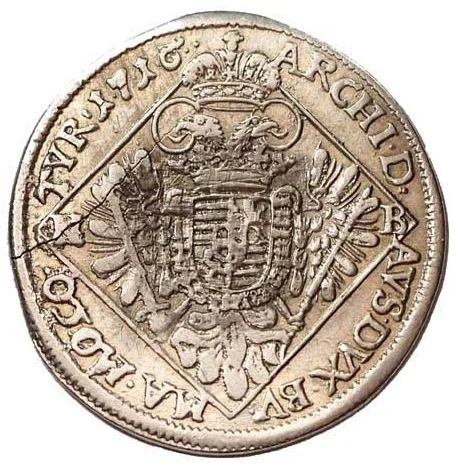
Imperial eagle in rhombus, dividing inscription and NB mintmark. On chest: crowned U-shaped cartouche with quartered Hungarian-Bohemian arms, central Austrian shield. Date ends inscription.
Inscription:
ARCHID : AVS : DVX : BV : MA : MO : CO : TYR : 1716 ·
N B
N B
Script: Latin
Edge
Plain
Mints
| Name | Mark |
|---|---|
| Baia Mare | NB |
Mintings
| Year | Mint Mark | Mintage | Quality | Collection |
|---|---|---|---|---|
| — | B | — | ||
| 1714 | N | — | ||
| 1715 | N | — | ||
| 1716 | N | — | ||
| 1717 | N | — |
Historical background
In 1714, Hungary’s currency situation was chaotic and deeply unstable, a direct legacy of the prolonged wars against the Ottoman Empire and the recent Rákóczi War of Independence (1703-1711). The Habsburg monarchy, having reasserted control after the Treaty of Szatmár (1711), inherited a realm where the official coinage—the silver Thaler (Tallér) and the smaller copper Denars—coexisted with a plethora of debased, obsolete, and foreign coins. Decades of war finance had led to severe depreciation, particularly of the copper currency, causing rampant inflation and crippling uncertainty for both commerce and taxation.
The primary challenge was the severe shortage of high-quality silver coinage in circulation. Much of the reliable currency was hoarded or used for international trade, leaving the domestic economy to rely on heavily debated copper coins of low intrinsic value. Furthermore, the Habsburg government’s own mints, notably in Nagybánya (now Baia Mare, Romania), had historically engaged in inflationary minting to fund military campaigns, flooding the market with coins whose metal content was well below their face value. This practice eroded public trust in the currency system entirely.
Consequently, the year 1714 fell within a period of difficult post-war consolidation. While the wars were over, the monetary system was yet to be reformed. The Habsburg authorities faced the urgent task of standardizing and stabilizing the currency to restore economic order, facilitate reconstruction, and fully integrate Hungary into the imperial fiscal system. This groundwork would eventually lead to more centralized monetary policies, but in 1714, the situation remained defined by fragmentation, depreciation, and the slow, challenging beginning of recovery.
The primary challenge was the severe shortage of high-quality silver coinage in circulation. Much of the reliable currency was hoarded or used for international trade, leaving the domestic economy to rely on heavily debated copper coins of low intrinsic value. Furthermore, the Habsburg government’s own mints, notably in Nagybánya (now Baia Mare, Romania), had historically engaged in inflationary minting to fund military campaigns, flooding the market with coins whose metal content was well below their face value. This practice eroded public trust in the currency system entirely.
Consequently, the year 1714 fell within a period of difficult post-war consolidation. While the wars were over, the monetary system was yet to be reformed. The Habsburg authorities faced the urgent task of standardizing and stabilizing the currency to restore economic order, facilitate reconstruction, and fully integrate Hungary into the imperial fiscal system. This groundwork would eventually lead to more centralized monetary policies, but in 1714, the situation remained defined by fragmentation, depreciation, and the slow, challenging beginning of recovery.

✨ Legendary