

3 Kreuzers – Hungary
Hungary

Obverse
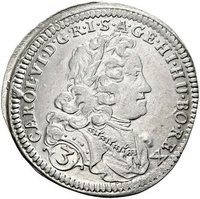
Description:
Curly laureate bust, no pearl circle. Inscription begins at top, with framed "3" at 7 o'clock.
Inscription:
CAROLVS · VI · D · G · R · I · S · A · G (3) HISP · H · B · REX ·
Reverse
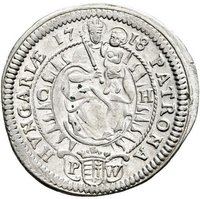
Description:
Crowned Madonna in mandorla on a crescent, holding child and scepter, breaking inner pearl circle. Double-crowned Hungarian shield below. Mintmark N B divided, date divided by crown.
Inscription:
PATRONA · HVNGARIÆ · 17 15
Edge
Plain
Mints
| Name | Mark |
|---|---|
| Baia Mare | NB |
Mintings
| Year | Mint Mark | Mintage | Quality | Collection |
|---|---|---|---|---|
| 1715 | N | — |
Historical background
In 1715, Hungary’s currency situation was chaotic and deeply unstable, a direct legacy of the preceding decades of war and rebellion. The country was part of the Habsburg Monarchy, having been largely reconquered from Ottoman rule after the Great Turkish War (1683-1699) and the Rákóczi War of Independence (1703-1711). These conflicts had drained the treasury, leading the Vienna court to repeatedly debase the silver coinage, particularly the denarius (denar) and the tallér (thaler). The coinage in circulation was a confusing mix of older, purer coins, newer debased issues, and various foreign currencies, causing widespread confusion and loss of public trust.
The primary unit of account was the Hungarian gold forint (gulden), but everyday transactions relied on silver and copper. The Habsburg government, seeking to finance its military and administrative costs, had significantly reduced the silver content of coins minted in Nagybánya (today Baia Mare, Romania) and Körmöcbánya (today Kremnica, Slovakia). This practice of debasement led to Gresham’s Law in action, where "bad money drove out good," as people hoarded older, higher-value coins and used the poorer new ones for payments. This effectively created a two-tier monetary system and fueled price inflation, particularly damaging for peasants and soldiers paid in the debased currency.
Recognizing the crisis, the Habsburg authorities under Charles III were in the early stages of attempting monetary reform. The aim was to standardize the coinage across the realm, restore its intrinsic value, and stabilize the economy to better integrate Hungary into the monarchy’s fiscal system. However, in 1715, these reforms were still in planning; the immediate reality was one of monetary disorder, which hindered trade and economic recovery in a war-ravaged country struggling with reconstruction and increased tax burdens.
The primary unit of account was the Hungarian gold forint (gulden), but everyday transactions relied on silver and copper. The Habsburg government, seeking to finance its military and administrative costs, had significantly reduced the silver content of coins minted in Nagybánya (today Baia Mare, Romania) and Körmöcbánya (today Kremnica, Slovakia). This practice of debasement led to Gresham’s Law in action, where "bad money drove out good," as people hoarded older, higher-value coins and used the poorer new ones for payments. This effectively created a two-tier monetary system and fueled price inflation, particularly damaging for peasants and soldiers paid in the debased currency.
Recognizing the crisis, the Habsburg authorities under Charles III were in the early stages of attempting monetary reform. The aim was to standardize the coinage across the realm, restore its intrinsic value, and stabilize the economy to better integrate Hungary into the monarchy’s fiscal system. However, in 1715, these reforms were still in planning; the immediate reality was one of monetary disorder, which hindered trade and economic recovery in a war-ravaged country struggling with reconstruction and increased tax burdens.
✨ Legendary