

17 Kreuzers – Hungary
Hungary
Context
Years: 1751–1765
Issuer: Hungary 
Ruler: Maria Theresa
Currency:
(1526—1754)
Demonetized: Yes
Total mintage: 3,103,000
References
KM: #Click to copy to clipboard356.2
Numista: #48229
Value
Bullion value: $17.17
Obverse
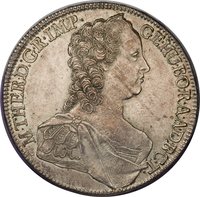
Description:
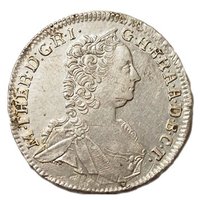
Right-facing bust with necklace, no inner circle. Inscription begins lower left.
Inscription:
M . THER . D : G . R . IMP . GE . HU . BO . R . A . A . D . B . C . T .
Reverse
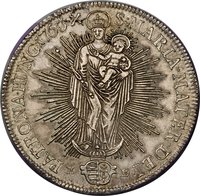
Description:
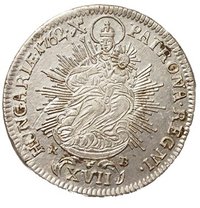
Madonna and child seated on crescent; value XVII below splits mintmark.
Inscription:
PATRONA . REGNI . HUNGARIAE . 1762 . X
(XVII)
N B
(XVII)
N B
Edge
Mints
| Name | Mark |
|---|---|
| Baia Mare | N B |
Mintings
| Year | Mint Mark | Mintage | Quality | Collection |
|---|---|---|---|---|
| 1751 | N | 49,000 | ||
| 1752 | N | 127,000 | ||
| 1753 | N | 251,000 | ||
| 1754 | N | 284,000 | ||
| 1755 | N | 204,000 | ||
| 1762 | N | 431,000 | ||
| 1763 | N | 587,000 | ||
| 1764 | N | 632,000 | ||
| 1765 | N | 538,000 |
Historical background
In 1751, the currency situation in the Kingdom of Hungary, then part of the Habsburg Monarchy, was characterized by a fragile and complex system struggling with instability. The primary currency was the silver guilder (or forint), but its value and circulation were undermined by a chronic shortage of precious metals. This shortage was exacerbated by Hungary's trade imbalance, which saw more silver flowing out to pay for imported goods than was coming in from its own exports, primarily agricultural products. Furthermore, the circulation was clogged with a multitude of older, debased coins and foreign currencies, creating confusion and hindering commerce.
The Habsburg state authority, the Hofkammer in Vienna, held a monopoly on minting and sought to standardize the monetary system across its realms. However, these efforts often clashed with local Hungarian economic realities and interests. A significant reform had been enacted just a few years prior, in 1747, with the aim of introducing stable, high-quality silver coins (the Conventionsmünze standard) to replace debased currency. By 1751, the process of implementing this reform was still ongoing, facing practical difficulties in withdrawing old coins from circulation and producing enough new ones to meet demand.
Consequently, the everyday monetary experience for most Hungarians in 1751 was one of uncertainty. Peasants and traders often had to deal in a mix of underweight domestic coins, older Turkish thalers, and even barter, especially in rural areas. This instability discouraged investment and complicated taxation, perpetuating economic challenges within the kingdom. Thus, the year represents a point within a longer, difficult transition toward a more unified and reliable monetary system under centralized Habsburg control, a goal not yet fully realized.
The Habsburg state authority, the Hofkammer in Vienna, held a monopoly on minting and sought to standardize the monetary system across its realms. However, these efforts often clashed with local Hungarian economic realities and interests. A significant reform had been enacted just a few years prior, in 1747, with the aim of introducing stable, high-quality silver coins (the Conventionsmünze standard) to replace debased currency. By 1751, the process of implementing this reform was still ongoing, facing practical difficulties in withdrawing old coins from circulation and producing enough new ones to meet demand.
Consequently, the everyday monetary experience for most Hungarians in 1751 was one of uncertainty. Peasants and traders often had to deal in a mix of underweight domestic coins, older Turkish thalers, and even barter, especially in rural areas. This instability discouraged investment and complicated taxation, perpetuating economic challenges within the kingdom. Thus, the year represents a point within a longer, difficult transition toward a more unified and reliable monetary system under centralized Habsburg control, a goal not yet fully realized.
Series: 1751 Hungary circulation coins

✨ Legendary