

6 Kreuzers – Hungary
Hungary

Obverse
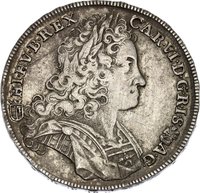
Description:
Laureate bust in a pearl circle, with surrounding inscription starting above. Face value (6) in a frame within the inscription.
Inscription:
CAROL · VI · D · G · R · I · S (VI)· A· G · HI · H · B · REX ·
Reverse
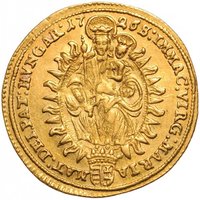
Description:
Radiant crowned Madonna in mandorla, seated on a crescent, holding child on left arm and scepter in right, breaking inner pearl circle. KB mintmark divided. Date ends inscription.
Inscription:
PATRONA · HVN GARIÆ · 1718
Edge
Plain
Mints
| Name | Mark |
|---|---|
| Kremnica | KB |
Mintings
| Year | Mint Mark | Mintage | Quality | Collection |
|---|---|---|---|---|
| 1718 | KB | — |
Historical background
In 1718, the currency situation in Hungary, then part of the Habsburg Monarchy, was one of profound instability and debasement, a direct legacy of the recent Rákóczi War of Independence (1703-1711) and the ongoing financial strains of the Habsburgs' broader European conflicts, notably the War of the Spanish Succession. The prolonged warfare had devastated the Hungarian economy, leading to severe shortages of precious metals and forcing both the princely government of Francis II Rákóczi and the Habsburg authorities in Vienna to issue vast quantities of low-value emergency coinage, primarily made from copper. By 1718, the monetary system was flooded with these debased coins, causing rampant inflation, a collapse in public trust, and a chaotic multiplicity of circulating currencies.
The primary unit of account was the Hungarian forint (gulden), but its physical representation was problematic. The silver forint coin was scarce, while the ubiquitous copper coins, like the poltura and denarius, circulated at rates far below their nominal value. Furthermore, older, higher-quality silver thalers from the German states and the Dutch Republic circulated alongside these, creating a complex and inefficient exchange environment. The Habsburg state treasury, desperate for revenue, continued to engage in monetary manipulation, periodically decreeing new exchange rates between the copper and silver coins, which often amounted to partial state bankruptcies that further eroded economic confidence.
This chaotic situation persisted into 1718 despite the peace established years earlier, as the Habsburg government's financial priorities were focused on its Mediterranean engagements following the 1718 Treaty of Passarowitz. A comprehensive monetary reform for Hungary was urgently needed but would not materialize until the 1750s and 1760s under Empress Maria Theresa. Therefore, in 1718, Hungary remained stuck with a dysfunctional, inflationary currency system that stifled trade, penalized savings, and reflected the kingdom's strained integration into the fiscally extractive Habsburg state structure in the aftermath of a devastating civil war.
The primary unit of account was the Hungarian forint (gulden), but its physical representation was problematic. The silver forint coin was scarce, while the ubiquitous copper coins, like the poltura and denarius, circulated at rates far below their nominal value. Furthermore, older, higher-quality silver thalers from the German states and the Dutch Republic circulated alongside these, creating a complex and inefficient exchange environment. The Habsburg state treasury, desperate for revenue, continued to engage in monetary manipulation, periodically decreeing new exchange rates between the copper and silver coins, which often amounted to partial state bankruptcies that further eroded economic confidence.
This chaotic situation persisted into 1718 despite the peace established years earlier, as the Habsburg government's financial priorities were focused on its Mediterranean engagements following the 1718 Treaty of Passarowitz. A comprehensive monetary reform for Hungary was urgently needed but would not materialize until the 1750s and 1760s under Empress Maria Theresa. Therefore, in 1718, Hungary remained stuck with a dysfunctional, inflationary currency system that stifled trade, penalized savings, and reflected the kingdom's strained integration into the fiscally extractive Habsburg state structure in the aftermath of a devastating civil war.
✨ Legendary