

1 Denier – Hungary
Hungary

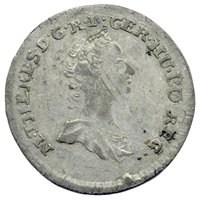
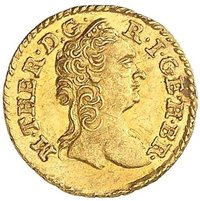
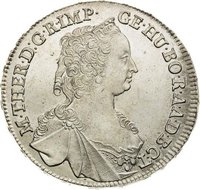
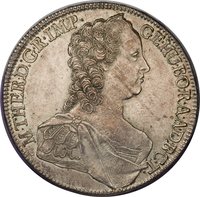
Obverse
Description:
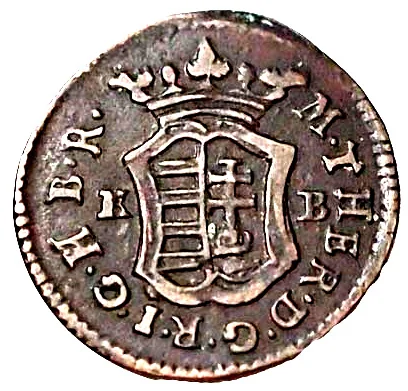
Curved double Hungarian shield under an open crown, separated by mintmark.
Inscription:
M · THER · D · G · R · I · G · H · B · R ·
Script: Latin
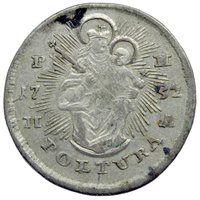
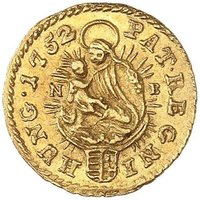
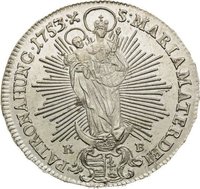
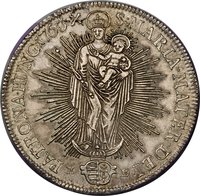
Reverse
Description:
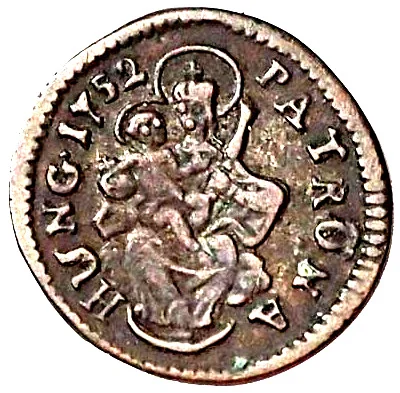
Madonna and Child on crescent, date in legend.
Inscription:
PATRONA · HUNG · 1752
Script: Latin
Edge
Plain
Mints
| Name | Mark |
|---|---|
| Kremnica | K B |
Mintings
| Year | Mint Mark | Mintage | Quality | Collection |
|---|---|---|---|---|
| 1752 | K | 456,000 | ||
| 1753 | K | — |
Historical background
In 1752, the currency situation in the Kingdom of Hungary, then part of the Habsburg Monarchy, was characterized by a fragile and complex dual system. The official currency was the Viennese silver guilder (Gulden or forint), but the economy still widely relied on the older Hungarian silver thaler (tallér) and its fractional coins. More critically, a vast amount of low-quality copper and billon (debased silver) coins, often from earlier wartime minting, flooded circulation. This created a severe imbalance, as the "good" silver coins were hoarded or used for foreign trade, while the "bad" debased coins were used for everyday transactions, leading to inflation and public distrust.
The root of this instability lay in the preceding decades of conflict, notably Rákóczi's War of Independence (1703-1711) and the ongoing military demands of the Habsburgs. To finance these efforts, the state had repeatedly resorted to debasement—reducing the precious metal content in coins—which eroded their intrinsic value. By 1752, the monetary system was in dire need of standardization and reform to facilitate commerce and stabilize the crown's finances. The Habsburg court in Vienna sought greater control over the monetary union across its lands, but practical enforcement in Hungary remained a challenge.
Consequently, 1752 fell within a period of transition and negotiation toward the major monetary reform that would be enacted by Empress Maria Theresa in 1754. This reform aimed to standardize the coinage across the Habsburg realms, firmly establishing the Conventionsthaler (Konvenciós tallér) as a stable silver standard and regulating the subsidiary coinage. Therefore, the situation in 1752 was one of lingering disorder from past policies, actively setting the stage for the imminent centralizing reforms that would define the Habsburg monetary system for the remainder of the century.
The root of this instability lay in the preceding decades of conflict, notably Rákóczi's War of Independence (1703-1711) and the ongoing military demands of the Habsburgs. To finance these efforts, the state had repeatedly resorted to debasement—reducing the precious metal content in coins—which eroded their intrinsic value. By 1752, the monetary system was in dire need of standardization and reform to facilitate commerce and stabilize the crown's finances. The Habsburg court in Vienna sought greater control over the monetary union across its lands, but practical enforcement in Hungary remained a challenge.
Consequently, 1752 fell within a period of transition and negotiation toward the major monetary reform that would be enacted by Empress Maria Theresa in 1754. This reform aimed to standardize the coinage across the Habsburg realms, firmly establishing the Conventionsthaler (Konvenciós tallér) as a stable silver standard and regulating the subsidiary coinage. Therefore, the situation in 1752 was one of lingering disorder from past policies, actively setting the stage for the imminent centralizing reforms that would define the Habsburg monetary system for the remainder of the century.
Series: 1752 Hungary circulation coins

✨ Legendary