

1 quattrino – Bologna
Add to wishlist
Italy
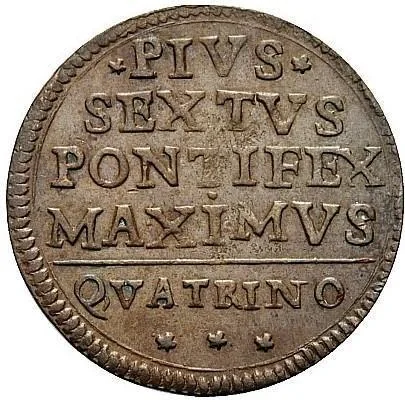
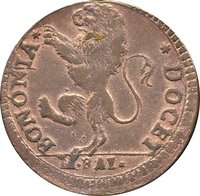
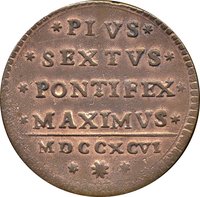
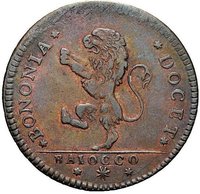
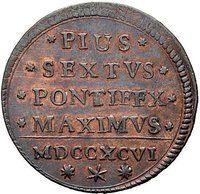
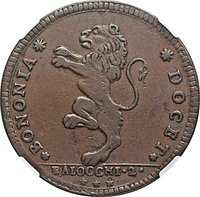
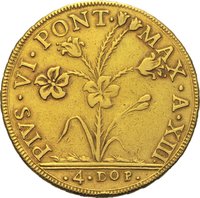
Obverse
Description:
Inscription above value and stars.
Inscription:
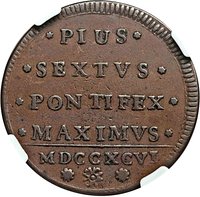
·PIVS·
SEXTVS
PONTIFEX
MAXIMVS
QVATRINO
SEXTVS
PONTIFEX
MAXIMVS
QVATRINO
Script: Latin
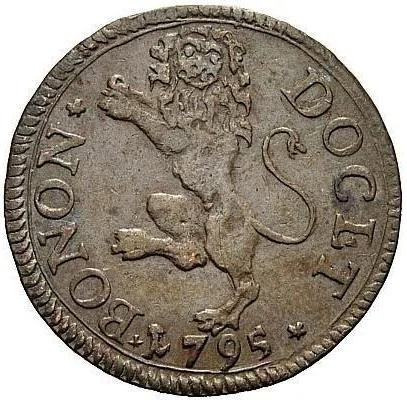
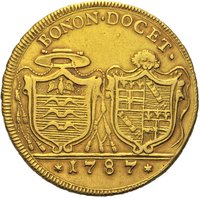
Reverse
Edge
Mints
| Name | Mark |
|---|---|
| Bologna | — |
Mintings
| Year | Mint Mark | Mintage | Quality | Collection |
|---|---|---|---|---|
| 1795 | — | — |
Historical background
In 1795, Bologna found itself in a complex monetary landscape, caught between its historical legacy and the seismic political shifts of the era. Officially, the city was part of the Papal States, and the official currency remained the Papal scudo, divided into 100 baiocchi. However, the economic reality was one of significant fragmentation. Centuries of trade and the city's former status as a major intellectual and commercial centre meant that a multitude of foreign coins, particularly the Tuscan fiorino and various northern Italian and Austrian issues, circulated freely alongside the papal coinage, leading to constant exchange rate fluctuations and merchant disputes.
This monetary confusion was exacerbated by the aftershocks of the French Revolutionary Wars, which were sweeping across Europe. While the French armies would not directly occupy Bologna until 1796, their influence was already being felt economically. The threat of invasion and the disruption of traditional trade routes created instability, leading to hoarding of precious metal coins. This, in turn, caused a scarcity of sound currency (specie), prompting increased reliance on depreciated billon (debased silver) coins and local token money for everyday transactions, further eroding public confidence in the monetary system.
Thus, the currency situation in 1795 was one of precarious transition. Bologna operated under a de jure papal system that was de facto multilayered and unstable, strained by both its own mercantile history and the impending political storm. The system was fragile, awaiting the imminent collapse that would come the following year with the arrival of French troops, the establishment of the Cispadane Republic, and the eventual introduction of revolutionary francs and new republican coinage, forcibly ending the old papal monetary order.
This monetary confusion was exacerbated by the aftershocks of the French Revolutionary Wars, which were sweeping across Europe. While the French armies would not directly occupy Bologna until 1796, their influence was already being felt economically. The threat of invasion and the disruption of traditional trade routes created instability, leading to hoarding of precious metal coins. This, in turn, caused a scarcity of sound currency (specie), prompting increased reliance on depreciated billon (debased silver) coins and local token money for everyday transactions, further eroding public confidence in the monetary system.
Thus, the currency situation in 1795 was one of precarious transition. Bologna operated under a de jure papal system that was de facto multilayered and unstable, strained by both its own mercantile history and the impending political storm. The system was fragile, awaiting the imminent collapse that would come the following year with the arrival of French troops, the establishment of the Cispadane Republic, and the eventual introduction of revolutionary francs and new republican coinage, forcibly ending the old papal monetary order.
Series: 1795 Bologna circulation coins
✨ Legendary