

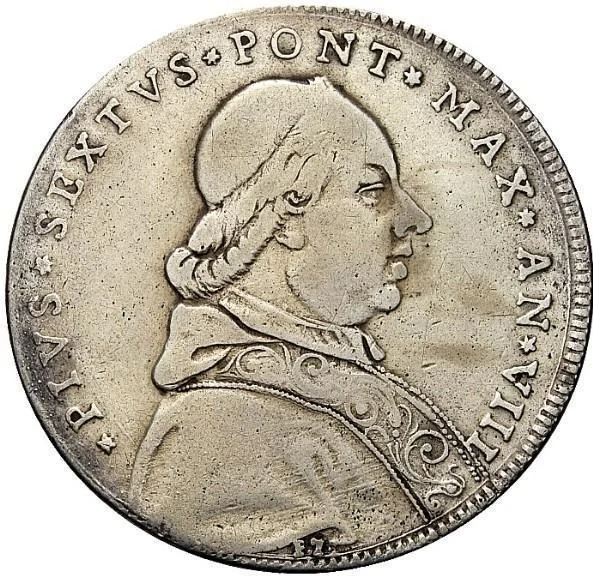

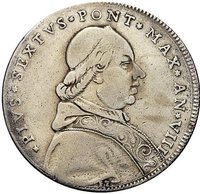
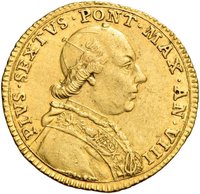
Obverse
Description:
Capped bust right, PT below.
Inscription:
· PIVS · SEXTVS · PONT · MAX · AN · VIII
Script: Latin
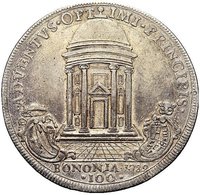
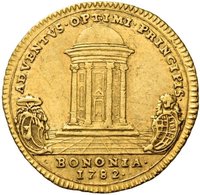
Reverse
Description:
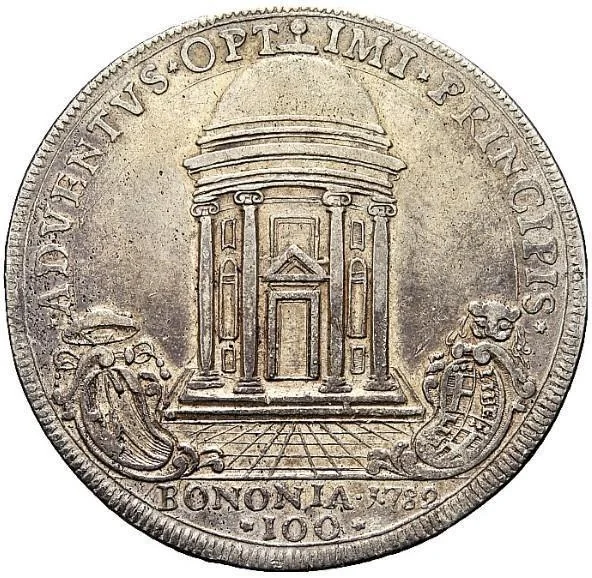
Temple between two shields, value beneath.
Inscription:
·ADVENTVS·OPT IMI·PRICIPIS·
BONONIA·1789
·100·
BONONIA·1789
·100·
Script: Latin
Edge
Embossed leaves
Categories
| Animal> Feline |
| Building> Religious building |
| Person> Monarch |
| Person> Religious figure |
| Object> Hat |
Mints
| Name | Mark |
|---|---|
| Bologna | — |
Mintings
| Year | Mint Mark | Mintage | Quality | Collection |
|---|---|---|---|---|
| 1782 | — | — |
Historical background
In 1782, Bologna operated under a complex monetary system characteristic of the Italian peninsula before unification, where political boundaries and economic zones did not align. The city was part of the Papal States, and the official currency was the Papal scudo, divided into 100 baiochi or 10 paoli. However, the practical reality was one of significant monetary pluralism. Due to Bologna's historic role as a major commercial and academic hub, a multitude of foreign coins circulated freely alongside papal issues, including Tuscan fiorini, Venetian ducats, Genoese lire, and various Austrian and French silver coins. This created a daily challenge for merchants and citizens, who had to be familiar with the fluctuating exchange rates and intrinsic silver or gold content of dozens of different coins.
The local economy also relied heavily on a system of "ghost money" or moneta di conto—the lira bolognese—which was not a physical coin but an abstract accounting unit used for pricing, bookkeeping, and contracts. Prices were often listed in lire, soldi, and denari (the £sd system), but actual payment could be made in a mix of physical scudi, paoli, and foreign specie. This required constant calculation to convert the moneta di conto into the actual metal value of the coins tendered, a task performed by money-changers (banchi di cambio) whose benches were a fixture in the city's bustling markets. The value of the lira bolognese against the papal scudo was fixed by municipal authority, but this official rate often strained against market pressures.
This fragmented system, while functional, was inefficient and prone to instability. Debasement of coins by various states, wear and tear on circulating specie, and arbitrage by money-changers could lead to localized inflation or shortages of sound money. For Bologna's population in 1782, from silk merchants to students, navigating this monetary landscape was a routine part of economic life, reflecting the city’s integration into broader European trade networks while remaining under the temporal authority of the Pope. It was a system awaiting the rationalizing force of 19th-century nationalism, which would eventually impose uniform currency across Italy.
The local economy also relied heavily on a system of "ghost money" or moneta di conto—the lira bolognese—which was not a physical coin but an abstract accounting unit used for pricing, bookkeeping, and contracts. Prices were often listed in lire, soldi, and denari (the £sd system), but actual payment could be made in a mix of physical scudi, paoli, and foreign specie. This required constant calculation to convert the moneta di conto into the actual metal value of the coins tendered, a task performed by money-changers (banchi di cambio) whose benches were a fixture in the city's bustling markets. The value of the lira bolognese against the papal scudo was fixed by municipal authority, but this official rate often strained against market pressures.
This fragmented system, while functional, was inefficient and prone to instability. Debasement of coins by various states, wear and tear on circulating specie, and arbitrage by money-changers could lead to localized inflation or shortages of sound money. For Bologna's population in 1782, from silk merchants to students, navigating this monetary landscape was a routine part of economic life, reflecting the city’s integration into broader European trade networks while remaining under the temporal authority of the Pope. It was a system awaiting the rationalizing force of 19th-century nationalism, which would eventually impose uniform currency across Italy.
✨ Legendary