

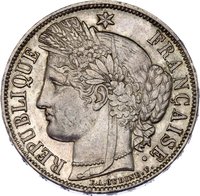
Obverse
Description:
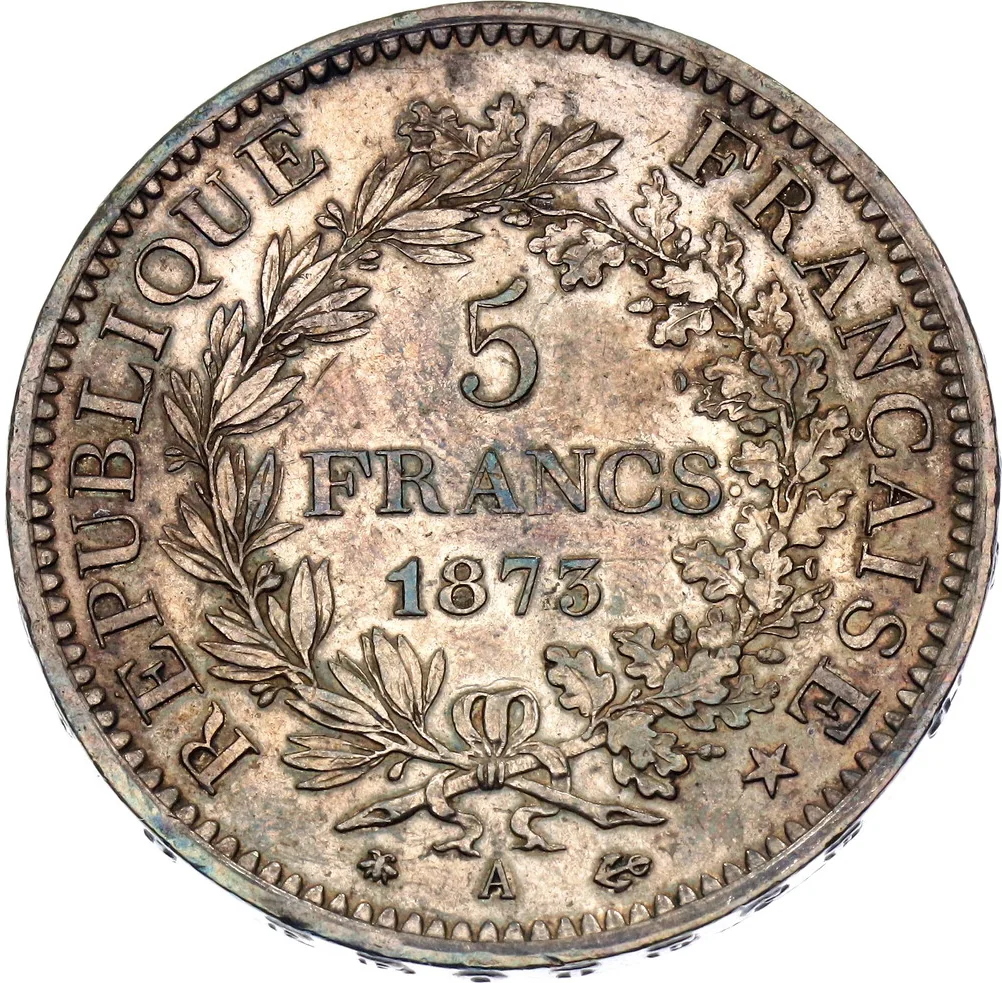
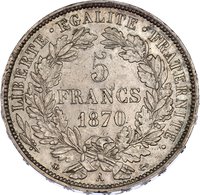
Denomination and date encircled by wreath.
Inscription:
RÉPUBLIQUE FRANÇAISE
5
FRANCS
1873
A
5
FRANCS
1873
A
Translation:
FRENCH REPUBLIC
5
FRANCS
1873
5
FRANCS
1873
Script: Latin
Language: French
Engraver: Augustin Dupré
Reverse
Description:
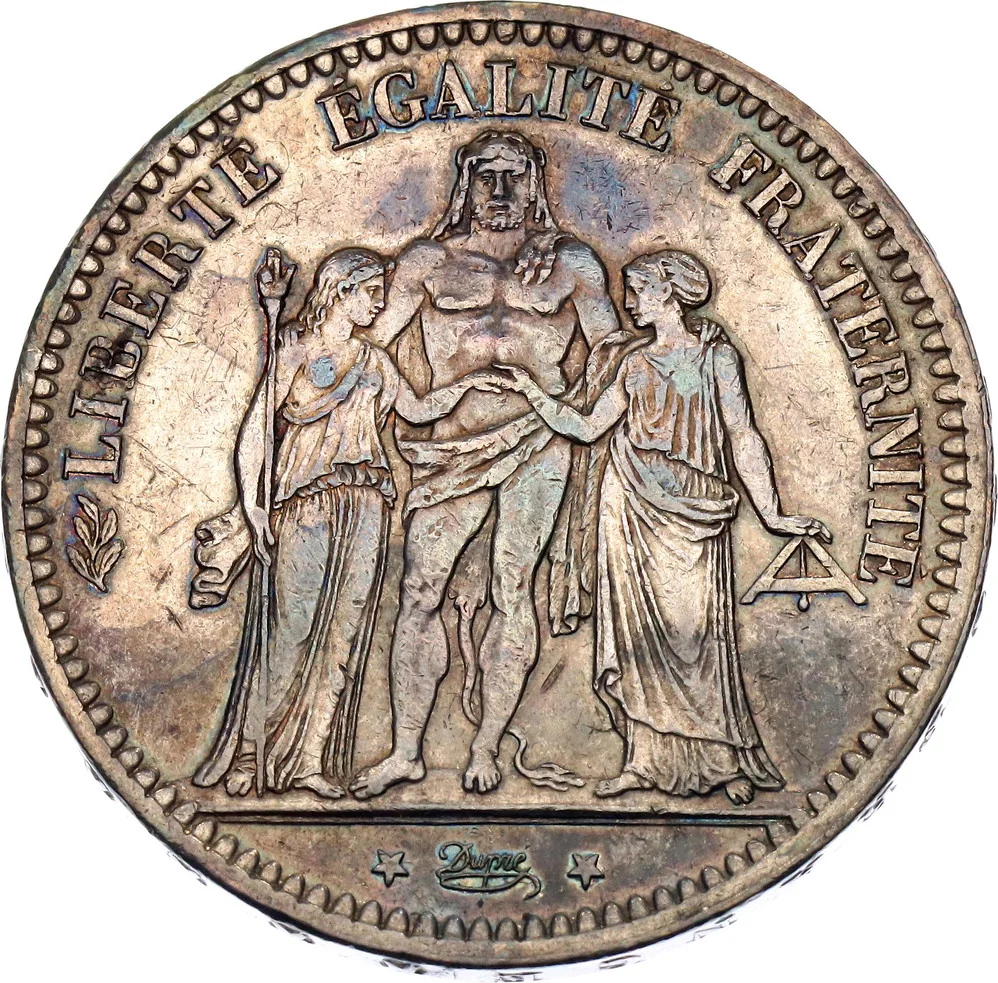
Hercules group, exergue below.
Inscription:
LIBERTÉ ÉGALITÉ FRATERNITÉ
Dupré
Dupré
Translation:
Liberty Equality Fraternity
Dupré
Dupré
Script: Latin
Language: French
Engraver: Augustin Dupré
Edge
Inscription in relief
Legend:
★ DIEU ★ PROTEGE ★ LA ★ FRANCE
Translation:
God protects France.
Language: French
Categories
| Mythology |
| Symbol> Phrygian cap |
| Symbol> Wreath |
Mints
| Name | Mark |
|---|---|
| Monnaie de Paris | A |
| Bordeaux | K |
Mintings
Historical background
In 1870, France operated under a bimetallic system, established by the Franc Germinal law of 1803. This system fixed the value of the franc to specific quantities of both gold and silver, creating a legal exchange ratio between the two metals. The franc was defined as 0.290322 grams of fine gold or 4.5 grams of fine silver, establishing a mint ratio of 15.5 to 1. This system aimed to provide monetary stability and facilitate international trade, and for decades it functioned effectively, making the franc a leading international currency.
However, the bimetallic system was under growing strain by the late 1860s. Major discoveries of silver in the Americas, combined with many European nations like Britain and the emerging German states moving towards a pure gold standard, led to a global oversupply and depreciation of silver. This caused the market value of silver to fall below its fixed legal ratio to gold in France, leading to Gresham's Law in practice: "bad money drives out good." Cheaper silver coins flooded circulation, while gold coins were hoarded or exported, threatening France's gold reserves.
The outbreak of the Franco-Prussian War in July 1870 triggered a full-blown crisis. To finance the war, the government suspended the convertibility of banknotes into specie (gold or silver) and granted the Bank of France the right to issue more paper currency. This move effectively ended the bimetallic standard in practice, placing France on a temporary, inflationary paper money regime. The subsequent defeat and the enormous war indemnity of five billion francs imposed by the new German Empire in 1871 would force a fundamental restructuring, ultimately leading France to formally abandon bimetallism and join the international gold standard in the latter part of the decade.
However, the bimetallic system was under growing strain by the late 1860s. Major discoveries of silver in the Americas, combined with many European nations like Britain and the emerging German states moving towards a pure gold standard, led to a global oversupply and depreciation of silver. This caused the market value of silver to fall below its fixed legal ratio to gold in France, leading to Gresham's Law in practice: "bad money drives out good." Cheaper silver coins flooded circulation, while gold coins were hoarded or exported, threatening France's gold reserves.
The outbreak of the Franco-Prussian War in July 1870 triggered a full-blown crisis. To finance the war, the government suspended the convertibility of banknotes into specie (gold or silver) and granted the Bank of France the right to issue more paper currency. This move effectively ended the bimetallic standard in practice, placing France on a temporary, inflationary paper money regime. The subsequent defeat and the enormous war indemnity of five billion francs imposed by the new German Empire in 1871 would force a fundamental restructuring, ultimately leading France to formally abandon bimetallism and join the international gold standard in the latter part of the decade.
Series: 1870 France circulation coins
🌱 Very Common