

¼ Thaler - ¼ Guldiner – Bishopric of Salzburg
Context
Material
References
KM: #Click to copy to clipboard305.1
Numista: #479592
Value
Bullion value: $20.48
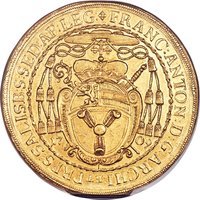
Obverse
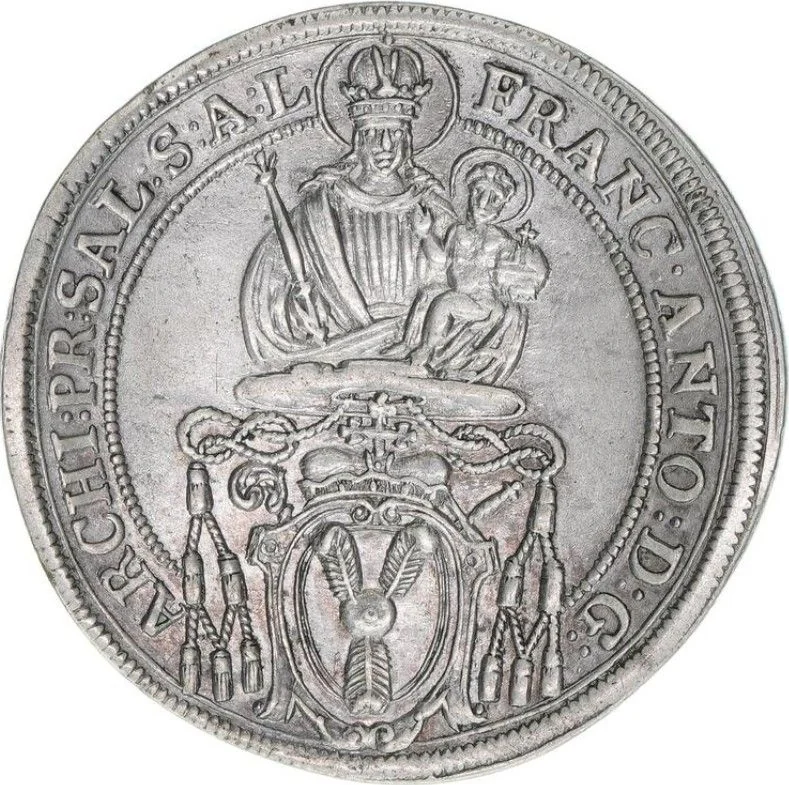
Description:
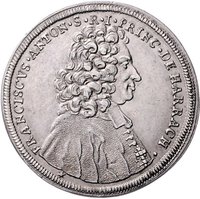
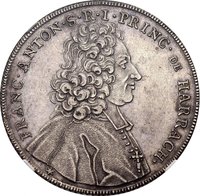
Madonna and Child over the bishop's coat of arms.
Inscription:
FRANC ANTO D G ARCH PR SAL S A L
SVB TVVM PRÆSIDIVM CONFVG
SVB TVVM PRÆSIDIVM CONFVG
Script: Latin
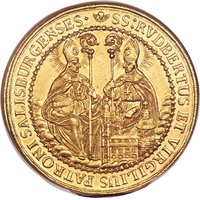
Reverse
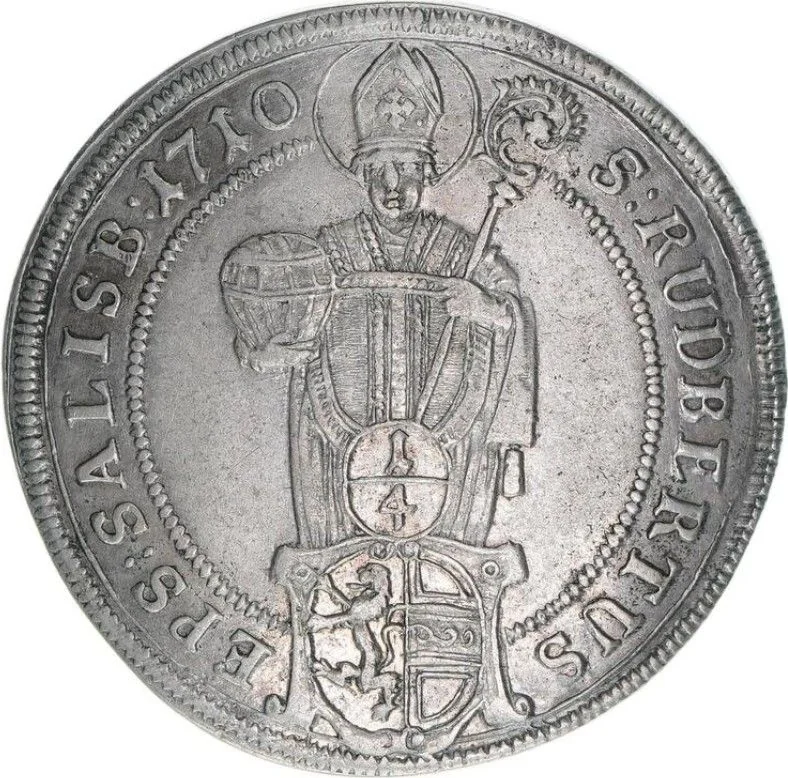
Description:
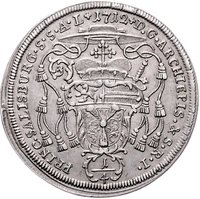
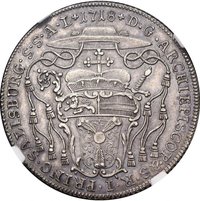
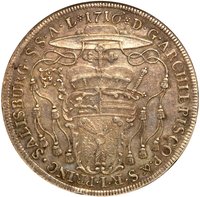
Saint Ruper, holding a crozier and salt box, overlooks Salzburg's coat of arms.
Inscription:
S RVDBERTVS EP SALISBVRG 1710
Script: Latin
Edge
Mintings
| Year | Mint Mark | Mintage | Quality | Collection |
|---|---|---|---|---|
| 1710 | — | — |
Historical background
In 1710, the Bishopric of Salzburg, a wealthy and independent ecclesiastical principality within the Holy Roman Empire, operated within a complex and fragmented monetary landscape. Like most German territories, it did not possess exclusive rights to mint its own coins; that privilege was held by the prince-archbishop, who issued currency in his capacity as a temporal ruler. The primary silver coin was the Salzburg Gulden, subdivided into 60 Kreuzer, but the circulation was dominated by a multitude of foreign coins. Trade, especially with the powerful Bavarian Wittelsbachs to the west and the Habsburg lands to the east, brought a flood of Reichsthalers, Bavarian and Austrian coins, and smaller regional currencies into daily use, leading to chronic confusion over exchange rates and metal values.
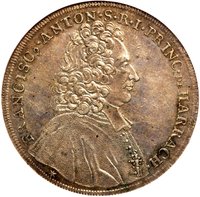
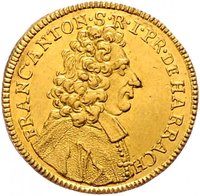
This period was one of significant monetary instability across Europe, exacerbated by the ongoing War of the Spanish Succession (1701-1714). The financial strains of war often led rulers, including Salzburg's Prince-Archbishop Franz Anton von Harrach, to engage in debasement—reducing the precious metal content in coins while maintaining their face value. This practice, aimed at generating short-term revenue to fund state expenses, eroded public trust in currency. Consequently, people hoarded older, purer coins (Gresham's Law), further complicating commerce and creating a disconnect between official mint prices and the actual market value of silver.
The situation demanded constant administrative attention. The Salzburg mint issued periodic mandates and valuation lists (Münzpatente) to fix exchange rates between the myriad circulating coins and the official Salzburg currency. These decrees attempted to stabilize the local economy, control inflation, and define which foreign coins were legal tender. However, their effectiveness was limited by the sheer volume of cross-border trade and the broader regional economic pressures. Thus, in 1710, a merchant or peasant in Salzburg navigated a daily economy defined by a jumble of coins of varying origins and intrinsic worth, under the anxious regulation of a princely government striving to maintain fiscal order in a turbulent time.
This period was one of significant monetary instability across Europe, exacerbated by the ongoing War of the Spanish Succession (1701-1714). The financial strains of war often led rulers, including Salzburg's Prince-Archbishop Franz Anton von Harrach, to engage in debasement—reducing the precious metal content in coins while maintaining their face value. This practice, aimed at generating short-term revenue to fund state expenses, eroded public trust in currency. Consequently, people hoarded older, purer coins (Gresham's Law), further complicating commerce and creating a disconnect between official mint prices and the actual market value of silver.
The situation demanded constant administrative attention. The Salzburg mint issued periodic mandates and valuation lists (Münzpatente) to fix exchange rates between the myriad circulating coins and the official Salzburg currency. These decrees attempted to stabilize the local economy, control inflation, and define which foreign coins were legal tender. However, their effectiveness was limited by the sheer volume of cross-border trade and the broader regional economic pressures. Thus, in 1710, a merchant or peasant in Salzburg navigated a daily economy defined by a jumble of coins of varying origins and intrinsic worth, under the anxious regulation of a princely government striving to maintain fiscal order in a turbulent time.
✨ Legendary