

5 Lire – San Marino
San Marino
Context
Year: 1980
Issuer: San Marino 
Period:
(since 301)
Currency:
(1864—2001)
Demonetization: 1 March 2002
Total mintage: 125,000
Material
References
KM: #Click to copy to clipboard104
Numista: #11866
Value
Exchange value: 5 SML
Obverse
Description:
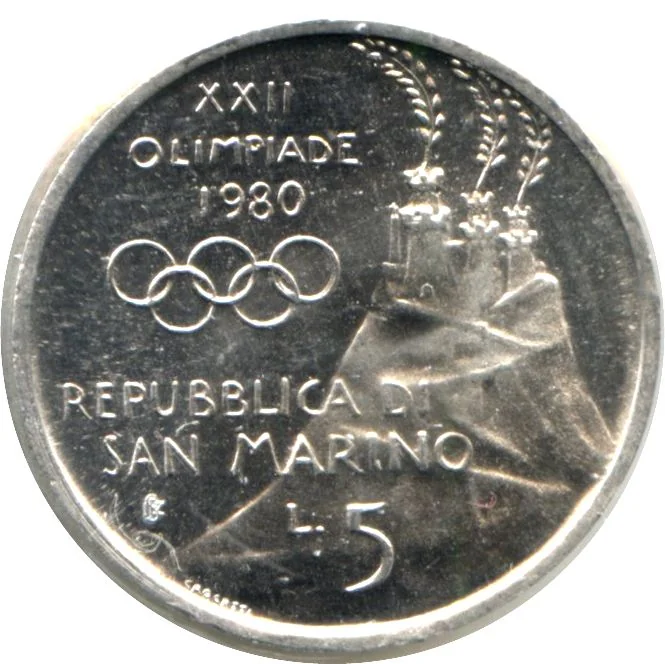
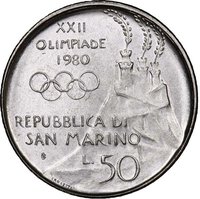
San Marino's coat of arms behind the inscription and Olympic logo.
Inscription:
XXII
OLIMPIADE
1980
REPUBBLICA DI
SAN MARINO
L. 5
OLIMPIADE
1980
REPUBBLICA DI
SAN MARINO
L. 5
Script: Latin
Engraver: Venanzo Crocetti
Reverse
Description:
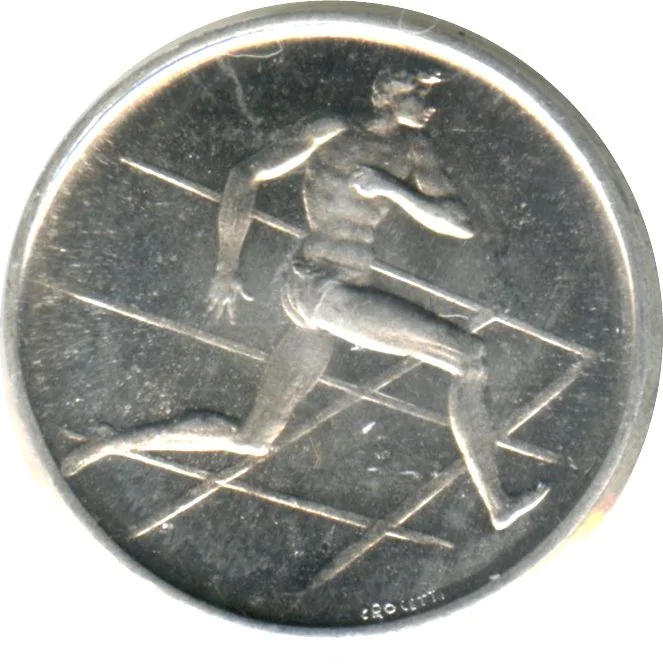
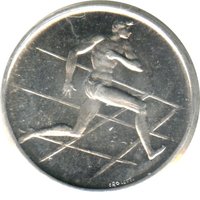
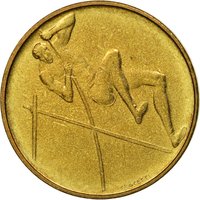
Runner finishing race.
Engraver: Venanzo Crocetti
Edge
Plain
Categories
| Sport> Summer Olympic Games |
| Sport> Athletics |
Mints
| Name | Mark |
|---|---|
| Rome | (IPZS) |
Mintings
| Year | Mint Mark | Mintage | Quality | Collection |
|---|---|---|---|---|
| 1980 | IPZS | 125,000 | In sets |
Historical background
In 1980, San Marino's currency situation was fundamentally defined by its close economic and monetary integration with Italy, governed by a series of bilateral treaties. The most important was the 1939 Convention, which established the Italian Lira as legal tender within the republic and granted San Marino limited rights to mint its own coinage. These Sammarinese lire were issued in low, commemorative denominations (such as 1, 2, 5, 10, 20, 50, 100, and 500 lire coins) and circulated interchangeably with Italian coins and banknotes, but they represented a tiny fraction of the money in actual use. The republic had no central bank and could not conduct independent monetary policy, effectively ceding control to the Banca d'Italia.
The year 1980 fell within a turbulent economic period for the Italian Lira, which directly impacted San Marino. Italy was experiencing high inflation, political instability, and lira volatility, pressures which were fully imported into the Sammarinese economy. While the local commemorative coins held numismatic value, the practical daily currency for commerce, banking, and government finance was the Italian Lira. This dependency meant San Marino had no monetary tools to insulate itself from Italy's "Years of Lead" economic challenges, though its small, agile economy and status as a tax haven provided some compensatory fiscal advantages.
Furthermore, the early 1980s marked the beginning of European monetary discussions that would eventually lead to the Euro, a process San Marino monitored closely due to its existential implications for the currency arrangement. While not an EU member, San Marino's fate was tied to Italy's, setting the stage for future negotiations to ensure its continued right to issue its own euros under a new agreement. Thus, the 1980 currency landscape was one of passive dependence on a struggling Italian Lira, with the republic's distinctive coinage serving more as a symbol of sovereignty than as a functional monetary instrument.
The year 1980 fell within a turbulent economic period for the Italian Lira, which directly impacted San Marino. Italy was experiencing high inflation, political instability, and lira volatility, pressures which were fully imported into the Sammarinese economy. While the local commemorative coins held numismatic value, the practical daily currency for commerce, banking, and government finance was the Italian Lira. This dependency meant San Marino had no monetary tools to insulate itself from Italy's "Years of Lead" economic challenges, though its small, agile economy and status as a tax haven provided some compensatory fiscal advantages.
Furthermore, the early 1980s marked the beginning of European monetary discussions that would eventually lead to the Euro, a process San Marino monitored closely due to its existential implications for the currency arrangement. While not an EU member, San Marino's fate was tied to Italy's, setting the stage for future negotiations to ensure its continued right to issue its own euros under a new agreement. Thus, the 1980 currency landscape was one of passive dependence on a struggling Italian Lira, with the republic's distinctive coinage serving more as a symbol of sovereignty than as a functional monetary instrument.
Series: 1980 Olympics
🌱 Common