

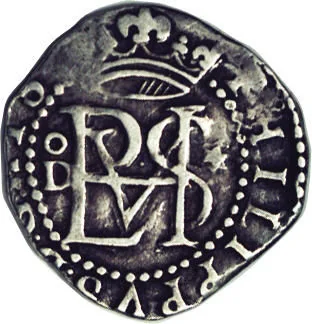
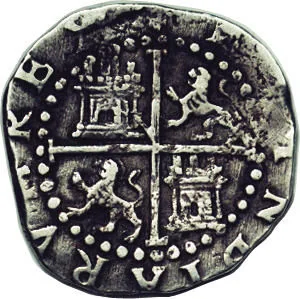
½ Real – Peru
Peru

Material
Weight: 1.69 g
Silver weight: 1.57 g
Shape: Irregular round
Composition: 93.1% Silver
Magnetic: No
Technique: Hammered
References
KM: #Click to copy to clipboard5
Numista: #47913
Value
Bullion value: $4.47
Obverse
Description:
Philipp II monogram with crown, assayer initial, and Lima star 🟌. (Mark positions may vary.)
Inscription:
PHILIPPVS D G HIS(PAN)
Script: Latin
Reverse
Description:
Spanish coat of arms with castles and lions, encircled by dots.
Inscription:
ET INDIARVM REX ✠
Script: Latin
Edge
Mintings
| Year | Mint Mark | Mintage | Quality | Collection |
|---|---|---|---|---|
| 1570 | — | — | ||
| 1571 | — | — | ||
| 1572 | — | — | ||
| 1573 | — | — | ||
| 1574 | — | — | ||
| 1575 | — | — | ||
| 1576 | — | — | ||
| 1577 | — | — |
Historical background
In 1570, Peru was in the midst of a profound monetary transformation under Spanish colonial rule. The primary currency in circulation was the silver real, with eight reales making a peso, often called the "piece of eight." However, the economy operated on a dual system: this official Spanish coinage coexisted with various indigenous mediums of exchange, including coca leaves, cloth, and shells, which remained vital for local and regional trade, especially in highland communities less integrated into the colonial cash economy. The cornerstone of the entire system was the silver from the Cerro Rico de Potosí (in modern Bolivia), discovered in 1545, which began flooding into the global economy and minting into coins at the newly established Lima mint (Casa de Moneda) in 1568.
This monetary landscape was directly shaped by the brutal mita system, a forced labor draft that supplied indigenous workers to the Potosí mines. The immense silver output, extracted at a horrific human cost, was the lifeblood of the Spanish Empire, financing its wars and administration while fueling trans-Pacific trade to Manila and the Atlantic fleets to Seville. Yet, within Peru itself, there was a chronic shortage of small-denomination coinage for everyday transactions, leading to the continued use of barter and cut or fragmented coins (recortes), and creating a persistent gap between the vast wealth being extracted and the difficult, inflationary reality of the local colonial economy.
Administratively, the Spanish Crown was actively trying to impose order and control. The establishment of the Lima mint was a key step to standardize coinage, combat fraud, and ensure the Crown received its royal fifth (quinto real) of all mined silver. By 1570, Viceroy Francisco de Toledo was implementing sweeping reforms to consolidate Spanish rule, which included tightening the mita system and further integrating the silver-based monetary economy. Thus, the currency situation was one of coercive integration, where Andean wealth was systematically converted into imperial currency, laying the foundation for Peru's role as a primary silver exporter for centuries, while its own internal economy remained uneven and strained.
This monetary landscape was directly shaped by the brutal mita system, a forced labor draft that supplied indigenous workers to the Potosí mines. The immense silver output, extracted at a horrific human cost, was the lifeblood of the Spanish Empire, financing its wars and administration while fueling trans-Pacific trade to Manila and the Atlantic fleets to Seville. Yet, within Peru itself, there was a chronic shortage of small-denomination coinage for everyday transactions, leading to the continued use of barter and cut or fragmented coins (recortes), and creating a persistent gap between the vast wealth being extracted and the difficult, inflationary reality of the local colonial economy.
Administratively, the Spanish Crown was actively trying to impose order and control. The establishment of the Lima mint was a key step to standardize coinage, combat fraud, and ensure the Crown received its royal fifth (quinto real) of all mined silver. By 1570, Viceroy Francisco de Toledo was implementing sweeping reforms to consolidate Spanish rule, which included tightening the mita system and further integrating the silver-based monetary economy. Thus, the currency situation was one of coercive integration, where Andean wealth was systematically converted into imperial currency, laying the foundation for Peru's role as a primary silver exporter for centuries, while its own internal economy remained uneven and strained.

✨ Legendary