Logo Title
Context
Year: 1625
Country: Austria Country flag
Currency:
Demonetized: Yes
Material
Diameter: 42 mm
Shape: Round
Composition: Silver
Magnetic: No
References
KM: #Click to copy to clipboard101
Numista: #478617

Obverse

Description:
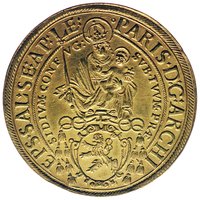
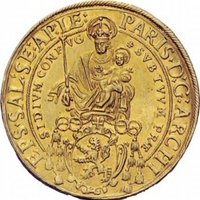
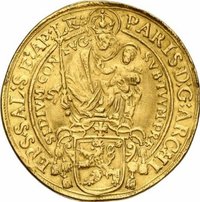
Madonna and Child above the archbishop's coat of arms.
Inscription:
⸰ PARIS · D : G: ARCHI EPS · SAL · SE : AP : LE :

SVB · TVVM PRÆ SIDIVM · CONF VG :
Script: Latin

Reverse

Description:
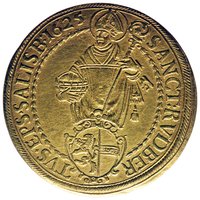
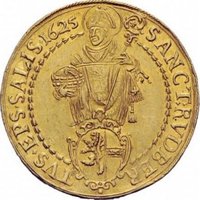
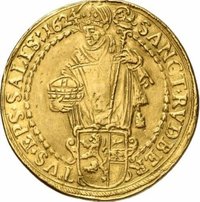
Saint Rupert holding a salt barrel and crozier, above the Salzburg arms.
Inscription:
SANCT : RVDBER TVS · EPS · SALISB : 1625
Script: Latin

Edge

Mintings

YearMint MarkMintageQualityCollection
1625

Historical background

In 1625, the Bishopric of Salzburg, a wealthy and independent ecclesiastical principality within the Holy Roman Empire, was navigating a period of significant monetary instability common across Central Europe. This was the height of the Kipper und Wipperzeit, a devastating period of currency debasement and inflation. Neighboring states, facing the immense financial pressures of the Thirty Years' War (1618-1648), were systematically reducing the silver content of their coinage to fund military campaigns, flooding the region with poor-quality money. As a major trading hub with control over lucrative salt mines, Salzburg was particularly vulnerable to this influx of debased coinage, which disrupted commerce and eroded trust in the monetary system.

Prince-Archbishop Paris von Lodron (r. 1619-1653), a skilled and pragmatic ruler, recognized the threat this posed to Salzburg's economic stability and sovereignty. In direct response, he pursued a policy of monetary conservatism. Rather than debasing Salzburg's currency to compete, he sought to maintain the high silver standard of his own coinage, most notably the Salzburg Thaler. His aim was to establish his coinage as a reliable and trusted Handelsmünze (trade coin) within the region, thereby protecting the bishopric's economy from the worst of the inflationary spiral and asserting its financial independence.

Consequently, the currency situation in Salzburg in 1625 was one of deliberate isolation and quality maintenance amidst regional chaos. While surrounding territories experienced rampant inflation and monetary confusion, von Lodron's administration worked to enforce strict minting standards. This policy served not only an economic purpose but also a political one, reinforcing Salzburg's de facto independence during the war and shielding its population, at least in part, from the full brunt of the continent-wide financial crisis. The stability of Salzburg's currency under von Lodron became a cornerstone of his successful strategy to keep the bishopric neutral, fortified, and prosperous while war raged around it.

Series: 1625 Bishopric of Salzburg circulation coins

4 Thalers obverse
4 Thalers reverse
4 Thalers
1625
8 Ducats obverse
8 Ducats reverse
8 Ducats
1625-1628
1 Ducat obverse
1 Ducat reverse
1 Ducat
1625-1638
6 Ducats obverse
6 Ducats reverse
6 Ducats
1625-1628
¼ Thaler - ¼ Guldiner obverse
¼ Thaler - ¼ Guldiner reverse
¼ Thaler - ¼ Guldiner
1625-1626
Legendary