

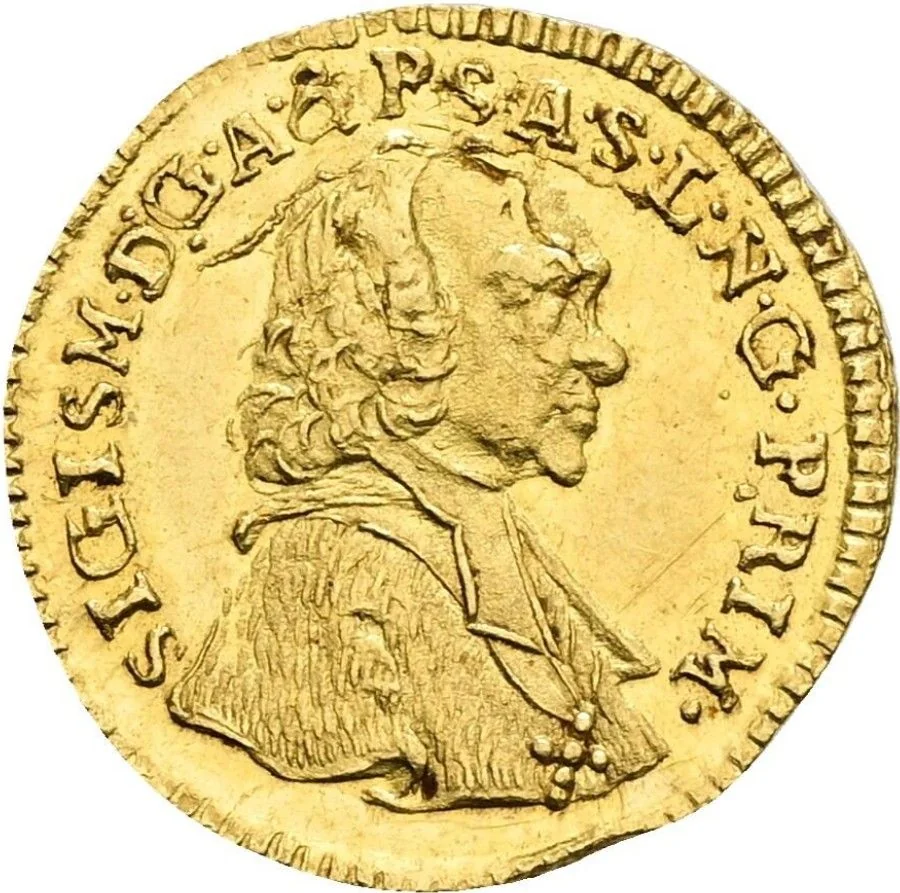

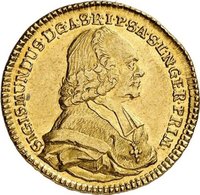
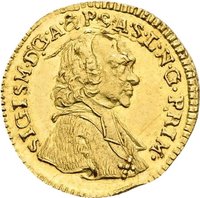
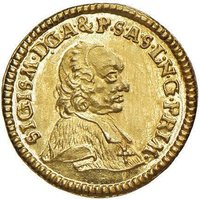
Obverse
Description:
Sigismund bust facing right.
Inscription:
SIGISM D G A & P S A S L N G PRIM
Script: Latin
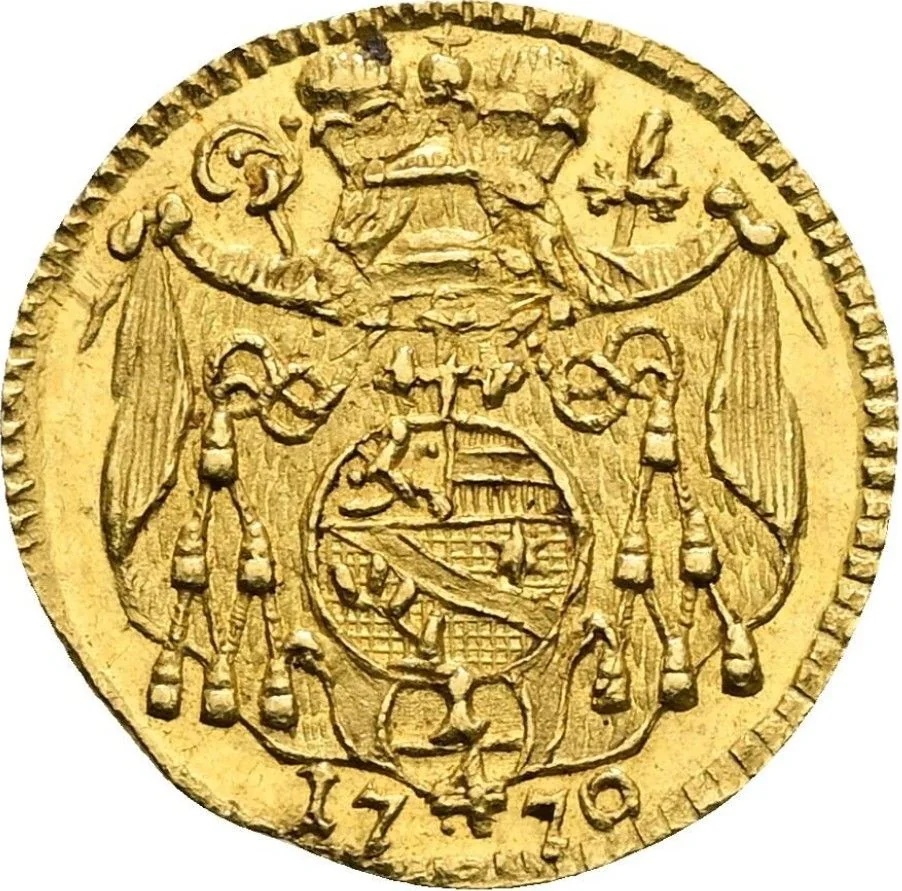
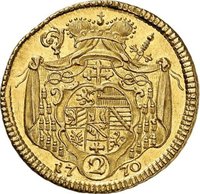
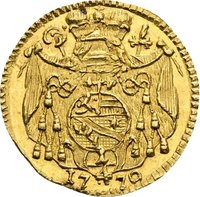
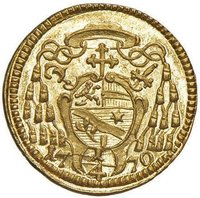
Reverse
Edge
Mintings
| Year | Mint Mark | Mintage | Quality | Collection |
|---|---|---|---|---|
| 1770 | — | — |
Historical background
In 1770, the currency situation within the Prince-Archbishopric of Salzburg was complex and fragmented, reflecting the broader monetary disarray of the Holy Roman Empire. The principality did not have a single, unified coinage system. Instead, its economy operated on a dual standard: the Conventionsgeld (Convention Money) for large silver coins and the Gulden system for accounting. Salzburg was a member of the Austrian-Bavarian Currency Convention of 1753, which established the Conventionsthaler as a large silver coin containing a defined amount of fine silver. This provided some stability for regional trade, with 1 Conventionsthaler being equal to 2 Gulden in account.
However, daily transactions were dominated by a bewildering variety of physical coins. Alongside Salzburg's own minted coins (like Kreuzers and Groschen), currencies from neighbouring states—especially Bavarian, Austrian, and even Tyrolean coins—circulated freely and were essential for commerce. The value of these coins was not always fixed, leading to constant calculations and exchange disputes. Furthermore, the small denomination coinage, vital for ordinary people, was often chronically debased, containing less precious metal than their face value implied, which fueled inflation and hardship among the lower classes.
This monetary mosaic created significant administrative challenges and economic inefficiency. Prince-Archbishop Hieronymus von Colloredo, who ascended to power in 1772, would later identify this chaos as a major obstacle to modernising the state. The situation in 1770 was thus one of precarious balance, reliant on an international treaty for high-value trade but mired in localised confusion, setting the stage for the sweeping financial and monetary reforms that Colloredo would implement in the subsequent decades.
However, daily transactions were dominated by a bewildering variety of physical coins. Alongside Salzburg's own minted coins (like Kreuzers and Groschen), currencies from neighbouring states—especially Bavarian, Austrian, and even Tyrolean coins—circulated freely and were essential for commerce. The value of these coins was not always fixed, leading to constant calculations and exchange disputes. Furthermore, the small denomination coinage, vital for ordinary people, was often chronically debased, containing less precious metal than their face value implied, which fueled inflation and hardship among the lower classes.
This monetary mosaic created significant administrative challenges and economic inefficiency. Prince-Archbishop Hieronymus von Colloredo, who ascended to power in 1772, would later identify this chaos as a major obstacle to modernising the state. The situation in 1770 was thus one of precarious balance, reliant on an international treaty for high-value trade but mired in localised confusion, setting the stage for the sweeping financial and monetary reforms that Colloredo would implement in the subsequent decades.
✨ Legendary