


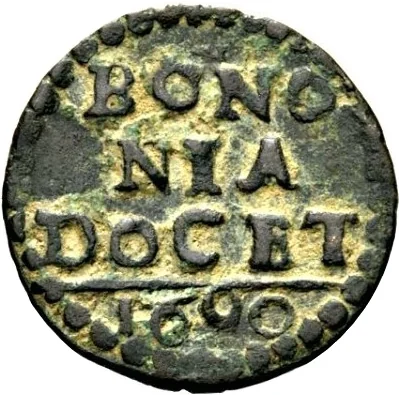
1 Quattrino – Bologna
Italy
Context
Year: 1690
Country: Italy 
Issuer: Bologna
Ruler: Alexander VIII
Currency:
(1534—1835)
Demonetized: Yes
Material

References
KM: #Click to copy to clipboard110
Numista: #46951
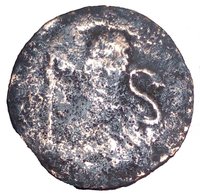
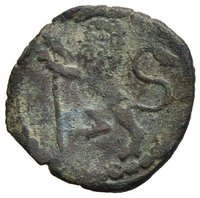
Obverse
Description:
Lion rampant holding banner.
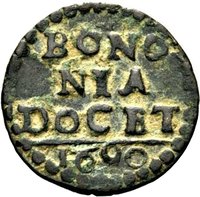
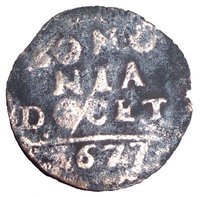
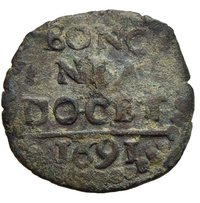
Reverse
Inscription:
BONO
NIA
DOCET
1690
NIA
DOCET
1690
Script: Latin
Edge
Plain
Mints
| Name | Mark |
|---|---|
| Bologna | — |
Mintings
| Year | Mint Mark | Mintage | Quality | Collection |
|---|---|---|---|---|
| 1690 | — | — |
Historical background
In 1690, Bologna operated within the complex monetary landscape of the Papal States, but with significant local particularities. Officially, the city used a bimetallic system based on the Papal scudo (gold) and the giulio (silver), with accounts often kept in the imaginary lira bolognese. However, the reality was one of profound disorder. The circulation was flooded with a bewildering variety of foreign coins—Spanish, Venetian, Florentine, and French—each with fluctuating intrinsic values. This proliferation, combined with the common practice of clipping and debasing coins, created chronic instability, making everyday commerce a matter of expert assessment and frequent dispute.
The local authorities, notably the Senato and the Zecca (mint), struggled to assert control. While papal edicts set official exchange rates, market forces and the poor state of many coins rendered these tariffs largely theoretical. The mint itself was often inactive during this period, unable to compete with the influx of foreign specie. This vacuum of reliable local currency encouraged the use of bollettini—credit notes or tokens issued by the city's Monte di Pietà (public pawnshop) and other institutions. These paper instruments, backed by the city's credit, became a crucial, if imperfect, lubricant for the local economy.
This monetary chaos had direct social and economic consequences. For artisans, shopkeepers, and laborers, the uncertainty eroded purchasing power and complicated simple transactions, often leading to exploitation. The instability also hindered larger commercial ventures and state finance, as tax revenues collected in debased coin created budgetary shortfalls. Thus, in 1690, Bologna's currency situation was not merely a financial technicality but a source of daily friction, economic inefficiency, and social tension, reflecting the broader challenges of a fragmented Italian peninsula before the age of monetary unification.
The local authorities, notably the Senato and the Zecca (mint), struggled to assert control. While papal edicts set official exchange rates, market forces and the poor state of many coins rendered these tariffs largely theoretical. The mint itself was often inactive during this period, unable to compete with the influx of foreign specie. This vacuum of reliable local currency encouraged the use of bollettini—credit notes or tokens issued by the city's Monte di Pietà (public pawnshop) and other institutions. These paper instruments, backed by the city's credit, became a crucial, if imperfect, lubricant for the local economy.
This monetary chaos had direct social and economic consequences. For artisans, shopkeepers, and laborers, the uncertainty eroded purchasing power and complicated simple transactions, often leading to exploitation. The instability also hindered larger commercial ventures and state finance, as tax revenues collected in debased coin created budgetary shortfalls. Thus, in 1690, Bologna's currency situation was not merely a financial technicality but a source of daily friction, economic inefficiency, and social tension, reflecting the broader challenges of a fragmented Italian peninsula before the age of monetary unification.
💎 Extremely Rare