

1 Quattrino – Papal States
Vatican City
Context
Year: 1640
Country: Vatican City 
Issuer: Papal States
Ruler: Urban VIII
Currency:
(1534—1835)
Demonetized: Yes
Material
Diameter: 20 mm
Weight: 3.25 g
Shape: Irregular round
Composition: Copper
Magnetic: No
Alignment: Medal alignment
flip
References
KM: #Click to copy to clipboard200 var
Numista: #463549
Obverse
Description:
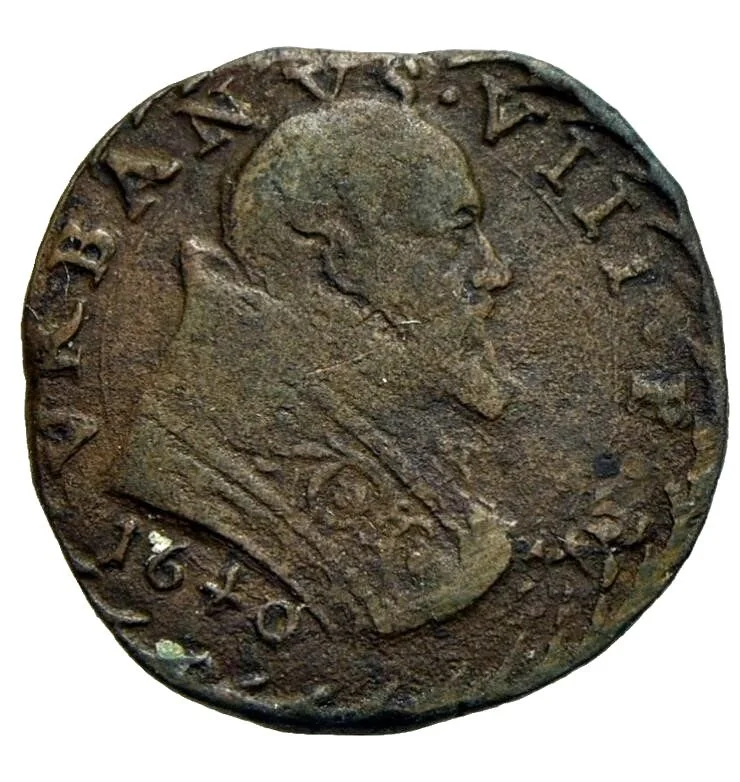
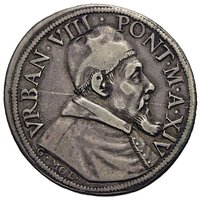
Bust right, date below, legend left.
Inscription:
VRBANVS · VIII · P · M ·
Script: Latin
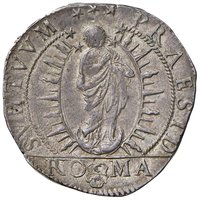
Reverse
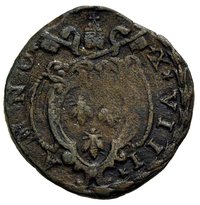
Description:
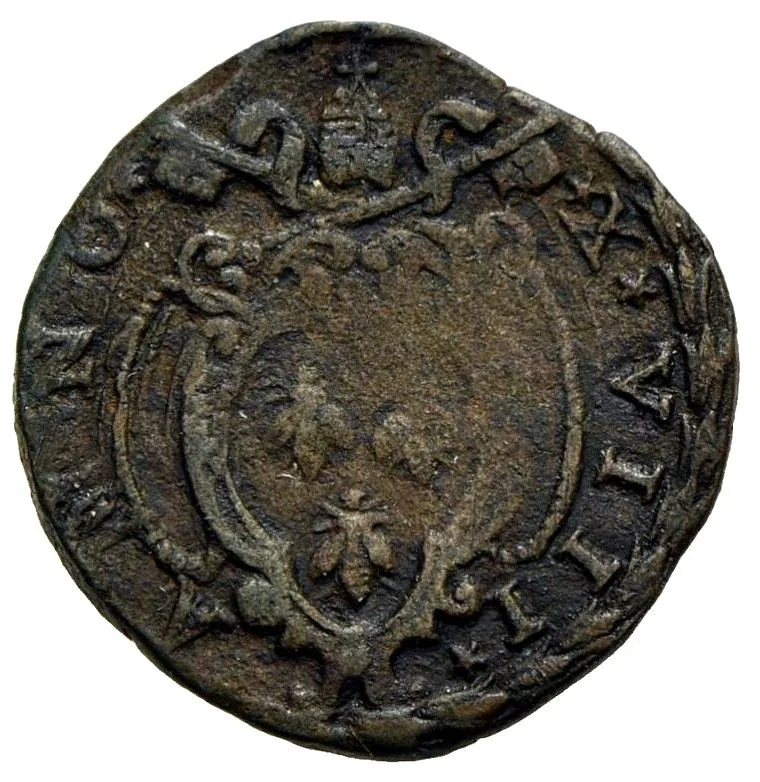
Papal arms with crossed keys; legend at left.
Inscription:
ANNO ⋆ X ⋆ VIII
Script: Latin
Edge
Categories
| Symbols> Coat of Arms |
Mints
| Name | Mark |
|---|---|
| Rome | — |
Mintings
| Year | Mint Mark | Mintage | Quality | Collection |
|---|---|---|---|---|
| 1640 | — | — |
Historical background
By 1640, the Papal States faced a complex and deteriorating currency situation, a legacy of prolonged fiscal strain. The primary unit was the scudo romano, a silver coin, but its value and purity were under constant pressure. Decades of deficit spending to fund monumental urban projects, maintain courtly splendour, and finance military engagements had emptied the papal treasury. Successive popes, unable to raise sufficient funds through taxes in the economically stagnant state, resorted to the debasement of coinage—reducing the silver content in minted coins—to create short-term liquidity. This practice, however, eroded public trust and triggered inflation, as prices adjusted to the weaker currency.
The problem was systemic and entangled with the Papal States' unique administration. Each new pope brought a different financial approach, often appointing relatives to key positions who sought quick profit, leading to inconsistent and sometimes predatory fiscal policies. Furthermore, the circulation was flooded with a multitude of foreign coins, particularly Spanish silver reales from the vast imports of American bullion, which circulated alongside various Italian state currencies. This heterogeneity made trade cumbersome and exchange rates volatile. The papal mint struggled to control this chaotic monetary environment, as the value of the scudo increasingly fluctuated against these foreign coins, disrupting both commerce and state finances.
Consequently, the 1640s represented a period of acute monetary dysfunction. The intrinsic value of papal coinage was often significantly lower than its face value, leading to Gresham’s Law in action: "bad money drives out good." Hoarders and merchants exported full-weight silver coins, leaving only the debased currency in common circulation, which further fueled price increases and hardship for the populace. While Pope Urban VIII (reigned 1623-1644) was a great patron of the arts, his expensive wars and nepotism exacerbated the fiscal crisis. Thus, the currency situation by 1640 was a clear symptom of a deeper malaise—a sovereign entity struggling to reconcile its spiritual prestige with the harsh economic realities of early modern statecraft.
The problem was systemic and entangled with the Papal States' unique administration. Each new pope brought a different financial approach, often appointing relatives to key positions who sought quick profit, leading to inconsistent and sometimes predatory fiscal policies. Furthermore, the circulation was flooded with a multitude of foreign coins, particularly Spanish silver reales from the vast imports of American bullion, which circulated alongside various Italian state currencies. This heterogeneity made trade cumbersome and exchange rates volatile. The papal mint struggled to control this chaotic monetary environment, as the value of the scudo increasingly fluctuated against these foreign coins, disrupting both commerce and state finances.
Consequently, the 1640s represented a period of acute monetary dysfunction. The intrinsic value of papal coinage was often significantly lower than its face value, leading to Gresham’s Law in action: "bad money drives out good." Hoarders and merchants exported full-weight silver coins, leaving only the debased currency in common circulation, which further fueled price increases and hardship for the populace. While Pope Urban VIII (reigned 1623-1644) was a great patron of the arts, his expensive wars and nepotism exacerbated the fiscal crisis. Thus, the currency situation by 1640 was a clear symptom of a deeper malaise—a sovereign entity struggling to reconcile its spiritual prestige with the harsh economic realities of early modern statecraft.
✨ Legendary