


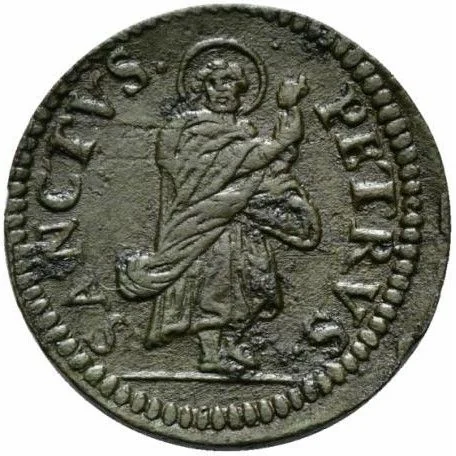
1 quattrino – Gubbio
Add to wishlist
Italy

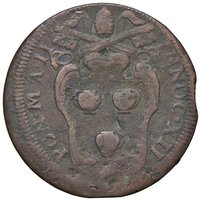
Obverse
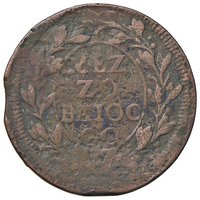
Reverse
Description:
Saint Peter standing, facing forward, right arm raised.
Inscription:
SANCTVS · PETRVS ·
Script: Latin
Edge
Plain
Categories
| Person> Religious figure |
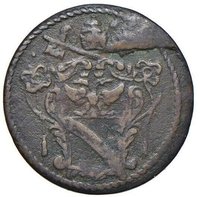
| Symbols> Coat of Arms |
Mints
| Name | Mark |
|---|---|
| Gubbio | — |
Mintings
| Year | Mint Mark | Mintage | Quality | Collection |
|---|---|---|---|---|
| — | — | — |
Historical background
In 1690, the Italian city-state of Gubbio, like much of the Papal States under which it fell, grappled with a complex and debased monetary system. The official currency was the Papal scudo, a silver coin, but its value and purity were increasingly unstable due to the financial pressures on the central treasury in Rome. More critically for daily life, a profusion of older, clipped, and worn coins from various Italian and foreign states circulated locally, creating confusion and frequent disputes over real value in the marketplace. This chaotic mix undermined trust in everyday transactions, as the face value of a coin rarely matched its intrinsic metal content.
The local economy, heavily reliant on wool textiles, pottery, and agriculture, suffered from this monetary uncertainty. Merchants and tradesmen were forced to become amateur assayers, weighing coins and judging their wear, which slowed commerce and invited fraud. Furthermore, the Papal government’s occasional attempts to recall and re-mint coinage often led to shortages of ready money, stifling economic activity. This environment created a stark divide: large transactions and external trade might be conducted using freshly minted scudi or even gold doppie, while the common people contended with a degraded bronze and billon coinage for their daily needs.
Ultimately, Gubbio’s currency situation was not unique but a local reflection of a broader European "crisis of small change." The city’s authorities had limited power to rectify the issue, as monetary policy was dictated by Rome. Therefore, the people of Gubbio in 1690 adapted through a persistent, informal system of barter for minor goods and a deep-seated skepticism toward coin, relying on community trust and traditional credit networks among guilds and families to keep the local economy functioning amidst the unreliable official currency.
The local economy, heavily reliant on wool textiles, pottery, and agriculture, suffered from this monetary uncertainty. Merchants and tradesmen were forced to become amateur assayers, weighing coins and judging their wear, which slowed commerce and invited fraud. Furthermore, the Papal government’s occasional attempts to recall and re-mint coinage often led to shortages of ready money, stifling economic activity. This environment created a stark divide: large transactions and external trade might be conducted using freshly minted scudi or even gold doppie, while the common people contended with a degraded bronze and billon coinage for their daily needs.
Ultimately, Gubbio’s currency situation was not unique but a local reflection of a broader European "crisis of small change." The city’s authorities had limited power to rectify the issue, as monetary policy was dictated by Rome. Therefore, the people of Gubbio in 1690 adapted through a persistent, informal system of barter for minor goods and a deep-seated skepticism toward coin, relying on community trust and traditional credit networks among guilds and families to keep the local economy functioning amidst the unreliable official currency.
✨ Legendary