

2 lire – San Marino
Add to wishlist
Non-circulating coins
Series: Peace
San Marino
Context
Year: 1973
Issuer: San Marino
Period:
(since 301)
Currency:
(1864—2001)
Demonetization: 1 March 2002
Total mintage: 291,000
Material
References
KM: #
Numista: #11843
Value
Exchange value: 2 SML
Obverse
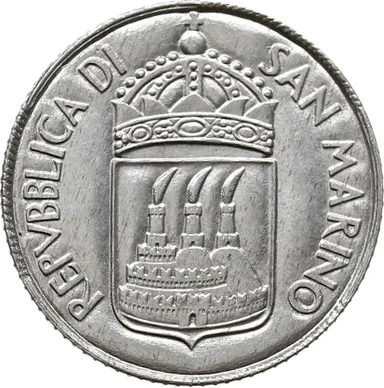
Description:
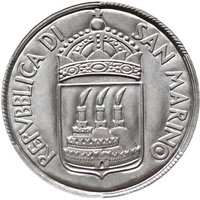
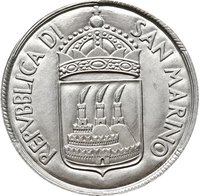
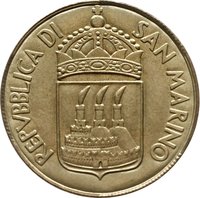
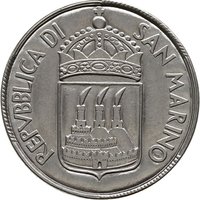
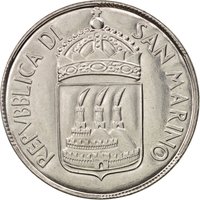
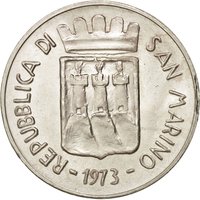
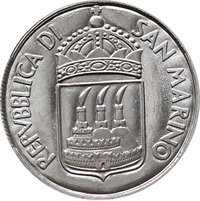
Shield with San Marino's coat of arms.
Inscription:
REPVBBLICA DI SAN MARINO
Translation:
Republic of San Marino
Script: Latin
Language: Italian
Engraver: Guido Veroi
Reverse
Edge
Reeded
Categories
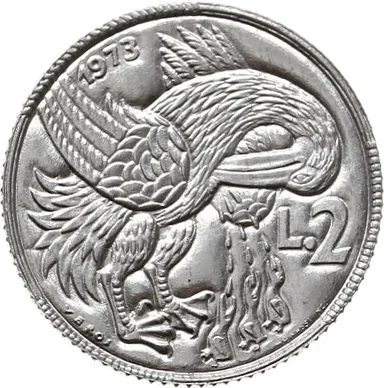
| Animal> Bird |
| Symbols> Coat of Arms |
Mints
| Name | Mark |
|---|---|
| Rome | — |
Mintings
| Year | Mint Mark | Mintage | Quality | Collection |
|---|---|---|---|---|
| 1973 | — | 291,000 | In sets |
Historical background
In 1973, San Marino's currency situation was intrinsically tied to its unique political and geographical relationship with Italy. As an enclave entirely surrounded by Italian territory, the Republic had long operated under a monetary convention with Italy, first formalized in 1897 and later updated. This agreement made the Italian Lira the official legal tender and day-to-day currency for all transactions within San Marino. While Sammarinese authorities had the right to mint their own limited-edition coinage, these "San Marino Lire" were primarily commemorative and intended for collectors, circulating only minimally alongside the dominant Italian currency.
Economically, this arrangement provided stability but came with a significant limitation: San Marino had no independent monetary policy. Its economy, heavily reliant on tourism, postage stamps, and light industry, was directly subject to the inflationary pressures and monetary decisions made by the Banca d'Italia. The early 1970s were a turbulent period globally, marked by the collapse of the Bretton Woods system and the 1973 oil shock, which triggered high inflation. San Marino, using the Lira, was swept along by Italy's own struggles with rising prices and economic instability during these years, without the tools to enact independent countermeasures.
Furthermore, the 1970s saw growing Sammarinese interest in greater economic self-determination. The existing monetary convention was under review, as the government sought a more formal and equitable arrangement that would grant it a share of seigniorage (profit from coinage) and greater autonomy in fiscal matters. This culminated in the 1979 Agreement, which eventually succeeded the older treaties. Therefore, 1973 represents a point within a transitional decade, where San Marino operated under an outdated monetary framework while actively negotiating for a revised system that would better acknowledge its sovereignty within the practical confines of its dependency on the Italian Lira.
Economically, this arrangement provided stability but came with a significant limitation: San Marino had no independent monetary policy. Its economy, heavily reliant on tourism, postage stamps, and light industry, was directly subject to the inflationary pressures and monetary decisions made by the Banca d'Italia. The early 1970s were a turbulent period globally, marked by the collapse of the Bretton Woods system and the 1973 oil shock, which triggered high inflation. San Marino, using the Lira, was swept along by Italy's own struggles with rising prices and economic instability during these years, without the tools to enact independent countermeasures.
Furthermore, the 1970s saw growing Sammarinese interest in greater economic self-determination. The existing monetary convention was under review, as the government sought a more formal and equitable arrangement that would grant it a share of seigniorage (profit from coinage) and greater autonomy in fiscal matters. This culminated in the 1979 Agreement, which eventually succeeded the older treaties. Therefore, 1973 represents a point within a transitional decade, where San Marino operated under an outdated monetary framework while actively negotiating for a revised system that would better acknowledge its sovereignty within the practical confines of its dependency on the Italian Lira.
Series: Peace
🌱 Common