

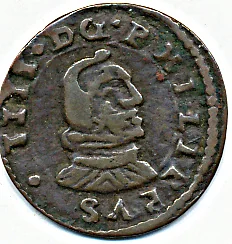
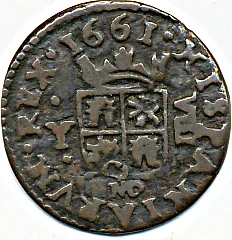
8 maravedis – Spain
Add to wishlist
Spain
Material
Diameter: 23 mm
Weight: 6.6 g
Thickness: 2 mm
Shape: Irregular round
Composition: Copper
Magnetic: No
Technique: Hammered
Alignment: Medal alignment
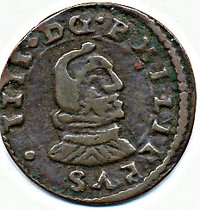
flip
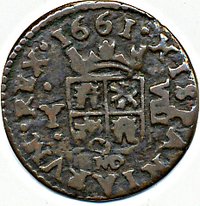
References
KM: #
Numista: #46040
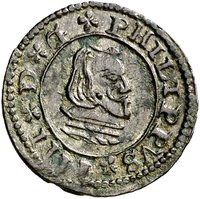
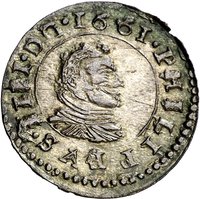
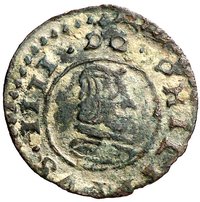
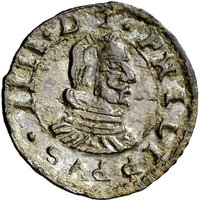
Obverse
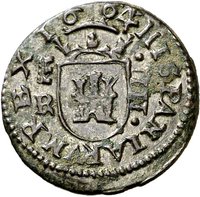
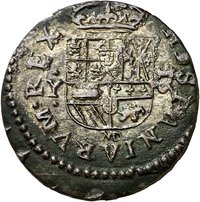
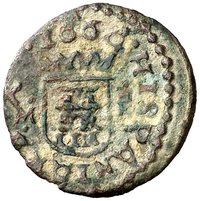
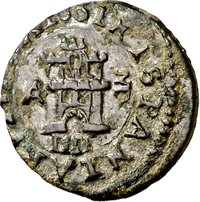
Reverse
Description:
Shield with crown between initial and value.
Inscription:
HISPANIARUM REX 1661
Y VIII
MD
Y VIII
MD
Script: Latin
Edge
Plain
Mints
| Name | Mark |
|---|---|
| Cuenca | — |
| Royal Mint of Burgos | — |
| Royal Mint of Granada | — |
| Royal Mint of Madrid | — |
Mintings
| Year | Mint Mark | Mintage | Quality | Collection |
|---|---|---|---|---|
| 1660 | B | — | ||
| 1660 | MDA | — | ||
| 1661 | C | — | ||
| 1661 | F | — | ||
| 1661 | GN | — | ||
| 1661 | M | — | ||
| 1661 | MDA | — | ||
| 1661 | MDY | — | ||
| 1662 | BR | — | ||
| 1662 | C | — | ||
| 1662 | GN | — | ||
| 1662 | MDA | — | ||
| 1662 | MDY | — | ||
| 1662 | MS | — | ||
| 1662 | MY | — | ||
| 1663 | MDY | — | ||
| 1663 | MS | — | ||
| 1663 | MY | — | ||
| 1663 | BR | — | ||
| 1663 | C | — | ||
| 1663 | GN | — | ||
| 1664 | BR | — | ||
| 1664 | C | — | ||
| 1664 | GN | — | ||
| 1664 | M | — | ||
| 1664 | MS | — | ||
| 1664 | MY | — |
Historical background
In 1660, Spain's currency system was in a state of profound crisis, a direct legacy of the "Price Revolution" and decades of fiscal mismanagement. The primary coin, the silver real, had been repeatedly debased by the Crown to finance its endless military commitments in the Thirty Years' War and conflicts with France. This created a chaotic monetary environment where older, purer coins (like the legendary piece of eight) were hoarded or exported, while newer, inferior coins circulated at artificially maintained values. The result was a severe shortage of sound money, rampant inflation, and a loss of public trust in the coinage, as the intrinsic metal value often fell far below the face value.
The situation was further complicated by the circulation of a vast quantity of vellón, a crude coinage of copper or billon (copper with a trace of silver). Originally intended as a fractional currency, successive governments, particularly under Philip IV and his minister Luis de Haro, had resorted to massive emissions of vellón to cover treasury shortfalls. By 1660, this flood of cheap currency had triggered hyperinflation for everyday goods, crippling the domestic economy and wages. Attempts to stabilize, such as the drastic deflationary decree of 1658 which slashed the nominal value of vellón, caused widespread social unrest and commercial paralysis without solving the underlying fiscal despair.
Ultimately, the monetary chaos of 1660 was a symptom of Spain's broader imperial decline. The influx of American silver, which had once powered its hegemony, was now in sharp decline and flowed directly out to pay foreign creditors and armies. The Crown's relentless borrowing and currency manipulations destroyed domestic credit and market confidence. Thus, Spain entered the 1660s financially exhausted, with a monetary system that undermined its economy, alienated its subjects, and left it increasingly dependent on foreign bankers, marking a stark contrast to the financial innovations taking hold in rival nations like the Dutch Republic.
The situation was further complicated by the circulation of a vast quantity of vellón, a crude coinage of copper or billon (copper with a trace of silver). Originally intended as a fractional currency, successive governments, particularly under Philip IV and his minister Luis de Haro, had resorted to massive emissions of vellón to cover treasury shortfalls. By 1660, this flood of cheap currency had triggered hyperinflation for everyday goods, crippling the domestic economy and wages. Attempts to stabilize, such as the drastic deflationary decree of 1658 which slashed the nominal value of vellón, caused widespread social unrest and commercial paralysis without solving the underlying fiscal despair.
Ultimately, the monetary chaos of 1660 was a symptom of Spain's broader imperial decline. The influx of American silver, which had once powered its hegemony, was now in sharp decline and flowed directly out to pay foreign creditors and armies. The Crown's relentless borrowing and currency manipulations destroyed domestic credit and market confidence. Thus, Spain entered the 1660s financially exhausted, with a monetary system that undermined its economy, alienated its subjects, and left it increasingly dependent on foreign bankers, marking a stark contrast to the financial innovations taking hold in rival nations like the Dutch Republic.
Series: 1660 Spain circulation coins
⭐ Somewhat Rare