

1 baiocco – Ancona
Add to wishlist
Italy
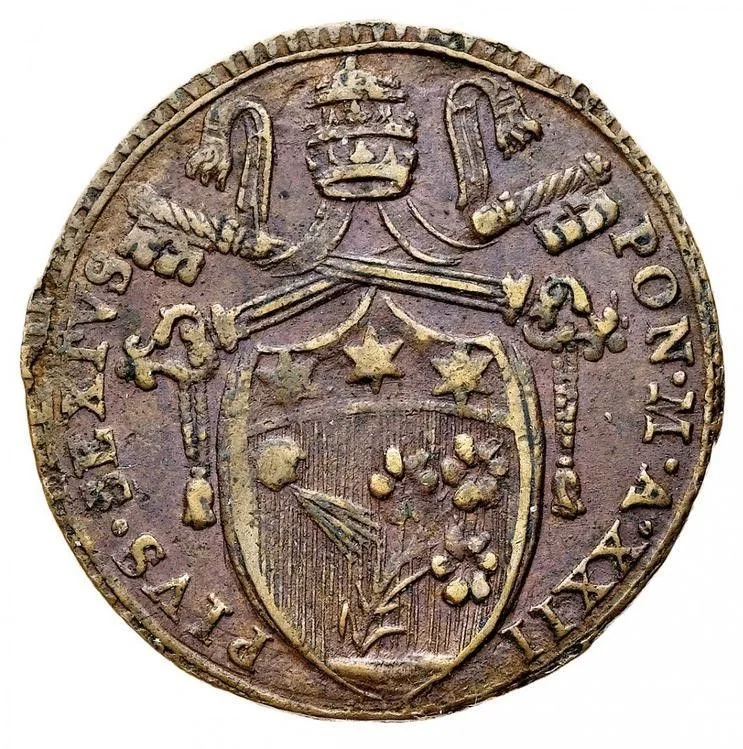
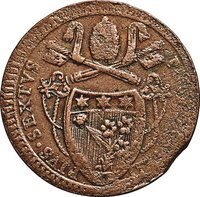
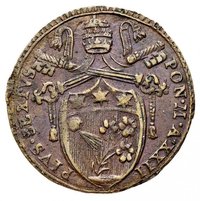
Obverse
Description:
Braschi arms under papal tiara and keys.
Inscription:
PIVS · SEXTVS PON · M · A · XXII
Script: Latin
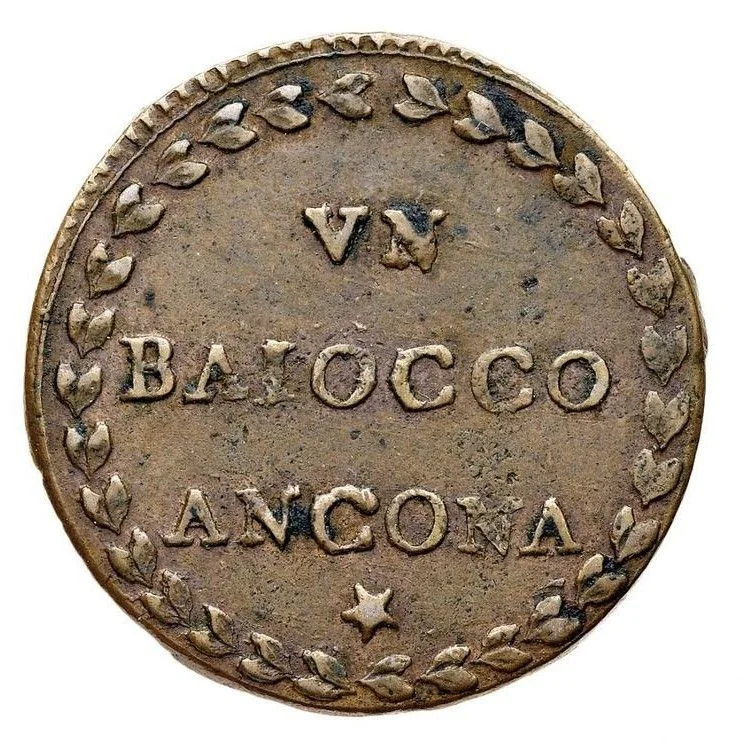
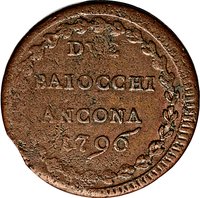
Reverse
Description:
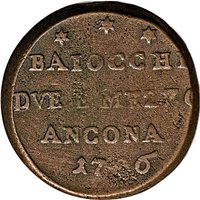
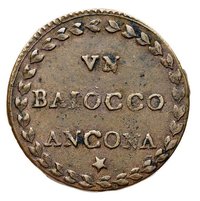
Star beneath three-line inscription within wreath.
Inscription:
VN
BAIOCCO
ANCONA
BAIOCCO
ANCONA
Script: Latin
Edge
Categories
| Symbols> Coat of Arms |
| Symbol> Wreath |
Mints
| Name | Mark |
|---|---|
| Ancona | — |
Mintings
| Year | Mint Mark | Mintage | Quality | Collection |
|---|---|---|---|---|
| 1796 | — | — |
Historical background
In 1796, Ancona found itself at a crucial geopolitical and economic crossroads. The city, a major port on the Adriatic Sea within the Papal States, was occupied by French Revolutionary forces under Napoleon Bonaparte in June of that year. This abrupt shift in power immediately destabilized the existing monetary system, which was based on the Papal scudo and its subsidiary coins. The French military administration, needing to fund its campaign, began imposing heavy war contributions and introduced their own currency, the French franc and assignats (paper money), into local circulation. This created a chaotic dual-currency environment where the value and acceptance of coins and notes were in constant flux, dictated by military decree and market distrust.
The situation was further complicated by Ancona's historic role as a commercial hub. Merchants were accustomed to a diverse array of coins from across the Mediterranean, including Venetian zecchini, Austrian thalers, and Turkish piastres. The French occupation disrupted this established trade, while their paper assignats, which were already suffering from inflation in France, met with deep skepticism from Ancona's populace and business community. Confidence in paper money was low, leading to widespread hoarding of precious metal coins, which in turn exacerbated currency scarcity and hindered daily transactions.
Consequently, the monetary landscape of Ancona in 1796 was one of profound uncertainty and coercion. The forced circulation of French currency alongside devalued and competing papal and foreign coins led to rapid inflation and severe hardship for the local population. This period marked the beginning of the end for the Papal States' monetary autonomy in the region, as Napoleon's forces used financial control as a tool of political subjugation, setting the stage for the eventual annexation of Ancona into the French-aligned Roman Republic in 1798.
The situation was further complicated by Ancona's historic role as a commercial hub. Merchants were accustomed to a diverse array of coins from across the Mediterranean, including Venetian zecchini, Austrian thalers, and Turkish piastres. The French occupation disrupted this established trade, while their paper assignats, which were already suffering from inflation in France, met with deep skepticism from Ancona's populace and business community. Confidence in paper money was low, leading to widespread hoarding of precious metal coins, which in turn exacerbated currency scarcity and hindered daily transactions.
Consequently, the monetary landscape of Ancona in 1796 was one of profound uncertainty and coercion. The forced circulation of French currency alongside devalued and competing papal and foreign coins led to rapid inflation and severe hardship for the local population. This period marked the beginning of the end for the Papal States' monetary autonomy in the region, as Napoleon's forces used financial control as a tool of political subjugation, setting the stage for the eventual annexation of Ancona into the French-aligned Roman Republic in 1798.
Series: 1796 Ancona circulation coins
✨ Legendary