

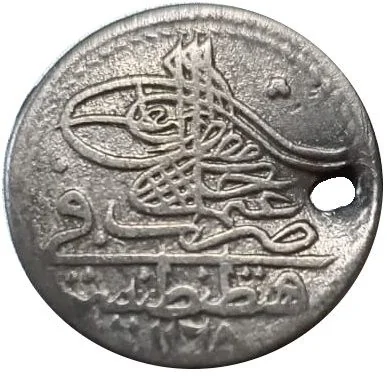
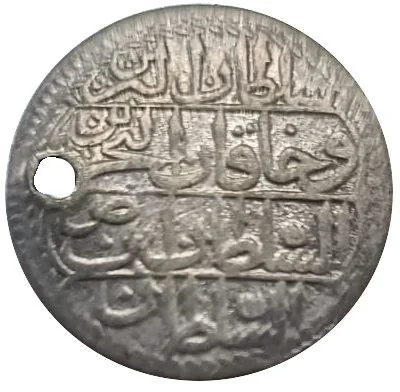
5 para – Ottoman Empire
Add to wishlist
Turkey
Context
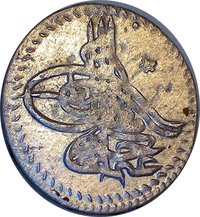
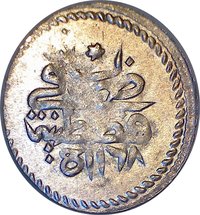
Year: 1755
Islamic (Hijri) Year:: 1168
Country: Turkey
Issuer: Ottoman Empire
Ruler: Osman III
Currency:
(1688—1844)
Demonetized: Yes
Material
References
KM: #
Numista: #459890
Mints
| Name | Mark |
|---|---|
| Constantinople | — |
Mintings
| Year | Mint Mark | Mintage | Quality | Collection |
|---|---|---|---|---|
| 1755 | — | — |
Historical background
In 1755, the Ottoman Empire’s currency system was in a state of prolonged crisis, characterized by chronic debasement and fiscal instability. The primary unit, the silver akçe, had been so severely degraded over the preceding century that it was practically defunct for large transactions. In its place, the silver kuruş (or piastre), introduced in the late 17th century, served as the main unit of account, but it too was subject to repeated devaluations. The state’s perennial budget shortfalls, driven by costly wars, a decentralized administrative structure, and inefficiencies in tax collection, were routinely addressed by reducing the silver content of coinage. This practice, known as tağşiş, provided immediate revenue but fueled inflation, eroded public trust, and disrupted both domestic trade and international commerce.
The monetary landscape was further complicated by the widespread circulation of a multitude of foreign coins, a testament to the Empire’s integration into global trade networks and its own monetary weakness. European silver coins, most notably the Spanish real (or "Spanish dollar") and the Dutch leeuwendaalder, circulated freely in major port cities like Istanbul, Izmir, and Aleppo. These foreign currencies, often seen as more reliable stores of value than the debased Ottoman issues, were essential for conducting foreign trade and large-scale transactions. This effectively created a dual system where the state’s finances were strained in devalued Ottoman currency, while the real economy of commerce increasingly relied on stable foreign specie.
Sultan Osman III, who ascended to the throne in 1754, inherited this entrenched financial dilemma. The year 1755 fell within a period of relative external peace, but the internal fiscal pressures remained acute. Attempts at reform were sporadic and largely ineffective against the powerful interests of provincial elites, janissary corps, and money changers (sarrafs) who benefited from the chaotic system. Consequently, the currency situation of 1755 was not an acute emergency but a symptomatic, ongoing malaise—a clear indicator of the Empire’s struggle to adapt its pre-modern fiscal structures to the demands of an evolving global economy, setting the stage for the more comprehensive but ultimately destabilizing reform attempts of the later 18th and 19th centuries.
The monetary landscape was further complicated by the widespread circulation of a multitude of foreign coins, a testament to the Empire’s integration into global trade networks and its own monetary weakness. European silver coins, most notably the Spanish real (or "Spanish dollar") and the Dutch leeuwendaalder, circulated freely in major port cities like Istanbul, Izmir, and Aleppo. These foreign currencies, often seen as more reliable stores of value than the debased Ottoman issues, were essential for conducting foreign trade and large-scale transactions. This effectively created a dual system where the state’s finances were strained in devalued Ottoman currency, while the real economy of commerce increasingly relied on stable foreign specie.
Sultan Osman III, who ascended to the throne in 1754, inherited this entrenched financial dilemma. The year 1755 fell within a period of relative external peace, but the internal fiscal pressures remained acute. Attempts at reform were sporadic and largely ineffective against the powerful interests of provincial elites, janissary corps, and money changers (sarrafs) who benefited from the chaotic system. Consequently, the currency situation of 1755 was not an acute emergency but a symptomatic, ongoing malaise—a clear indicator of the Empire’s struggle to adapt its pre-modern fiscal structures to the demands of an evolving global economy, setting the stage for the more comprehensive but ultimately destabilizing reform attempts of the later 18th and 19th centuries.
✨ Legendary