



5 Dollars – New Zealand
New Zealand
Context

Material


References
KM: #Click to copy to clipboard115a
Numista: #118410
Value
Exchange value: 5 NZD = $3.00
Bullion value: $79.52
Inflation-adjusted value: 8.62 NZD
Obverse
Description:
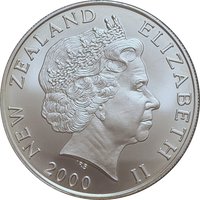
Queen Elizabeth II facing right in tiara, legend around, date below.
Inscription:
NEW ZEALAND
ELIZABETH II
IRB
1999
ELIZABETH II
IRB
1999
Script: Latin
Designer: Ian Rank-Broadley
Reverse
Description:
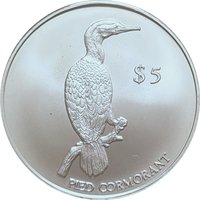
Morepork on branch with crescent moon. Legend above and below.
Inscription:
FIVE DOLLARS
MOREPORK
MOREPORK
Script: Latin
Designer: Michael McHalick
Edge
Reeded
Mints
| Name | Mark |
|---|---|
| Royal Mint | — |
Mintings
| Year | Mint Mark | Mintage | Quality | Collection |
|---|---|---|---|---|
| 1999 | — | 3,600 | Proof |
Historical background
In 1999, New Zealand's currency situation was characterised by a period of significant volatility and weakness for the New Zealand Dollar (NZD), driven by a combination of domestic economic fragility and external market turbulence. The NZD, which had been floated in 1985, was trading near historic lows, falling below 50 US cents for the first time in early 1999 and remaining under sustained pressure throughout the year. This depreciation was primarily fueled by a stark contrast in economic performance with key trading partners; while the United States and Australia were experiencing strong growth, New Zealand had entered a technical recession in 1998 and was recovering only slowly, leading to a wide interest rate differential that discouraged foreign investment.
The underlying economic conditions contributing to the currency's weakness included a substantial and persistent current account deficit, which ballooned to over 6% of GDP. This deficit reflected a structural imbalance where the nation's imports and overseas debt servicing costs far exceeded its export earnings. Furthermore, global financial instability, notably the 1997-98 Asian Financial Crisis, had severely impacted important export markets in Asia, reducing demand for New Zealand's commodity exports. The Reserve Bank of New Zealand (RBNZ), operating under its pioneering inflation-targeting framework established in 1989, maintained a relatively tight monetary policy to control inflation, but this did little to support the currency amidst the broader negative sentiment.
Politically, the currency's performance became a focal point in the lead-up to the November 1999 general election, with the opposition Labour Party criticising the incumbent National Party government for economic mismanagement. The weak NZD was a double-edged sword: it boosted returns for exporters in NZD terms, aiding the vital agricultural sector, but it also increased the cost of imports and overseas debt, contributing to domestic inflationary pressures. This precarious position set the stage for a major policy shift following the election of a new Labour-led government, which would soon move to reform the RBNZ Act and introduce a more proactive approach to monetary and fiscal policy.
The underlying economic conditions contributing to the currency's weakness included a substantial and persistent current account deficit, which ballooned to over 6% of GDP. This deficit reflected a structural imbalance where the nation's imports and overseas debt servicing costs far exceeded its export earnings. Furthermore, global financial instability, notably the 1997-98 Asian Financial Crisis, had severely impacted important export markets in Asia, reducing demand for New Zealand's commodity exports. The Reserve Bank of New Zealand (RBNZ), operating under its pioneering inflation-targeting framework established in 1989, maintained a relatively tight monetary policy to control inflation, but this did little to support the currency amidst the broader negative sentiment.
Politically, the currency's performance became a focal point in the lead-up to the November 1999 general election, with the opposition Labour Party criticising the incumbent National Party government for economic mismanagement. The weak NZD was a double-edged sword: it boosted returns for exporters in NZD terms, aiding the vital agricultural sector, but it also increased the cost of imports and overseas debt, contributing to domestic inflationary pressures. This precarious position set the stage for a major policy shift following the election of a new Labour-led government, which would soon move to reform the RBNZ Act and introduce a more proactive approach to monetary and fiscal policy.
Series: Native Birds Series












💎 Extremely Rare