

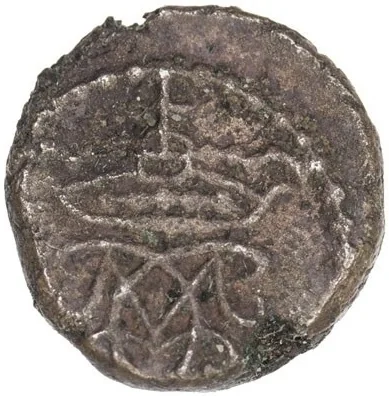
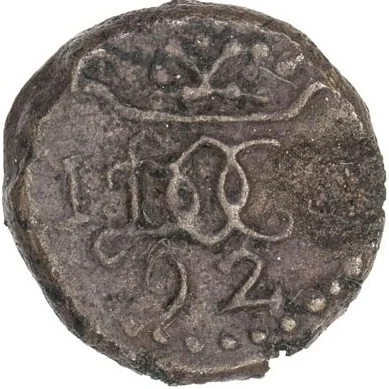
1 cash – Danish India
Add to wishlist
India
Context
Years: 1692–1697
Country: India
Issuer: Danish India
Ruler: Christian V
Currency:
(1730—1818)
Demonetized: Yes
Material
References
KM: #
Numista: #45723
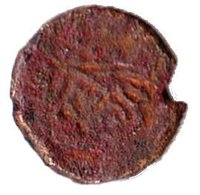
Obverse
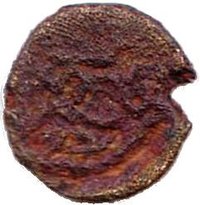
Reverse
Edge
Plain
Mintings
| Year | Mint Mark | Mintage | Quality | Collection |
|---|---|---|---|---|
| 1692 | — | — | ||
| 1694 | — | — | ||
| 1697 | — | — |
Historical background
In 1692, the currency situation in Danish India, centered on the small but strategic trading enclave of Tranquebar (Tharangambadi) on the Coromandel Coast, was complex and multifaceted. The Danish East India Company, operating with limited capital and influence compared to its powerful Dutch and English rivals, did not possess a dominant, standardized coinage. Instead, the local economy functioned on a pluralistic monetary system where a variety of coins circulated simultaneously. These included imported European currencies like Dutch leeuwendaalders (lion dollars) and Spanish silver reales, but more crucially, a wide array of Indian coins minted by neighboring regional powers, particularly the Mughal Empire and the Nawab of Arcot.
The primary challenge for Danish administrators was the constant fluctuation in the value and purity of these myriad coins, which complicated trade and tax collection. To bring order, the Danish company engaged in the practice of "stamping" or "countermarking." They would acquire foreign coins, especially the ubiquitous Mughal silver rupees, and impress them with a special mark, often the royal Danish cipher or the Company's monogram. This stamp certified the coin's weight and fineness, thereby converting it into a sanctioned medium of exchange for local transactions and payments to the Danish colony. This system was a pragmatic adaptation, avoiding the cost and effort of minting original coins while attempting to assert a degree of monetary control.
Consequently, the monetary landscape in Tranquebar in 1692 was one of negotiated authority and practical compromise. While the Danish crown claimed the right of minting, the reality was a hybrid economy reliant on overstruck foreign specie. This arrangement facilitated the colony's core business of procuring Indian textiles and spices for export, but it also left the settlement vulnerable to shifts in regional coinage supplies and the monetary policies of much larger indigenous states, underscoring the limited and dependent nature of European colonial outposts in this period.
The primary challenge for Danish administrators was the constant fluctuation in the value and purity of these myriad coins, which complicated trade and tax collection. To bring order, the Danish company engaged in the practice of "stamping" or "countermarking." They would acquire foreign coins, especially the ubiquitous Mughal silver rupees, and impress them with a special mark, often the royal Danish cipher or the Company's monogram. This stamp certified the coin's weight and fineness, thereby converting it into a sanctioned medium of exchange for local transactions and payments to the Danish colony. This system was a pragmatic adaptation, avoiding the cost and effort of minting original coins while attempting to assert a degree of monetary control.
Consequently, the monetary landscape in Tranquebar in 1692 was one of negotiated authority and practical compromise. While the Danish crown claimed the right of minting, the reality was a hybrid economy reliant on overstruck foreign specie. This arrangement facilitated the colony's core business of procuring Indian textiles and spices for export, but it also left the settlement vulnerable to shifts in regional coinage supplies and the monetary policies of much larger indigenous states, underscoring the limited and dependent nature of European colonial outposts in this period.
💎 Very Rare