

6 Mariengroschen – Brunswick-Lüneburg-Calenberg-Hannover
Germany

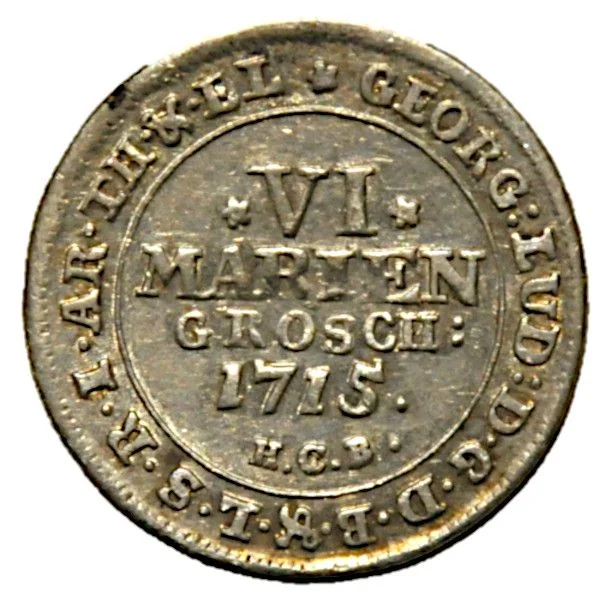
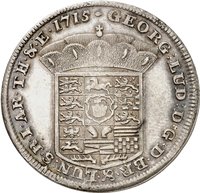
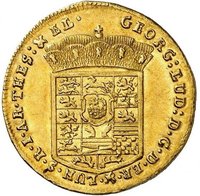
Obverse
Description:
Denomination and date in circle, legend around.
Inscription:
* GEORG:LUD:D.G.D.B.&.L.S.R.I.AR.TH.&.EL
*VI*
MARIEN
GROSCH:
1715.
H.C.B.
*VI*
MARIEN
GROSCH:
1715.
H.C.B.
Script: Latin
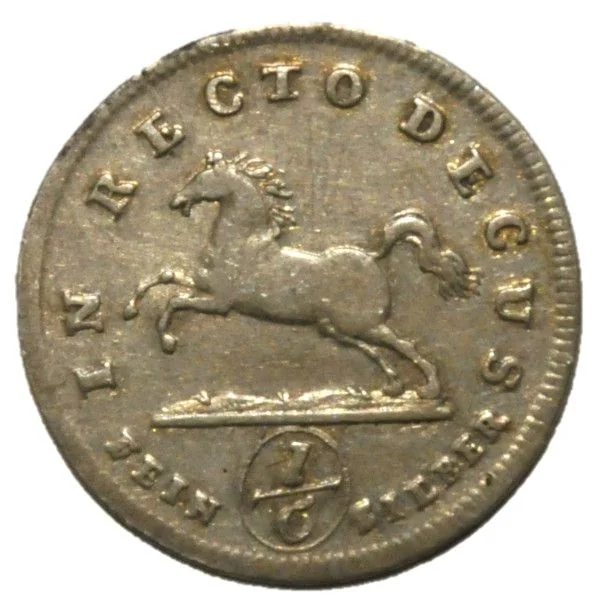
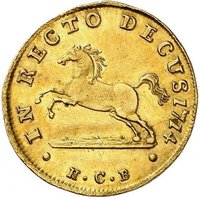
Reverse
Description:
Leaping horse left, denomination below.
Inscription:
IN RECTO DECUS
1/6
FEIN SILBER
1/6
FEIN SILBER
Script: Latin
Edge
Reeded.
Mints
| Name | Mark |
|---|---|
| Zellerfeld | — |
Mintings
| Year | Mint Mark | Mintage | Quality | Collection |
|---|---|---|---|---|
| 1714 | — | — | ||
| 1715 | — | — |
Historical background
In 1714, the currency situation in the Duchy of Brunswick-Lüneburg, specifically the Principality of Calenberg (with its capital in Hanover), was complex and fragmented, reflecting the broader monetary disarray of the Holy Roman Empire. The territory did not have a uniform, sovereign coinage system. Instead, circulation was dominated by a confusing mix of physical coins, including Reichsthaler (Imperial Thalers), Gute Groschen, and various Mariengroschen, alongside a separate system of accounting money used for bookkeeping, primarily the Reichsthaler specie (worth 24 Gute Groschen) and the Thaler Courant (worth 36 Mariengroschen). The value and metal content of coins could vary significantly, and foreign currencies, particularly from neighbouring states, also circulated freely, complicating trade and taxation.
This monetary fragmentation was actively managed through repeated Münzedikte (coinage ordinances) issued by the ducal government. These decrees attempted to fix the exchange rates between the myriad of circulating physical coins and the stable accounting units, a process known as Kurantgeld. However, the system was perpetually strained by the practice of debasement, where states would reduce the precious metal content in their coinage to generate short-term revenue, leading to inflation and a loss of public trust. The year 1714 itself fell within a period of relative stability under the Münzedikt of 1690, but the underlying structural problems remained acute.
The political context of 1714 was crucial, as it was the year the Elector of Hanover, George Louis, ascended to the British throne as King George I. This personal union with Great Britain did not immediately alter the local currency landscape, but it integrated the principality into a vast financial network. Hanover's fiscal needs began to align more with British geopolitical ambitions, particularly funding for armies, which would continue to exert pressure on its coinage. Thus, the currency situation was a fragile patchwork of traditional imperial structures, local administrative fixes, and the new demands of a rising European power.
This monetary fragmentation was actively managed through repeated Münzedikte (coinage ordinances) issued by the ducal government. These decrees attempted to fix the exchange rates between the myriad of circulating physical coins and the stable accounting units, a process known as Kurantgeld. However, the system was perpetually strained by the practice of debasement, where states would reduce the precious metal content in their coinage to generate short-term revenue, leading to inflation and a loss of public trust. The year 1714 itself fell within a period of relative stability under the Münzedikt of 1690, but the underlying structural problems remained acute.
The political context of 1714 was crucial, as it was the year the Elector of Hanover, George Louis, ascended to the British throne as King George I. This personal union with Great Britain did not immediately alter the local currency landscape, but it integrated the principality into a vast financial network. Hanover's fiscal needs began to align more with British geopolitical ambitions, particularly funding for armies, which would continue to exert pressure on its coinage. Thus, the currency situation was a fragile patchwork of traditional imperial structures, local administrative fixes, and the new demands of a rising European power.
✨ Legendary