

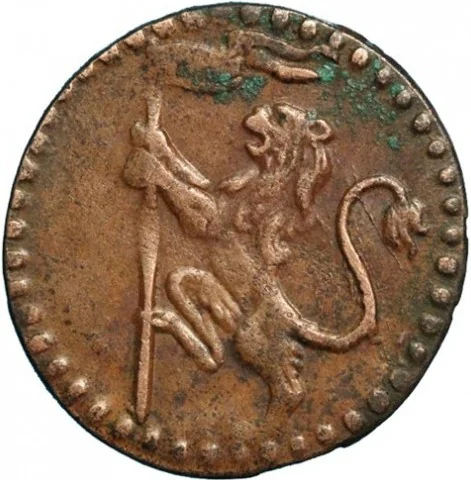
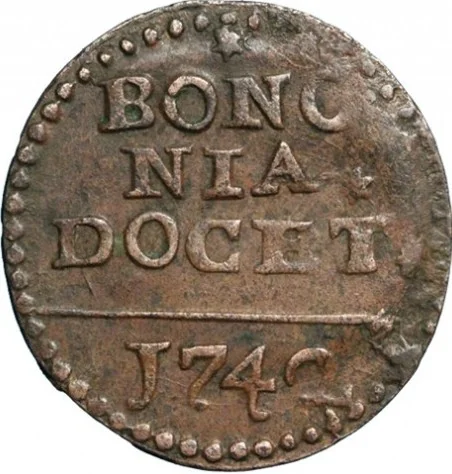
1 quattrino – Bologna
Add to wishlist
Italy
Obverse
Description:
Lion left, banner behind.
Reverse
Edge
Mints
| Name | Mark |
|---|---|
| Bologna | — |
Mintings
| Year | Mint Mark | Mintage | Quality | Collection |
|---|---|---|---|---|
| 1741 | — | — | ||
| 1742 | — | — | ||
| 1743 | — | — | ||
| 1744 | — | — | ||
| 1745 | — | — | ||
| 1746 | — | — | ||
| 1747 | — | — | ||
| 1748 | — | — | ||
| 1749 | — | — | ||
| 1750 | — | — | ||
| 1751 | — | — | ||
| 1752 | — | — | ||
| 1753 | — | — | ||
| 1754 | — | — | ||
| 1755 | — | — | ||
| 1756 | — | — | ||
| 1757 | — | — | ||
| 1758 | — | — |
Historical background
In 1741, Bologna existed within a complex monetary landscape typical of the Italian peninsula prior to unification, characterized by a duality of authority and a proliferation of circulating coins. Formally, the city was part of the Papal States, and thus the ultimate sovereign was Pope Benedict XIV. However, Bologna retained significant local autonomy, including the right of its Senate to mint its own coinage at the historic Zecca (mint). This created a situation where both Bolognese scudi, lire, and soldi and the broader Papal currency circulated simultaneously, their values often fluctuating against one another and against foreign coins.
The practical economy was a mosaic of metallic money. Gold zecchini and scudi d'oro were used for large transactions, trade, and state finance, while a bewildering array of silver scudi, paoli, and giulii, and copper quattrini and baiocchi facilitated daily market life. A significant challenge was the chronic wear and clipping of older coins and the intermittent arrival of foreign specie, particularly from neighboring states like the Republic of Venice or the Duchy of Modena. This led to frequent official "cries" (grida) issued by the papal legate, which attempted to fix exchange rates and prohibit the circulation of specific worn or foreign coins to maintain monetary order.
This unstable environment posed serious problems for commerce and administration. Merchants and bankers had to constantly assess the intrinsic metal value of coins, not just their face value, leading to disputes and inefficiency. For the poor, the scarcity and debasement of small-denomination copper coinage could cause acute hardship. Thus, the currency situation in 1741 Bologna was one of fragile equilibrium, managed through periodic decrees that reflected the ongoing tension between local economic needs, papal authority, and the realities of a fragmented European monetary system.
The practical economy was a mosaic of metallic money. Gold zecchini and scudi d'oro were used for large transactions, trade, and state finance, while a bewildering array of silver scudi, paoli, and giulii, and copper quattrini and baiocchi facilitated daily market life. A significant challenge was the chronic wear and clipping of older coins and the intermittent arrival of foreign specie, particularly from neighboring states like the Republic of Venice or the Duchy of Modena. This led to frequent official "cries" (grida) issued by the papal legate, which attempted to fix exchange rates and prohibit the circulation of specific worn or foreign coins to maintain monetary order.
This unstable environment posed serious problems for commerce and administration. Merchants and bankers had to constantly assess the intrinsic metal value of coins, not just their face value, leading to disputes and inefficiency. For the poor, the scarcity and debasement of small-denomination copper coinage could cause acute hardship. Thus, the currency situation in 1741 Bologna was one of fragile equilibrium, managed through periodic decrees that reflected the ongoing tension between local economic needs, papal authority, and the realities of a fragmented European monetary system.
⭐ Somewhat Rare