

20 Kreuzers – Landgraviate of Hesse-Darmstadt
Context
Year: 1772
Issuer: Landgraviate of Hesse-Darmstadt
Ruler: Louis IX
Currency:
(1568—1805)
Demonetized: Yes
References
KM: #Click to copy to clipboard230.2
Numista: #447229
Value
Bullion value: $18.67
Obverse
Description:
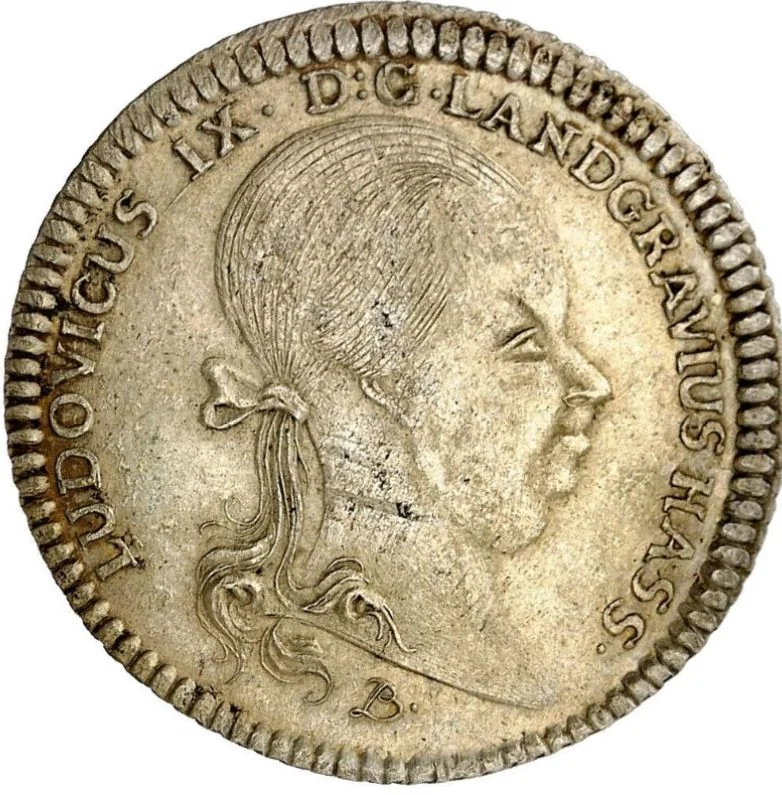
Bust right.
Inscription:
LUDOVICUS IX·D:G·LANDGRAVIUS HASS·
B.
B.
Scripts: Latin, Latin (cursive)
Reverse
Description:
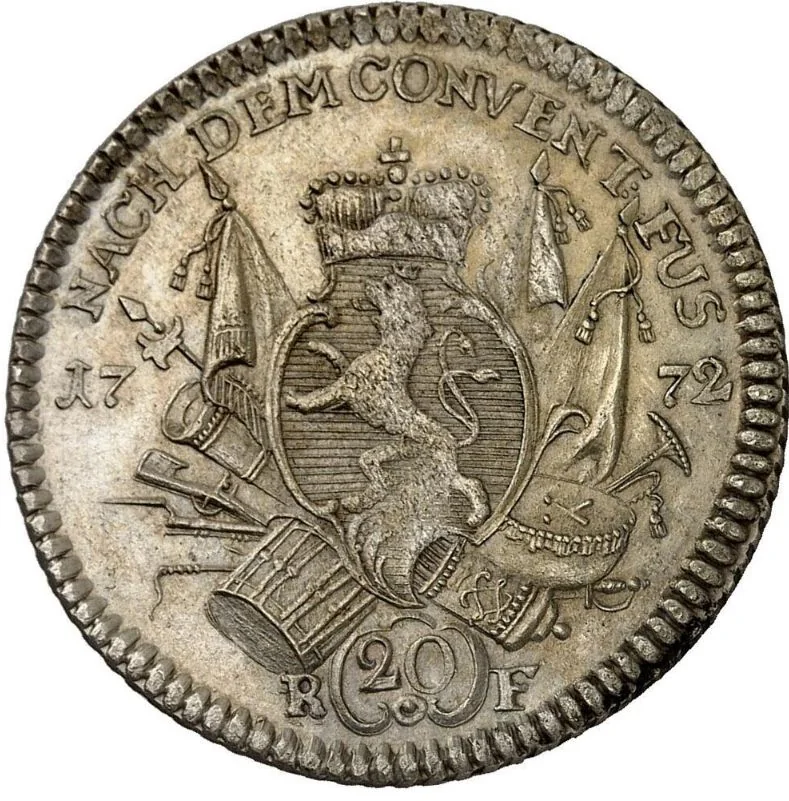
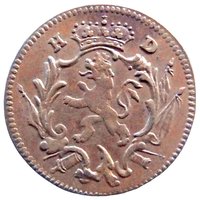
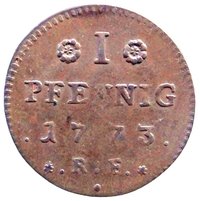
Crowned lion in cartouche with flags and arms, flanking date and value, mint initials below.
Inscription:
NACH DEM CONVENT: FUS
1772
R(20)F
1772
R(20)F
Script: Latin
Edge
Mints
| Name | Mark |
|---|---|
| Darmstadt | — |
Mintings
| Year | Mint Mark | Mintage | Quality | Collection |
|---|---|---|---|---|
| 1772 | B | — |
Historical background
In 1772, the currency situation in the Landgraviate of Hesse-Darmstadt was characterized by significant complexity and fragmentation, a common challenge across the Holy Roman Empire. The territory did not have a single, unified monetary system. Instead, it operated within a web of regional and supra-regional conventions, most notably the Reichsmünzfuß (Imperial minting standard), which aimed to provide a framework for the silver content of coins. However, the practical circulation was dominated by a multitude of foreign coins, particularly from neighboring states like Prussia and the trade-rich city of Frankfurt, alongside older domestic issues. This created a chaotic environment where merchants and officials constantly had to assess coins by their actual metal weight and origin.
Landgrave Ludwig IX, a ruler with strong military interests, faced constant fiscal pressures. The need to fund his military ventures and state administration drove periodic minting activities, but these were often reactive rather than systematic. The value of money was intrinsically tied to its silver content, and the landgraviate struggled to maintain the standard of its own limited coinage against the tide of often underweight or debased foreign coins circulating within its borders. This instability led to frequent complaints from merchants about exchange uncertainties and hindered smooth commercial transactions.
Ultimately, the monetary landscape was one of weak sovereign control. While the Darmstadt chancellery issued ordinances to try to fix exchange rates and outlaw certain foreign coins, enforcement was difficult. The economy relied on a de facto system where multiple currencies coexisted, requiring money changers and treasury officials to play a crucial role in daily economic life. This fragmented system would persist until the Napoleonic era and the subsequent mediatization, which forced the creation of more standardized monetary systems in the 19th century.
Landgrave Ludwig IX, a ruler with strong military interests, faced constant fiscal pressures. The need to fund his military ventures and state administration drove periodic minting activities, but these were often reactive rather than systematic. The value of money was intrinsically tied to its silver content, and the landgraviate struggled to maintain the standard of its own limited coinage against the tide of often underweight or debased foreign coins circulating within its borders. This instability led to frequent complaints from merchants about exchange uncertainties and hindered smooth commercial transactions.
Ultimately, the monetary landscape was one of weak sovereign control. While the Darmstadt chancellery issued ordinances to try to fix exchange rates and outlaw certain foreign coins, enforcement was difficult. The economy relied on a de facto system where multiple currencies coexisted, requiring money changers and treasury officials to play a crucial role in daily economic life. This fragmented system would persist until the Napoleonic era and the subsequent mediatization, which forced the creation of more standardized monetary systems in the 19th century.
✨ Legendary