

20 Kreuzers – Landgraviate of Hesse-Darmstadt
Context
Years: 1760–1762
Issuer: Landgraviate of Hesse-Darmstadt
Ruler: Louis VIII
Currency:
(1568—1805)
Demonetized: Yes
References
KM: #Click to copy to clipboard206
Numista: #445903
Value
Bullion value: $18.70
Obverse
Description:
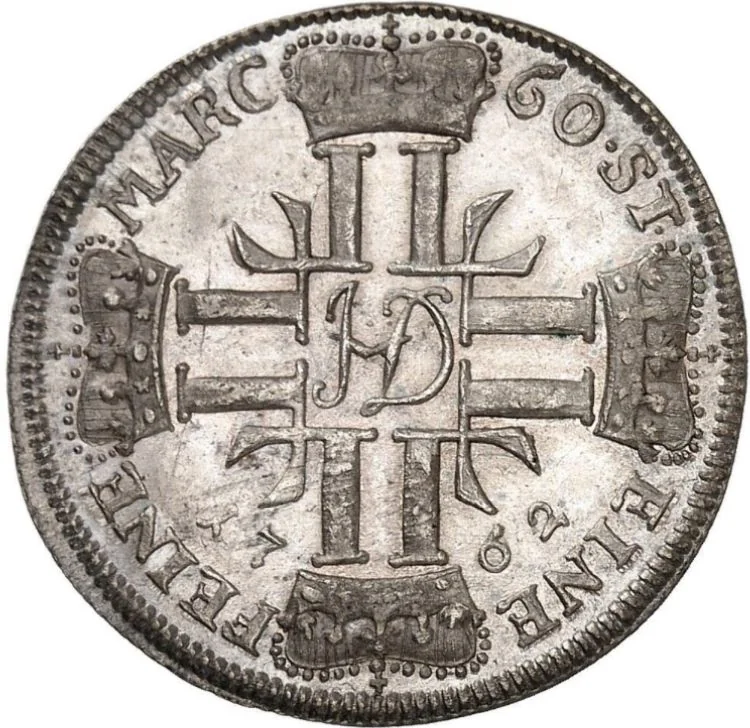
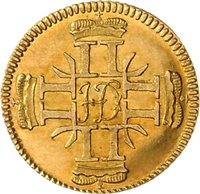
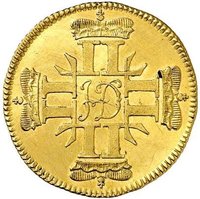
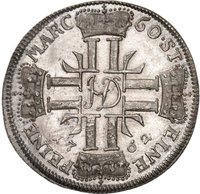
Four crowned double L monograms in a cross, flanking date below.
Inscription:
60·ST· EINE FEINE MARC
1762
LL LL LL LL
HD
1762
LL LL LL LL
HD
Scripts: Latin, Latin (cursive)
Reverse
Description:
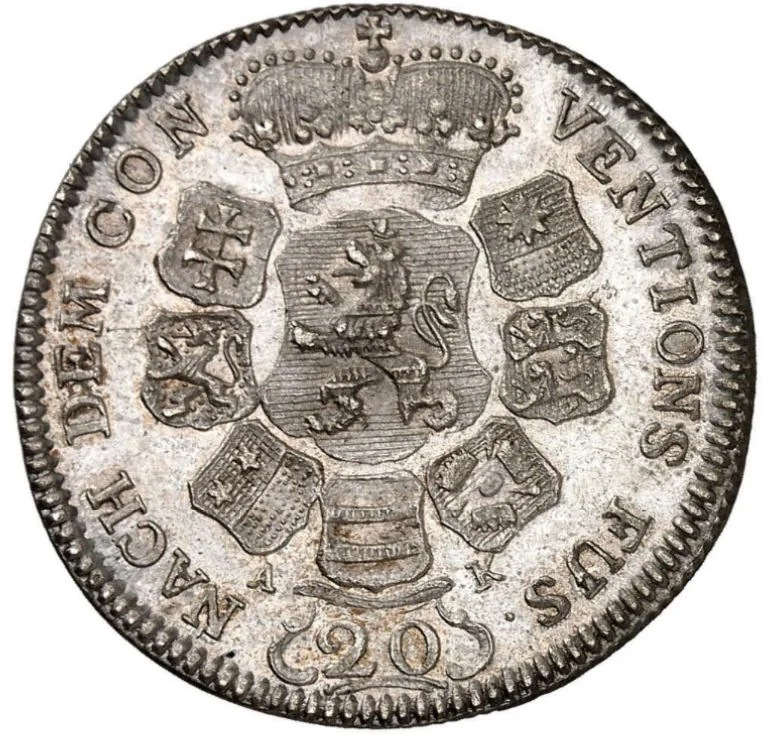
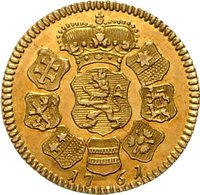
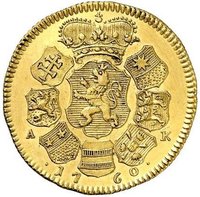
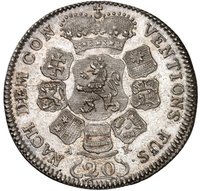
Crowned lion shield surrounded by seven smaller shields, value below.
Inscription:
VENTIONS FUS· NACH DEM CON
A K
(20)
A K
(20)
Script: Latin
Edge
Mints
| Name | Mark |
|---|---|
| Darmstadt | — |
Mintings
| Year | Mint Mark | Mintage | Quality | Collection |
|---|---|---|---|---|
| 1760 | — | — | ||
| 1762 | — | — |
Historical background
In 1760, the Landgraviate of Hesse-Darmstadt, like many German states of the Holy Roman Empire, operated within a complex and fragmented monetary system. The primary currency in circulation was the Hesse-Darmstadt Thaler, but its value and acceptance were far from absolute. The state existed within a web of competing monetary zones, where coins from neighboring territories like the Electorate of Mainz, the Palatinate, and even larger powers like Austria and France, circulated freely alongside local issues. This created a persistent challenge of valuation and exchange, as the intrinsic silver content and official face value of these coins varied widely.
The period was one of significant monetary strain due to the ongoing Seven Years' War (1756-1763). Landgrave Louis VIII, maintaining a policy of neutrality, nonetheless faced immense financial pressure to fund a mobilized army for defense and to pay war contributions (Kontributionen) to belligerent powers to avoid occupation. This drained the state's silver reserves, leading to a critical shortage of high-value, full-bodied coinage. In response, the treasury likely resorted to expedients common in wartime: debasing coinage (reducing silver content), issuing low-value subsidiary coins, and allowing the circulation of even more foreign and often inferior money, which further eroded public trust in the currency.
Consequently, the currency situation in 1760 was characterized by instability and inflation. Merchants and the populace had to navigate a daily reality of multiple exchange rates and the uncertainty of whether coins would be accepted at their stated value. The shortage of good money hindered commerce and state finances alike, creating a precarious economic environment. This instability underscored the fundamental weakness of the Empire's decentralized monetary structure, a problem that would persist until the 19th-century reforms following the Empire's dissolution.
The period was one of significant monetary strain due to the ongoing Seven Years' War (1756-1763). Landgrave Louis VIII, maintaining a policy of neutrality, nonetheless faced immense financial pressure to fund a mobilized army for defense and to pay war contributions (Kontributionen) to belligerent powers to avoid occupation. This drained the state's silver reserves, leading to a critical shortage of high-value, full-bodied coinage. In response, the treasury likely resorted to expedients common in wartime: debasing coinage (reducing silver content), issuing low-value subsidiary coins, and allowing the circulation of even more foreign and often inferior money, which further eroded public trust in the currency.
Consequently, the currency situation in 1760 was characterized by instability and inflation. Merchants and the populace had to navigate a daily reality of multiple exchange rates and the uncertainty of whether coins would be accepted at their stated value. The shortage of good money hindered commerce and state finances alike, creating a precarious economic environment. This instability underscored the fundamental weakness of the Empire's decentralized monetary structure, a problem that would persist until the 19th-century reforms following the Empire's dissolution.
✨ Legendary