

5 Kreuzers – Landgraviate of Hesse-Darmstadt
Context
Year: 1765
Issuer: Landgraviate of Hesse-Darmstadt
Ruler: Louis VIII
Currency:
(1568—1805)
Demonetized: Yes
References
KM: #Click to copy to clipboard218
Numista: #445797
Value
Bullion value: $6.03
Obverse
Description:
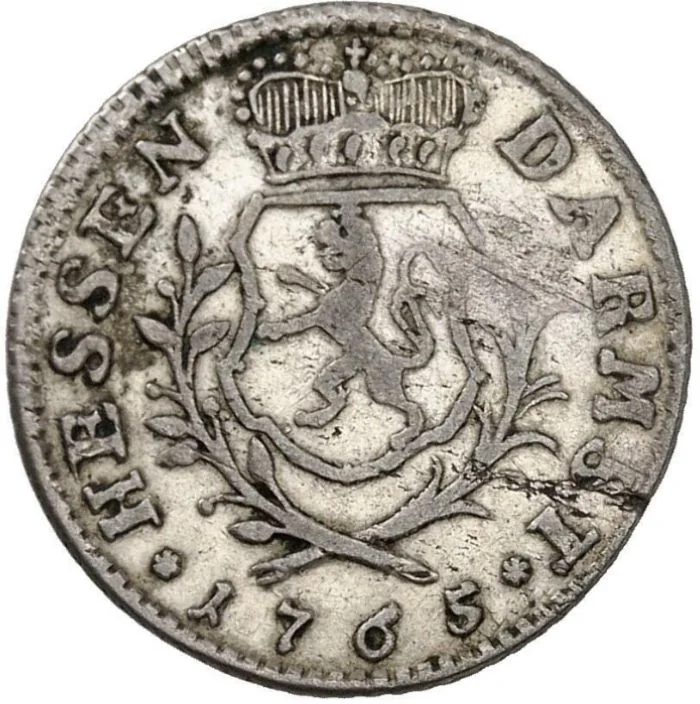
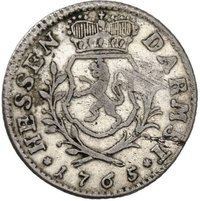
Crowned lion shield flanked by branches.
Inscription:
HESSEN DARMST
🞹1765🞹
🞹1765🞹
Script: Latin
Reverse
Edge
Mints
| Name | Mark |
|---|---|
| Darmstadt | — |
Mintings
| Year | Mint Mark | Mintage | Quality | Collection |
|---|---|---|---|---|
| 1765 | — | — |
Historical background
In 1765, the currency situation in the Landgraviate of Hesse-Darmstadt was complex and fragmented, typical of the Holy Roman Empire's myriad states. The landgraviate did not have a monopoly on coinage; its monetary system was a patchwork of various circulating coins. These included issues from its own mint, but also a substantial influx of coins from neighboring German states, particularly the larger and economically dominant Electorate of Saxony and the Kingdom of Prussia. Furthermore, the longstanding use of the Reichsthaler as an accounting unit created a disconnect between theoretical bookkeeping and the physical coins in daily use, leading to confusion and inefficiency in trade.
This monetary plurality was exacerbated by the ongoing use of both silver and small-denomination Heller coins for local transactions, while larger trade often relied on foreign Thalers. The value and silver content of these coins varied, making exchange a specialized business and creating opportunities for arbitrage and loss. Landgrave Ludwig IX, who focused heavily on military affairs, did not prioritize a comprehensive monetary reform, leaving the system to function on established conventions and the fluctuating market value of specie. Consequently, merchants and citizens had to constantly navigate a landscape of multiple valuations.
The situation posed significant challenges for the local economy and state finances. It hindered internal commerce, complicated tax collection, and made the landgraviate vulnerable to the debasement of coins imported from elsewhere. While not in a state of acute crisis in 1765, this lack of a unified, stable currency was a structural weakness. It reflected the broader political fragmentation of the Empire and would remain a persistent issue until the Napoleonic era and the later reforms of the 19th century pushed toward monetary consolidation.
This monetary plurality was exacerbated by the ongoing use of both silver and small-denomination Heller coins for local transactions, while larger trade often relied on foreign Thalers. The value and silver content of these coins varied, making exchange a specialized business and creating opportunities for arbitrage and loss. Landgrave Ludwig IX, who focused heavily on military affairs, did not prioritize a comprehensive monetary reform, leaving the system to function on established conventions and the fluctuating market value of specie. Consequently, merchants and citizens had to constantly navigate a landscape of multiple valuations.
The situation posed significant challenges for the local economy and state finances. It hindered internal commerce, complicated tax collection, and made the landgraviate vulnerable to the debasement of coins imported from elsewhere. While not in a state of acute crisis in 1765, this lack of a unified, stable currency was a structural weakness. It reflected the broader political fragmentation of the Empire and would remain a persistent issue until the Napoleonic era and the later reforms of the 19th century pushed toward monetary consolidation.
✨ Legendary